
Introduction: Why Healthcare Workflows Need to Be Connected
A patient’s journey through a clinic rarely involves just one person or one department.
A patient may begin by contacting the front desk, move through registration and consultation, require laboratory or radiology services, receive a prescription, visit physiotherapy or nutrition, complete billing, and eventually return for follow-up.
The challenge is that these steps are often managed through different systems, paper records, WhatsApp conversations, spreadsheets, or standalone applications.
When healthcare information is scattered, teams spend more time searching, re-entering, and coordinating data instead of focusing on the patient.
This is where connected healthcare software can make a difference.
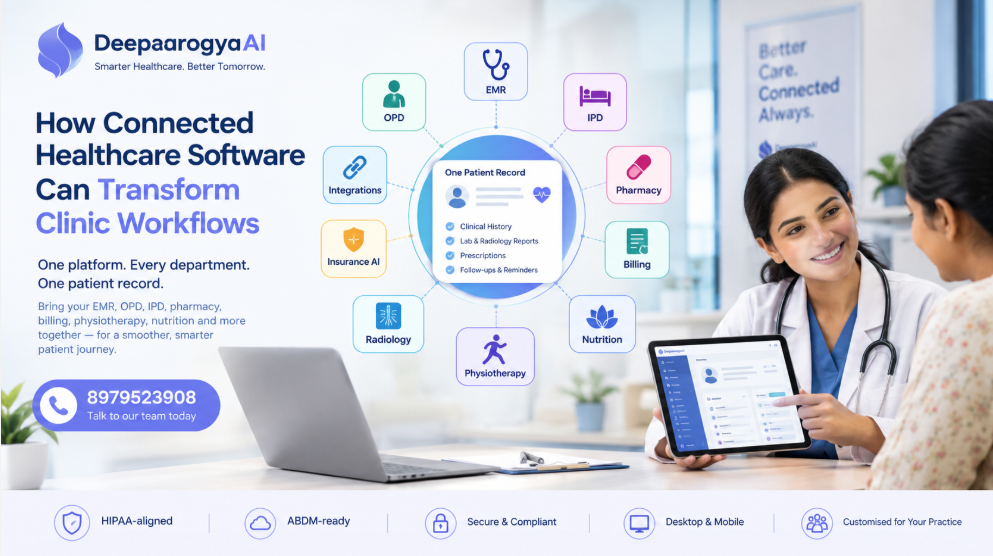
DeepaarogyaAI brings EMR, OPD, IPD, pharmacy, billing, physiotherapy, nutrition, radiology, e-prescriptions, integrations, and AI agents together around one connected patient record.
The goal is simple: every department should be able to work from the information already available in the patient’s chart.
What Happens When Healthcare Systems Are Disconnected?
Disconnected systems create friction throughout a clinic.
1. Patient information gets scattered
Patient information may exist across paper files, messaging platforms, spreadsheets, and multiple applications.
This makes it harder for different departments to access the same information at the right time.
2. Information gets entered repeatedly
When systems do not communicate, staff may need to enter the same patient information more than once.
This adds administrative work and creates opportunities for inconsistencies.
3. Departments operate in silos
A doctor may document a consultation in one place while physiotherapy, nutrition, pharmacy, or billing maintains separate information.
Without a shared record, coordination becomes more difficult.
4. Follow-up information can become disconnected
Appointments, reminders, prescriptions, and follow-up activities are more useful when they remain connected to the patient’s clinical record rather than existing as isolated tasks.
DeepaarogyaAI connects appointment and medicine reminders with the same EMR chart and provides delivery status and staff review.
What Is a Connected Healthcare Workflow?
A connected healthcare workflow means that the different stages of patient care operate around a shared source of patient information.
Instead of creating separate information silos, departments contribute to and access the same patient record.
For example:
Patient engagement → Intake → Consultation → Lab/Radiology → Physiotherapy/Nutrition → Pharmacy → Billing → Follow-up
DeepaarogyaAI describes this as an entire patient journey where different departments remain connected through one chart.
This approach can help clinics move from disconnected processes toward a more organized workflow.
One Patient Record for Multiple Departments
One of the central ideas behind DeepaarogyaAI is one connected patient record.
The EMR, OPD, IPD, pharmacy, and billing workflows can work from the same patient record instead of maintaining completely separate information.
Consider a patient visiting an orthopedic clinic.
The journey could involve:
- Registration and OPD intake
- Doctor consultation
- Vitals and clinical information
- Radiology or laboratory investigations
- Physiotherapy
- Medication
- Billing
- Follow-up
Rather than treating every step as an independent workflow, connected software keeps these activities associated with the same patient chart.
That creates a more continuous flow of information between teams.
How Connected Workflows Help Different Departments
Front Desk
The front desk can work with digital token queues, visit intake, and doctor workflows from one environment.
This provides a structured way to manage patient movement through OPD.
Doctors
Doctors can work with structured EMR case sheets and specialty workflows while accessing information captured elsewhere in the patient’s journey.
DeepaarogyaAI also includes a SOAP Agent that drafts structured SOAP notes for clinician review.
Physiotherapy Teams
Physiotherapy workflows can include protocol tracking, outcomes, team assignment, and session billing.
This is particularly relevant for physiotherapy-led clinics and orthopedic centres.
Nutrition Teams
Nutrition workflows can use information already available in the EMR.
DeepaarogyaAI’s Nutrition AI can generate diet-plan drafts through an agentic pipeline, with clinicians reviewing the output.
Pharmacy
Pharmacy information can remain linked with prescriptions and the EMR instead of operating as an entirely separate workflow.
Billing
Billing can remain connected to the wider hospital workflow, including package billing, partial payments, and GST-ready reporting.
From Data Entry to Connected Data Flow
The value of connected healthcare software is not simply about digitizing paperwork.
It is about allowing information to move through the workflow without unnecessary re-entry.
DeepaarogyaAI’s customizable case sheet is designed so that different tabs—including diagnosis, vitals, physiotherapy, medicines, and notes—write to the same patient record.
For example:
Vitals → Dietitian
Information captured during intake can be available to the nutrition workflow.
Doctor consultation → Physiotherapy
Relevant clinical information can remain available when a patient moves into physiotherapy.
Investigation → Patient chart
Laboratory and radiology information can remain associated with the same record.
This creates a workflow where departments are connected instead of repeatedly starting from zero.
AI Agents Inside the Healthcare Workflow
Connected healthcare software becomes even more useful when AI works inside the existing patient chart.
DeepaarogyaAI’s AI Agent OS includes agents for tasks such as:
- Discharge summaries
- Nutrition
- Voice reception
- WhatsApp follow-up
- Visit summaries
- Documentation
- SOAP notes
The platform states that AI-generated outputs remain in review and require appropriate clinician sign-off before being sent to patients.
This is an important distinction.
The purpose is not to replace clinical decision-making.
Instead, AI can help prepare drafts and handle repetitive documentation so healthcare professionals can review and approve the final output.
Connecting External Tools to the Patient Record
A modern clinic may already depend on several digital tools.
The challenge is making them part of a connected workflow.
DeepaarogyaAI supports integrations including:
Google Drive
Clinical files such as X-rays, surgery photographs, laboratory PDFs, and reports can be synced with the relevant patient chart while the hospital retains ownership of its Google Drive files.
Clinician-approved e-prescriptions can be sent through WhatsApp, while appointment, medicine, and revisit reminders can also be connected to the EMR workflow.
Google Meet
Telemedicine consultations can be initiated from appointments while keeping notes associated with the EMR record.
Google Calendar
OPD slots and follow-ups can be synchronized with the team’s calendar.
Google Docs
Discharge notes, handouts, and patient instructions can be drafted without leaving the Deepaarogya environment.
The broader idea is that integrations should support the workflow rather than create another disconnected layer.
Customization Matters More Than a One-Size-Fits-All EMR
Every healthcare practice does not operate in exactly the same way.
An orthopedic centre may require different workflows from an ENT clinic.
A physiotherapy-led clinic may need different protocols from a multi-specialty hospital.
That is why DeepaarogyaAI emphasizes customized workflows rather than a rigid EMR template.
The platform can configure OPD queues, physiotherapy protocols, nutrition desks, and billing rules around the clinic’s actual workflow.
This means digital transformation does not necessarily have to mean forcing an existing team to completely change how it works.
Instead, the technology can be configured around the practice.
Connected Healthcare Software Across the Patient Journey
A connected workflow becomes most valuable when it covers the entire journey.
Step 1: Engage
Patients can enter through WhatsApp, online booking, or a clinic walk-in.
Step 2: Intake
Demographics, vitals, habits, and body-composition information can be captured.
Step 3: Consult
The doctor works with the EMR case sheet, specialty workflows, and AI-assisted documentation.
Step 4: Coordinate
Laboratory, radiology, physiotherapy, nutrition, and pharmacy workflows remain connected.
Step 5: Bill & Follow Up
Billing, reminders, and the next visit can continue from the same patient journey.
The result is a workflow designed around the patient rather than around individual software tools.
Why This Matters for Growing Clinics and Hospitals
As a healthcare practice grows, the number of patients, departments, staff members, and administrative activities also increases.
A workflow that works with a few disconnected tools may become increasingly difficult to coordinate as operations expand.
Connected healthcare software can provide a common digital foundation across departments.
DeepaarogyaAI supports desktop and mobile workflows, role-based access, and deployment support for clinics moving from older systems or starting new operations.
This can make the transition to a digital workflow more structured.
Security and Access in a Connected Healthcare Environment
Connecting healthcare information also makes data security and access controls important.
DeepaarogyaAI describes its platform as ABDM-ready and HIPAA-aligned, with encryption and role-based access.
Different roles—including doctors, nurses, front-desk staff, pharmacy teams, and administrators—can have access based on what they need for their work.
For healthcare organizations, the objective is not simply to make information accessible.
It is to make the right information accessible to the appropriate users within the workflow.
DeepaarogyaAI: One Platform, Connected Healthcare
DeepaarogyaAI brings together multiple healthcare functions under one platform:
AI HMS + AI EMR + OPD + IPD + Pharmacy + Billing + Physiotherapy + Nutrition + Radiology + e-Prescription + AI Agents
The platform’s central approach is to keep these workflows connected through one patient record.
For clinics and hospitals looking to move away from disconnected systems, this provides a different approach to healthcare digitization:
not simply more software, but a more connected workflow.
Final Thoughts
Healthcare technology should make coordination easier—not create another layer of complexity.
When patient information is scattered across systems, departments can spend valuable time finding and re-entering information.
A connected healthcare platform can bring these workflows together around a shared patient record.
With its customizable EMR, hospital management workflows, specialty modules, integrations, and AI agents, DeepaarogyaAI is designed to connect different parts of the healthcare journey within one platform.
The future of healthcare digitization is not only about going paperless.
It is about making healthcare connected, organized, and easier for teams to manage.
Ready to explore a connected healthcare workflow?
See how DeepaarogyaAI can be configured around your clinic or hospital’s workflow.
Schedule a demo: https://calendar.google.com/calendar/u/0/appointments/schedules/AcZssZ0vSKKPxgfM4xlTbdYy6tpV9-iXMfsKmiOK87Q7JtKd3RWIndSlKV-CPisfq2AtrXm8Xywsc57a
Website: https://www.deepaarogya.com/
WhatsApp: +91 89795 23908
Frequently Asked Questions
1. What is connected healthcare software?
Connected healthcare software brings different clinical, administrative, and operational workflows together around shared patient information rather than keeping each department in a separate system.
2. What departments can DeepaarogyaAI connect?
DeepaarogyaAI supports workflows including EMR, OPD, IPD, pharmacy, billing, physiotherapy, nutrition, radiology, and AI-assisted clinical documentation.
3. Can DeepaarogyaAI be customized for a clinic?
Yes. The platform describes customizable OPD queues, physiotherapy protocols, nutrition desks, billing rules, and specialty workflows.
4. Does DeepaarogyaAI include AI agents?
Yes. Its AI Agent OS includes agents for areas such as discharge summaries, nutrition, voice reception, WhatsApp follow-up, visit summaries, documentation, and SOAP notes.
5. Does AI make clinical decisions automatically?
The platform states that its AI outputs remain drafts for clinician review and that outputs are not sent to patients without appropriate sign-off.
6. Can patient files be connected with Google Drive?
Yes. DeepaarogyaAI supports Google Drive patient-file synchronization for items such as X-rays, surgery photos, laboratory PDFs, and reports.
7. Does DeepaarogyaAI support WhatsApp?
Yes. The platform supports WhatsApp e-prescriptions as well as appointment, medicine, and revisit reminders connected to the EMR workflow.
8. Is DeepaarogyaAI suitable for multi-specialty hospitals?
The platform is positioned for multi-specialty, orthopedic, chronic-disease, and other practices across India, with multiple departments operating through a connected patient record.
9. Can staff access DeepaarogyaAI on mobile?
The platform states that its workflows are available across desktop, tablet, and phone, with role-based access.
10. How can a clinic explore DeepaarogyaAI?
Clinics and hospitals can schedule a demo and discuss their existing workflow with the DeepaarogyaAI team.
Explore DeepaarogyaAI and discover what a connected healthcare workflow can look like for your practice.