
A patient enters a clinic for one problem.
But their healthcare journey may involve several teams before that problem is addressed completely.
The doctor may need a radiology report.
The radiology team may need the clinical context.
The physiotherapist may need the diagnosis and treatment plan.
The pharmacy may need the latest prescription.
The billing team needs the correct services and charges.
When these departments work in isolation, even a simple patient journey can become slower and more complicated.
The issue is not always a shortage of staff.
Sometimes, the real problem is the movement of information between departments.
A report may be available, but the doctor may not immediately see it. A treatment plan may have been documented, but another department may not have access to the relevant information. A patient may have to explain the same information again.
For modern clinics and hospitals, improving healthcare workflow therefore means looking beyond individual departments.
It means asking:
Can every department access the right patient information at the right point in the journey?
This is where connected healthcare technology and AI-assisted workflows can make a difference.
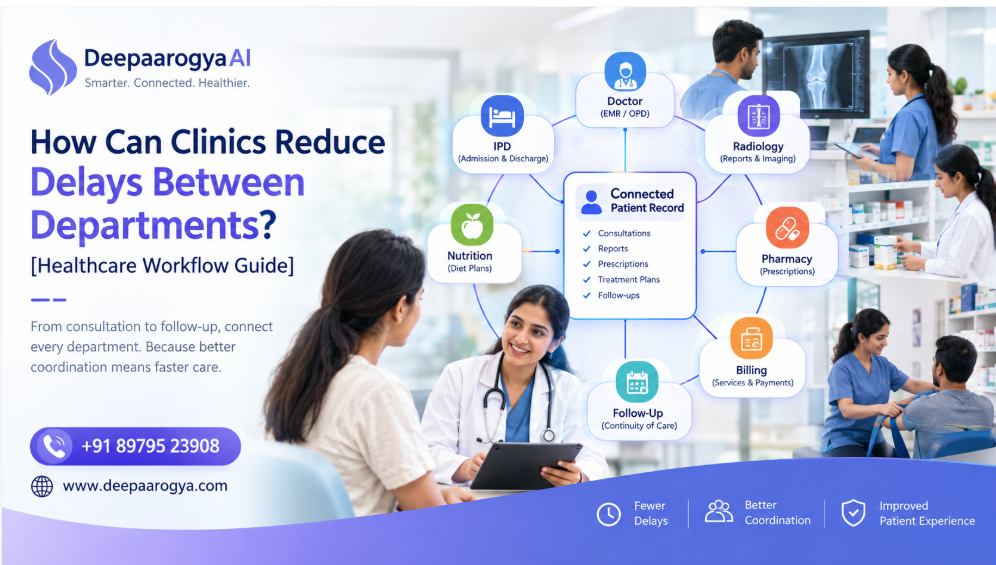
DeepaarogyaAI is designed as an AI Hospital OS for Indian clinics and hospitals, bringing EMR, OPD, IPD, pharmacy, billing, radiology, physiotherapy, nutrition and AI workflows around a connected patient record.
Why Do Delays Happen Between Healthcare Departments?
A patient’s journey rarely follows a single straight line.
Consider a patient visiting an orthopedic clinic.
The journey could look like:
Registration → Doctor Consultation → X-Ray → Diagnosis → Physiotherapy → Pharmacy → Billing → Follow-Up
Each step may involve a different team.
If those teams operate through disconnected systems, several problems can appear.
1. Information Has to Be Entered Multiple Times
A patient’s information may already exist somewhere in the clinic.
Yet another department may ask for the same details again.
This creates unnecessary administrative work and increases the possibility of inconsistent information.
2. Reports May Not Be Available at the Right Moment
A diagnostic report can be generated successfully but still create workflow delays if the treating team has to search for it manually.
The problem isn’t necessarily the availability of data.
It is data accessibility within the workflow.
3. Departments May Have Different Systems
A clinic might use one system for EMR, another for billing, WhatsApp for communication, spreadsheets for tracking, and separate workflows for physiotherapy or nutrition.
Every individual tool may perform its task.
But the patient journey can still remain fragmented.
4. Staff Spend Time Coordinating Information
When systems don’t communicate effectively, people become the connection between systems.
Someone has to:
- Search for reports
- Forward information
- Re-enter patient details
- Confirm prescriptions
- Check whether a service was completed
- Coordinate with another department
- Update records
This creates administrative friction that can affect the entire patient journey.
What Does a Connected Department Workflow Look Like?
A connected workflow does not mean that every department has to work in exactly the same way.
Instead, it means that relevant patient information remains connected while each team follows its own workflow.
For example:
Doctor
The doctor records the consultation and treatment plan.
↓
Radiology
The imaging workflow is linked to the same patient record.
↓
Physiotherapy
The physiotherapy team can access relevant clinical information.
↓
Pharmacy
The prescription remains connected to the patient’s chart.
↓
Billing
Services and payments can be handled within the broader patient workflow.
↓
Follow-Up
The patient’s next interaction continues from the existing record.
The objective is simple:
Move the patient forward without repeatedly moving information manually.
How Can Clinics Reduce Department-to-Department Delays?
1. Create One Source of Patient Information
The first step is reducing information fragmentation.
Instead of maintaining separate versions of a patient’s information across different systems, clinics can organize relevant clinical and operational information around a shared patient record.
This can include:
- Patient demographics
- Consultation notes
- Vitals
- Diagnoses
- Prescriptions
- Investigation reports
- Radiology
- Physiotherapy information
- Nutrition information
- Billing information
- Follow-up details
With a connected record, each department can work from the information relevant to its role.
DeepaarogyaAI’s platform is built around this model, connecting multiple departments and workflows through one patient record.
2. Connect Diagnostic Workflows With Clinical Workflows
Imagine a doctor orders an X-ray.
In a disconnected workflow, the process might involve:
Doctor → Paper/Request → Radiology → Report → Manual Sharing → Doctor
Every handoff creates another opportunity for delay.
A connected workflow can instead keep the imaging order and report associated with the patient’s chart.
The doctor can then access the relevant information from the same patient record.
DeepaarogyaAI includes radiology workflows where imaging orders, queues and reports can be linked to the patient chart.
This does not eliminate the need for professional interpretation.
It simply makes the information easier to manage within the workflow.
3. Connect Physiotherapy With the Patient Journey
Physiotherapy is often not an isolated service.
A patient may reach physiotherapy after:
Consultation → Diagnosis → Treatment Recommendation → Physiotherapy
If the physiotherapy team has to reconstruct the patient’s clinical context manually, valuable time can be spent gathering information.
A connected workflow can allow relevant patient information to remain available to the physiotherapy team.
DeepaarogyaAI includes a dedicated physiotherapy workflow with protocol tracking, outcomes, team assignment and session billing.
This can help make physiotherapy part of the broader patient journey rather than a completely separate workflow.
4. Reduce Repeated Data Entry
Every time information is manually copied from one system to another, the workflow becomes more dependent on human data transfer.
Consider:
Patient Name → Diagnosis → Prescription → Treatment Plan
If these details are already available in the patient record, departments shouldn’t have to repeatedly recreate the same information.
A connected system can allow relevant information to flow through the workflow instead.
The goal isn’t to remove people from healthcare.
The goal is to reduce unnecessary administrative repetition so teams can spend more time on their actual responsibilities.
5. Use AI Where Documentation Creates Bottlenecks
Not every workflow delay requires AI.
But documentation-heavy processes can be good candidates for AI assistance.
For example, DeepaarogyaAI provides AI-assisted workflows including SOAP documentation, patient summaries, discharge summaries and nutrition-related workflows. These outputs are designed as drafts for professional review rather than autonomous clinical decisions.
Consider a doctor completing a consultation.
Instead of starting documentation from a blank page, an AI workflow can help prepare a structured draft.
The workflow becomes:
Consultation → AI-assisted draft → Doctor review → Final record
The clinician remains responsible for reviewing and approving the output.
6. Keep Prescriptions Connected to the Patient Record
Prescriptions are another important handoff between doctor, patient and pharmacy.
A disconnected workflow may require:
Doctor creates prescription → Print → Patient carries paper → Pharmacy processes it
Digital workflows can make this process more connected.
DeepaarogyaAI supports e-prescriptions that can be sent to patients through WhatsApp after clinician sign-off, with the prescription remaining associated with the patient’s chart.
This can reduce unnecessary paper-based handoffs while keeping the clinician in control of the prescription.
7. Connect Billing With Clinical Activity
Departmental coordination is not limited to clinical information.
Billing also needs visibility into what happened during the patient’s journey.
A patient may receive:
- Consultation
- Diagnostic services
- Physiotherapy sessions
- Medicines
- Procedures
- Other services
If billing information is maintained separately, staff may need to manually reconstruct which services were provided.
A connected workflow can bring billing closer to the operational and clinical journey.
DeepaarogyaAI includes billing and GST workflows alongside its EMR, OPD, IPD, pharmacy and specialty workflows.
What Happens When Departments Work From the Same Patient Context?
The biggest change is not simply that information becomes digital.
It becomes connected.
Consider this example.
A patient visits an orthopedic clinic.
The doctor records the consultation.
The doctor recommends an X-ray and physiotherapy.
The radiology department receives the imaging workflow.
The report becomes part of the patient’s record.
The physiotherapy team accesses the relevant information and manages the treatment workflow.
The pharmacy handles the prescription.
Billing records the applicable services.
The patient receives the prescription digitally.
Later, the clinic can continue the patient’s follow-up from the same record.
Instead of treating these as seven independent activities, the clinic can treat them as one connected patient journey.
That is the difference between digitizing individual departments and connecting the healthcare workflow.
Why Is Workflow Visibility Important for Clinic Management?
When information moves through disconnected systems, administrators may have limited visibility into where a patient’s journey currently stands.
For example:
- Has the diagnostic test been completed?
- Has the report been added?
- Has the patient reached physiotherapy?
- Was the prescription issued?
- Has billing been completed?
- Does the patient need another visit?
A connected system can give teams a more unified view of the workflow.
This can make it easier to identify where a process is waiting for the next action.
The goal is not simply to collect more data.
It is to make existing information more useful.
Connected Healthcare Is About More Than EMR
An EMR can digitize clinical records.
But a modern healthcare organization often needs more than a digital case sheet.
It needs coordination between:
EMR + OPD + IPD + Radiology + Pharmacy + Physiotherapy + Nutrition + Billing + Patient Communication
That is why the concept of an AI Hospital OS goes beyond traditional record keeping.
DeepaarogyaAI combines these healthcare workflows around a connected patient record and adds AI-assisted workflows within the same ecosystem.
The larger objective is straightforward:
One patient. One connected workflow. Multiple departments working from the right context.
How DeepaarogyaAI Supports Connected Department Workflows
DeepaarogyaAI is designed for clinics and hospitals that want their healthcare operations to work as a connected system rather than as isolated tools.
Its platform brings together:
🩺 EMR
Structured electronic medical records for patient consultations and specialty workflows.
🧑⚕️ OPD
Digital intake, token queues and consultation workflows.
🛏️ IPD
Admission-to-discharge workflows and case sheets.
🩻 Radiology
Imaging orders, queues and reports connected to patient records.
💗 Physiotherapy
Protocols, outcomes, team assignment and session billing.
🥗 Nutrition
AI-assisted nutrition workflows with professional review.
💊 Pharmacy
Prescription and dispensing workflows connected to the patient record.
🧾 Billing
Package billing, payments and GST-ready reporting.
✨ AI Agents
AI-assisted workflows for documentation, summaries, discharge and other healthcare tasks.
🔗 Integrations
Google Drive, WhatsApp, Google Meet, Google Calendar and Google Docs integrations can connect additional parts of the healthcare workflow.
The Future of Healthcare Workflow Is Connected
Healthcare does not happen inside one department.
A patient may interact with reception, doctors, radiology, pharmacy, physiotherapy, nutrition, billing and follow-up teams during a single journey.
If every department operates as an information island, the patient journey can become fragmented.
But when the right information remains connected, departments can coordinate more effectively.
AI can then add another layer by helping with repetitive, documentation-heavy and workflow-specific tasks.
The result isn’t about replacing healthcare professionals.
It is about creating a system where people, information and technology work together more efficiently.
For clinics and hospitals looking to modernize their operations, the question is no longer simply:
“Do we have an EMR?”
The more important question may be:
“Can every department work from the same patient context?”
That is where connected healthcare platforms such as DeepaarogyaAI can become part of the next generation of clinic and hospital operations.
Frequently Asked Questions
1. Why do delays happen between healthcare departments?
Delays can occur when departments use disconnected systems, rely on manual information sharing, repeatedly enter data or cannot easily access relevant patient information.
2. How can clinics connect different departments?
Clinics can use a unified healthcare platform that connects workflows such as EMR, OPD, radiology, pharmacy, physiotherapy, nutrition and billing around a shared patient record.
3. Can AI help reduce healthcare workflow delays?
AI can assist with specific workflow and documentation tasks such as SOAP notes, summaries, discharge documentation and nutrition workflows. Professional review remains important for AI-generated healthcare outputs.
4. Does DeepaarogyaAI support radiology and physiotherapy?
Yes. DeepaarogyaAI includes radiology workflows and a dedicated physiotherapy workflow as part of its connected healthcare platform.
5. Can prescriptions be shared digitally?
Yes. DeepaarogyaAI supports WhatsApp e-prescriptions after clinician sign-off, keeping the prescription connected to the patient workflow.
6. Is DeepaarogyaAI only for hospitals?
No. DeepaarogyaAI states that it is designed for individual clinics as well as multi-specialty hospitals, with configurable plans and workflows.
Make Every Department Part of One Connected Patient Journey
Your clinic may have excellent doctors, efficient departments and capable staff.
But when information is disconnected, the overall workflow can still become complicated.
DeepaarogyaAI brings clinical, operational and AI-assisted workflows together around one connected patient record.
One platform. Every department. One connected patient journey.
👉 Explore DeepaarogyaAI: https://www.deepaarogya.com/
📱 WhatsApp: +91 89795 23908
Schedule a complimentary workflow optimization consultation and discover how DeepaarogyaAI can fit your clinic’s actual workflow.