
A patient’s hospital journey does not begin with a doctor’s consultation—and it certainly does not end when the discharge papers are printed.
Between admission and discharge, multiple teams may become involved:
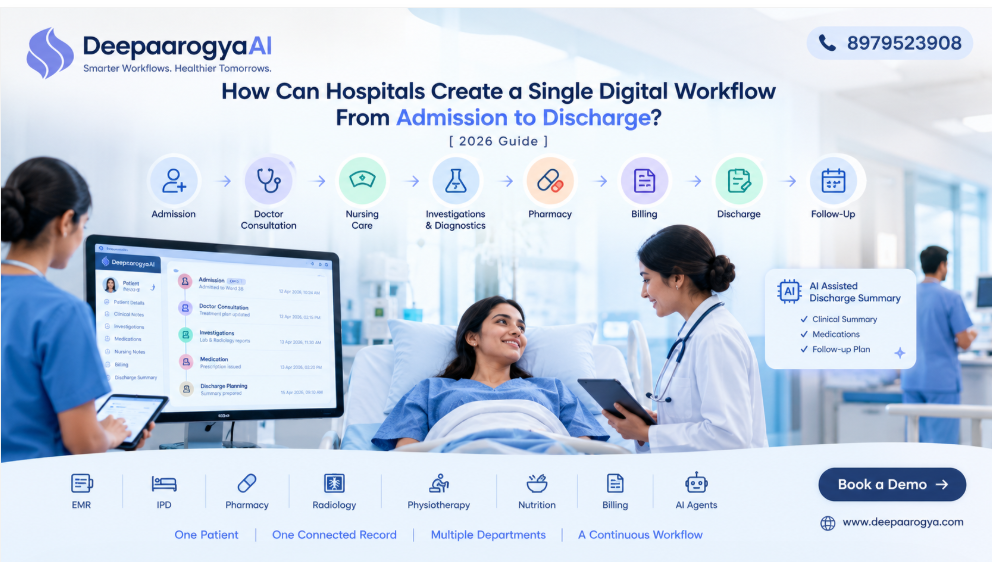
Front desk → Doctor → Nursing → Diagnostics → Pharmacy → Billing → Discharge → Follow-up
Each department handles a different responsibility, but they are all working with the same patient.
The challenge begins when every department manages its part of the journey through disconnected systems, paper records, spreadsheets, messages, or separate software.
A doctor may document the treatment plan in one system. Nursing teams may maintain separate notes. Diagnostic reports may exist somewhere else. Pharmacy manages medicines independently, while billing works from another workflow.
The result?
The patient journey becomes fragmented.
A modern hospital needs more than individual digital tools. It needs a connected workflow that follows the patient from admission to discharge.
This is where an AI-powered healthcare platform such as DeepaarogyaAI can help connect clinical and operational workflows around a shared patient record.
What Is an Admission-to-Discharge Digital Workflow?
An admission-to-discharge workflow connects the major stages of an inpatient journey into one structured digital process.
A typical workflow can look like:
Patient Registration
↓
Admission
↓
Initial Assessment
↓
Doctor Consultation
↓
Orders & Investigations
↓
Nursing Care
↓
Medication & Pharmacy
↓
Clinical Monitoring
↓
Treatment Updates
↓
Discharge Planning
↓
Discharge Summary
↓
Billing & Closure
↓
Follow-Up
Instead of treating each step as a separate activity, a connected system keeps these activities associated with the same patient record.
This creates continuity throughout the hospitalization.
Why Do Hospitals Struggle With Disconnected IPD Workflows?
Inpatient care involves multiple teams working simultaneously.
When their workflows are disconnected, information can become difficult to coordinate.
1. Patient Information Gets Scattered
A patient may have information stored across:
- Paper case sheets
- Separate EMR modules
- Nursing records
- Diagnostic systems
- Pharmacy software
- Billing systems
- Messaging applications
- Spreadsheets
Even when the information exists digitally, it may not be available within the workflow where it is needed.
The problem is therefore not always lack of data.
It can be a lack of connected data.
2. Clinical Information May Need to Be Entered More Than Once
Imagine a patient is admitted with a particular condition.
The same patient details may need to appear in:
- Admission records
- Doctor notes
- Nursing documentation
- Investigation requests
- Pharmacy workflows
- Billing records
- Discharge documentation
When systems do not communicate effectively, staff may need to repeatedly enter or transfer information.
This creates additional administrative work and increases the possibility of inconsistencies.
3. Different Departments See Different Pieces of the Journey
A doctor may know the treatment plan.
The nursing team knows the latest bedside observations.
The pharmacy knows which medicines were dispensed.
The billing team knows which services have been charged.
The patient, however, experiences all of these as one hospital journey.
A connected hospital workflow should reflect that continuity.
What Should a Modern IPD Workflow Include?
A digital inpatient workflow should cover more than admission and discharge.
It should support the major activities that happen between those two points.
Admission
Patient registration, admission details, room/bed allocation and initial information.
Clinical Documentation
Doctor assessments, progress notes, diagnoses, treatment plans and relevant clinical information.
Nursing
Nursing documentation, observations and patient-care information.
Investigations
Orders, reports and relevant diagnostic information connected to the patient.
Pharmacy
Prescriptions, medicines and dispensing workflows.
Billing
Hospital services, packages, payments and other relevant billing activities.
Discharge
Discharge planning, documentation, summary preparation and closure.
Follow-Up
The patient journey can continue after leaving the hospital through appropriate follow-up workflows.
The objective is to create a continuous digital journey instead of disconnected departmental activities.
How Can DeepaarogyaAI Support the IPD Journey?
DeepaarogyaAI is positioned as an AI Hospital OS for clinics and hospitals, bringing EMR, OPD, IPD, pharmacy, billing, radiology, physiotherapy, nutrition and AI-assisted workflows into a connected healthcare environment.
Its IPD workflow can be viewed as part of a broader patient record rather than an isolated admission system.
A simplified journey can look like:
Admission
↓
IPD Case Sheet
↓
Doctor & Nursing Documentation
↓
Orders & Investigations
↓
Pharmacy
↓
Treatment Updates
↓
Discharge
↓
Follow-Up
The advantage of this approach is that different stages remain connected to the same patient.
Step-by-Step: What Does a Connected IPD Workflow Look Like?
Step 1: Patient Admission
The patient enters the hospital and the admission workflow begins.
Instead of creating a completely separate record for inpatient care, the admission can become another stage in the patient’s broader digital journey.
Relevant patient information can remain associated with the patient record.
Step 2: Initial Clinical Assessment
The doctor assesses the patient and documents relevant clinical information.
This may include:
- Presenting complaints
- Medical history
- Examination
- Diagnosis
- Investigations
- Treatment plan
- Medication
The information becomes part of the digital clinical record.
Step 3: Nursing Workflow
Nursing teams play an important role throughout the inpatient journey.
Their documentation and observations contribute to the overall patient record.
Instead of maintaining an isolated information trail, nursing workflows can remain connected to the patient’s IPD record.
Step 4: Investigations and Diagnostics
The patient may require laboratory tests or radiology during hospitalization.
A connected workflow can associate investigation orders and reports with the same patient record.
This means the diagnostic stage becomes part of the patient’s overall hospital journey.
Step 5: Pharmacy and Medication
Medication management is another important part of inpatient care.
The clinical team may prescribe medicines while pharmacy teams manage dispensing.
A connected workflow can link:
Doctor → Prescription → Pharmacy → Dispensing → Patient Record
This reduces the need to treat medication management as an entirely separate digital process.
Step 6: Ongoing Treatment Documentation
Hospitalization can involve multiple clinical updates.
Instead of creating isolated notes, the hospital can maintain a continuous record of relevant clinical activity.
This helps the authorized care team understand what has already happened and what the current stage of treatment is.
Step 7: Discharge Planning
Discharge should not be treated as a completely separate event.
By the time a patient is ready to leave, the hospital may already have accumulated:
- Admission information
- Clinical assessments
- Diagnoses
- Investigation reports
- Medication information
- Treatment documentation
- Nursing information
- Follow-up recommendations
A connected digital record provides the foundation for organizing this information for the discharge workflow.
Where Does AI Fit Into the IPD Workflow?
AI does not need to replace doctors, nurses or hospital staff.
Instead, it can assist with documentation-heavy and repetitive workflow tasks.
For example, an AI system can help prepare drafts from information already present in the digital record, which healthcare professionals can then review.
DeepaarogyaAI includes AI-assisted workflows such as Discharge Summary, Visit Summary, Patient Summary and SOAP-related documentation.
The important principle is:
AI assists. Healthcare professionals review and approve.
This keeps the clinical team involved in the final decision-making and documentation process.
How AI Can Help Reduce Documentation Friction
Consider a traditional workflow.
A doctor completes several clinical activities during hospitalization.
Later, information may need to be gathered again to prepare documentation.
This can involve:
Review records → Find relevant information → Copy details → Organize information → Draft document → Edit → Finalize
An AI-assisted workflow can potentially make the process more structured:
Patient Record → AI-Assisted Draft → Professional Review → Final Document
The AI output should remain a draft, not an independent clinical decision.
This distinction is particularly important in healthcare.
One Patient, One Connected Hospital Journey
Consider a patient admitted with a condition requiring several days of inpatient care.
The journey may involve:
Day 1
Admission → Assessment → Diagnosis → Investigations
Day 2
Treatment → Medication → Nursing Documentation → Monitoring
Day 3
Clinical Review → Investigation Results → Treatment Update
Day 4
Discharge Planning → Medication Review → Discharge Documentation
After Discharge
Follow-Up → Further Consultation → Continued Care
The patient experiences this as one continuous journey.
The hospital’s digital infrastructure should aim to preserve that continuity.
What Happens When Every Department Works Separately?
A disconnected IPD workflow can look like this:
Admission System
↓
Separate EMR
↓
Separate Nursing Records
↓
Separate Diagnostic System
↓
Separate Pharmacy
↓
Separate Billing
↓
Separate Discharge Documentation
The patient remains the same, but the information becomes fragmented.
A connected workflow looks different:
One Patient Record
↓
Admission
↓
Clinical Care
↓
Diagnostics
↓
Nursing
↓
Pharmacy
↓
Billing
↓
Discharge
↓
Follow-Up
The difference is not simply the number of software modules.
It is how those modules work together.
7 Ways Hospitals Can Improve Their Admission-to-Discharge Workflow
1. Create One Patient-Centric Workflow
Instead of designing every department as an isolated system, organize the workflow around the patient journey.
2. Reduce Repeated Data Entry
Identify information that staff repeatedly enter across different departments.
Where appropriate, connect those workflows so information can flow between them.
3. Connect Clinical and Operational Processes
Clinical documentation should not exist completely separately from pharmacy, diagnostics, billing and other operational workflows.
4. Standardize IPD Documentation
Create structured workflows for admission, assessments, progress documentation, orders and discharge.
This can make processes easier to follow across teams.
5. Keep Diagnostics Connected
Investigation orders and reports should remain associated with the correct patient record.
6. Use AI Where It Actually Helps
Instead of adding AI simply for the sake of having an AI feature, identify documentation and workflow tasks where AI assistance can provide value.
Examples can include:
- Clinical note drafting
- Patient summaries
- Visit summaries
- Discharge documentation
All AI-generated clinical content should remain subject to appropriate professional review.
7. Design the Workflow Around Real Hospital Operations
Every hospital works differently.
A multi-specialty hospital may require a much more complex IPD workflow than a smaller facility.
The digital platform should therefore support configurable workflows rather than forcing every organization into exactly the same process.
What Should Hospitals Look for in an IPD Platform?
Before selecting or upgrading hospital software, administrators can ask:
Patient Record
- Can clinical information remain connected to the patient?
- Can authorized departments access relevant information?
IPD
- Does the platform support admission-to-discharge workflows?
- Can doctors and nursing teams document patient care digitally?
Diagnostics
- Can investigation orders and reports remain linked to the patient record?
Pharmacy
- Can prescriptions and pharmacy workflows remain connected?
Billing
- Can clinical and billing workflows work together?
AI
- Does AI assist with actual workflow problems?
- Are AI outputs reviewed by healthcare professionals?
Customization
- Can workflows be configured according to the hospital’s requirements?
Security
- Can different users have appropriately controlled access?
These questions can help hospitals evaluate software based on workflow fit, rather than simply counting features.
Why an End-to-End Workflow Matters
Digital transformation is sometimes approached as:
“We need an EMR.”
But an EMR alone may not answer every operational challenge faced by a hospital.
The bigger question is:
“Can our systems follow the patient throughout the entire hospital journey?”
A patient does not experience:
EMR + Pharmacy + Billing + Diagnostics + Nursing
as separate products.
They experience:
Admission → Treatment → Recovery → Discharge → Follow-Up
A connected healthcare platform aims to bring the technology closer to that reality.
How DeepaarogyaAI Brings the Workflow Together
DeepaarogyaAI combines multiple healthcare capabilities within a broader connected platform, including:
🩺 EMR
Structured electronic medical records and specialty workflows.
🏥 OPD
Patient intake, token queues and consultation workflows.
🛏️ IPD
Admission-to-discharge workflows and case sheets.
💊 Pharmacy
Prescription and pharmacy workflows connected with the patient record.
🩻 Radiology
Imaging orders, queues and reports linked to the patient chart.
💗 Physiotherapy
Protocol tracking, outcomes, team assignment and session billing.
🥗 Nutrition
Nutrition workflows with AI-assisted capabilities.
🧾 Billing
Package billing, payments and GST-related workflows.
🤖 AI Agents
AI-assisted documentation and healthcare workflows.
Together, these capabilities are designed to support a more connected patient journey rather than isolated departmental software.
The Future of Hospital Management Is Workflow-Centric
The next stage of healthcare digitization is not simply about putting more information online.
It is about making information usable within the workflow.
A hospital can have enormous amounts of digital data and still struggle if employees have to search across multiple systems to understand what is happening with a patient.
The future therefore moves toward:
Connected Records
Connected Departments
AI-Assisted Workflows
Human Review
Patient-Centric Operations
This is the direction in which AI-enabled healthcare platforms such as DeepaarogyaAI are positioned.
Conclusion
A hospital admission is only the beginning of a patient’s inpatient journey.
Between admission and discharge, multiple departments contribute to the patient’s care.
When these workflows operate independently, information can become fragmented and staff may spend unnecessary time searching, transferring and re-entering data.
A connected admission-to-discharge workflow can bring these activities together around the patient.
With DeepaarogyaAI, hospitals can connect EMR, IPD, diagnostics, pharmacy, billing, specialty workflows and AI-assisted capabilities within a broader healthcare platform.
The goal is not simply to digitize each department.
It is to create a connected digital journey from admission to discharge.
One patient.
One connected record.
Multiple departments.
One continuous workflow.
That is the foundation for a more organized digital hospital.
FAQs
1. What is an admission-to-discharge workflow?
It is a digital workflow that connects major inpatient activities—from patient admission and clinical assessment through treatment, diagnostics, medication, billing and discharge.
2. Why should hospitals connect IPD with other departments?
Patients often interact with multiple departments during hospitalization. Connecting relevant workflows can help keep information associated with the same patient journey.
3. Can DeepaarogyaAI support IPD workflows?
Yes. DeepaarogyaAI includes IPD and case-sheet workflows as part of its broader healthcare platform, alongside EMR, OPD, pharmacy, billing, radiology, physiotherapy, nutrition and AI-assisted workflows.
4. How can AI help with hospital documentation?
AI can assist with tasks such as generating structured drafts and summaries from available information. These outputs should be reviewed and approved by the appropriate healthcare professional.
5. Can AI independently make clinical decisions?
AI should not independently make clinical decisions. AI-assisted healthcare workflows should support healthcare professionals while keeping appropriate human review and approval in place.
6. Can hospital workflows be customized?
Healthcare organizations have different operational requirements. A configurable workflow can allow organizations to adapt digital processes according to their departments and operating model.
7. What departments can be connected to an IPD workflow?
Depending on the hospital’s setup, relevant workflows can include doctors, nursing, diagnostics, pharmacy, billing, physiotherapy, nutrition and other departments involved in the patient’s journey.
8. What is the biggest benefit of a connected hospital workflow?
The core benefit is continuity. Instead of treating admission, treatment, diagnostics, pharmacy, billing and discharge as unrelated activities, a connected workflow organizes them around the same patient journey.