
A doctor may spend 10–20 minutes with a patient, but that consultation creates information that can influence the rest of the patient’s care.
Symptoms are discussed.
A diagnosis may be recorded.
Investigations may be recommended.
Medicines may be prescribed.
A physiotherapy or nutrition plan may be required.
Billing may need to be completed.
A follow-up may need to happen later.
Yet many healthcare workflows still treat the consultation as an isolated event.
The doctor documents the visit. Then another team member may enter information somewhere else. The prescription moves to the pharmacy. Investigation information may arrive separately. Another department may need to interpret the doctor’s instructions.
The consultation contains the information—but the challenge is turning that information into coordinated action.
This is where an AI healthcare workflow can make a meaningful difference.
DeepaarogyaAI approaches healthcare as an interconnected environment rather than a collection of individual software tools. Its AI Hospital OS brings together EMR, OPD, IPD, pharmacy, billing, radiology, physiotherapy, nutrition, e-prescriptions and AI-assisted workflows around a connected patient record.
The goal is not to replace the doctor.
The goal is to help the healthcare organization move from documentation to action.
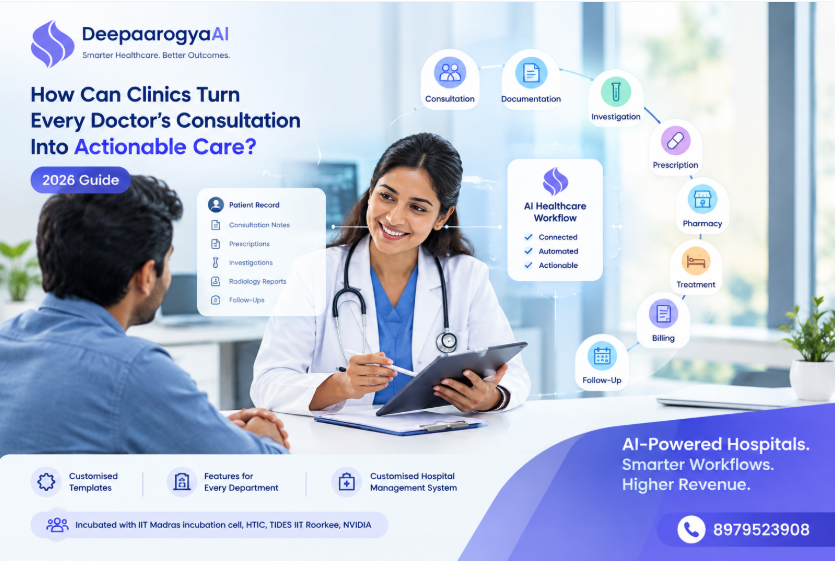
What Is an Actionable Healthcare Workflow?
An actionable healthcare workflow connects what happens during a consultation with what needs to happen next.
For example:
Consultation → Clinical Documentation → Investigation → Prescription → Pharmacy → Treatment → Billing → Follow-Up
In a fragmented environment, each step may be managed separately.
In a connected environment, the patient’s information can remain associated with the same record throughout the process.
This distinction is important because digital healthcare is not simply about storing information. It is about making information useful at the right point in the workflow.
Why Do Consultations Often Create More Work After the Patient Leaves?
The consultation may be complete, but the operational work often continues.
1. Clinical information needs to be documented
Doctors need to record important information from the consultation.
Manual documentation can consume time, particularly in busy clinics.
2. The next action needs to be communicated
A patient may need:
- A diagnostic investigation
- Medication
- Physiotherapy
- Nutrition support
- Another consultation
- A follow-up visit
If these actions are handled independently, information can become fragmented.
3. Other departments need context
The pharmacy, radiology, physiotherapy, nutrition or billing team may need information connected to the consultation.
4. Patients need clear next steps
Patients should not have to figure out the entire process themselves after leaving the consultation.
A better healthcare workflow connects the doctor’s decision with the appropriate downstream processes.
How Can AI Turn Consultation Information Into Action?
AI does not have to make the clinical decision to be useful.
It can assist with the organization, documentation and movement of information created during the consultation.
1. AI Can Help Structure Consultation Information
Doctors often capture information in different ways depending on their specialty and workflow.
AI-assisted documentation can help transform consultation information into structured notes that can be reviewed by the clinician.
For example, a SOAP workflow can organize information into:
- Subjective information
- Objective findings
- Assessment
- Plan
DeepaarogyaAI includes AI-assisted SOAP documentation workflows designed to create structured drafts for professional review.
The workflow can therefore become:
Consultation → AI Draft → Doctor Review → Final Record
The important principle is simple:
AI assists. The healthcare professional remains in control.
DeepaarogyaAI describes its AI-generated clinical outputs as drafts that remain subject to appropriate professional review and approval.
2. AI Patient Summaries Can Make Existing Information Easier to Use
A patient’s record can become extensive over time.
It may contain:
- Previous consultations
- Prescriptions
- Investigations
- Radiology reports
- Treatment history
- Vitals
- Department interactions
- Follow-up information
The challenge is not necessarily the absence of information.
The challenge is finding the relevant information quickly.
AI-assisted patient summaries can help organize existing information into a more accessible format for professional review.
This can be particularly useful when a patient returns after several weeks or months.
Instead of treating every consultation as a completely new event, the doctor can work from the patient’s existing clinical context.
DeepaarogyaAI includes an AI Patient Summary workflow as part of its broader AI-powered healthcare environment.
3. The Next Department Should Not Have to Start From Zero
Consider a patient visiting an orthopedic clinic.
The patient completes a consultation and the doctor recommends physiotherapy.
In a disconnected workflow, the physiotherapy team may need to manually understand:
- Why the patient was referred
- What treatment was recommended
- Relevant clinical information
- Previous investigations
- Existing treatment history
A connected patient record can make this information available within the broader workflow.
The journey can look like:
Orthopedic Consultation → Physiotherapy → Session Tracking → Outcomes → Billing
DeepaarogyaAI supports physiotherapy workflows involving areas such as protocol tracking, outcomes, team assignment, session management and billing.
This is where the value of an AI Hospital OS becomes clearer.
The objective is not simply to digitize one department.
It is to help different departments work around the same patient context.
4. Prescriptions Can Become Part of the Connected Workflow
The prescription is one of the most important outputs of a consultation.
But creating the prescription is only one step.
The patient may then need to:
- Receive the prescription
- Purchase the medicines
- Follow the prescribed treatment
- Return for review
When prescription and pharmacy workflows remain connected to the patient record, the process becomes more organized.
DeepaarogyaAI supports e-prescriptions and WhatsApp-based prescription delivery after clinician sign-off, while pharmacy workflows can remain connected with the broader patient record.
This creates a smoother transition:
Doctor → Prescription → Patient → Pharmacy
rather than treating every step as a separate activity.
5. Investigations Should Stay Connected to the Patient Story
Suppose a doctor orders an investigation during a consultation.
The investigation generates a report.
The patient returns later.
If the report is stored separately from the patient’s clinical record, the doctor may have to search for it.
A connected workflow aims to associate relevant investigation information with the patient and visit.
DeepaarogyaAI supports radiology workflows where imaging orders, queues and reports can remain linked to the patient chart. Its broader platform also supports clinical files and diagnostic information within connected patient workflows.
This helps turn:
Investigation → Report → Clinical Review
into one connected process.
6. AI Can Help Create a Better Patient Handoff
One of the biggest weaknesses in healthcare workflows occurs when information has to move between people.
A patient may move from:
Doctor → Radiology → Physiotherapy → Pharmacy → Billing
If each team receives only part of the information, staff may spend time clarifying what happened earlier.
A connected record provides a stronger foundation.
AI can add another layer by helping summarize or structure relevant information for the workflow.
This is particularly valuable because the goal should not be to give every department more information.
The goal should be to give each team the relevant information they need.
What Does This Look Like With DeepaarogyaAI?
Imagine a patient named Rahul visiting a multi-specialty clinic.
Step 1: Consultation
Rahul meets the doctor and explains his symptoms.
The consultation information is recorded in the EMR.
Step 2: AI-Assisted Documentation
An AI workflow helps prepare structured documentation.
The doctor reviews and finalizes it.
Step 3: Investigation
The doctor recommends an investigation.
The relevant workflow remains associated with Rahul’s patient record.
Step 4: Prescription
The doctor creates an e-prescription.
After appropriate clinician approval, it can be shared digitally.
Step 5: Pharmacy
The pharmacy can work with prescription and patient information connected to the broader workflow.
Step 6: Additional Care
If Rahul needs physiotherapy or nutrition support, the relevant department can continue the patient’s care using the connected record.
Step 7: Follow-Up
The patient’s next step can remain part of the overall healthcare workflow rather than becoming an isolated reminder.
The result is a journey where the information created during the consultation continues working after the consultation ends.
Why an AI Hospital OS Is Different From a Standalone AI Tool
There is an important difference between adding AI to healthcare and building healthcare workflows around AI.
Standalone approach
EMR → Copy Information → AI Tool → Copy Result → EMR
This can create additional work.
Connected approach
Patient Record → AI Workflow → Professional Review → Patient Record
This keeps AI closer to the actual healthcare workflow.
DeepaarogyaAI positions its platform as an AI Hospital OS, combining healthcare operations, EMR and AI-powered workflows around a connected patient record.
That creates a stronger foundation for practical AI adoption.
How Different Healthcare Teams Benefit
For Doctors
Doctors can benefit from:
- Structured AI-assisted documentation
- Patient summaries
- Connected clinical information
- Digital prescriptions
- Reduced repetitive administrative work
For Front-Desk Teams
A connected system can help organize:
- Patient registration
- Visit information
- OPD workflows
- Patient status
- Scheduling
For Pharmacy Teams
The pharmacy can work with prescription information connected to the patient’s broader record.
For Physiotherapists
Relevant clinical information can continue into physiotherapy workflows instead of requiring an entirely separate patient context.
For Nutrition Teams
Nutrition workflows can use appropriate patient information while keeping AI-generated plans within a professional review process.
For Administrators
Administrators can gain greater visibility across clinical and operational workflows rather than managing isolated systems.
The Real Goal: From Information to Action
Healthcare organizations already generate enormous amounts of information.
The bigger opportunity is making that information useful.
A modern AI healthcare workflow should answer three questions:
What happened?
The patient’s clinical history and current consultation.
What needs to happen next?
Investigation, treatment, prescription, referral, therapy or another appropriate step.
Who needs the information?
Doctor, nurse, physiotherapist, pharmacist, nutrition professional, billing team or patient.
When these three elements are connected, the healthcare workflow becomes much more actionable.
Why Human Oversight Still Matters
Healthcare AI should not be treated like ordinary automation.
Clinical information can influence patient care.
That is why AI-generated content should remain subject to appropriate professional review.
DeepaarogyaAI’s approach emphasizes AI-assisted workflows rather than autonomous clinical decision-making. AI can prepare drafts, summaries or structured information, while healthcare professionals review and approve relevant outputs.
This creates a practical model:
AI prepares → Professional reviews → Healthcare team acts
Why This Matters for Clinics in 2026
Healthcare organizations are moving beyond basic digitization.
The next challenge is not simply:
“Do we have an EMR?”
It is:
“Can our EMR actually connect what happens before, during and after a consultation?”
A clinic can have digital records and still have disconnected workflows.
An AI Hospital OS takes the idea further by combining:
EMR + Healthcare Workflows + AI + Department Connectivity + Human Oversight
That is where AI can become part of everyday healthcare operations rather than another separate technology layer.
How DeepaarogyaAI Helps Build Actionable Healthcare Workflows
DeepaarogyaAI brings multiple healthcare capabilities together around a connected patient record, including:
🩺 EMR
Structured digital patient records and customizable clinical workflows.
🏥 OPD & IPD
Patient intake, consultation, admission and inpatient workflows.
🩻 Radiology
Imaging-related workflows connected to patient information.
💊 Pharmacy
Prescription and dispensing workflows connected with the broader patient journey.
💗 Physiotherapy
Protocol, outcome, team and session management.
🥗 Nutrition
AI-assisted nutrition workflows with professional review.
🧾 Billing
Billing and GST-related healthcare workflows.
🤖 AI Agents
AI-assisted workflows for areas such as SOAP documentation, patient summaries, discharge documentation, nutrition and other healthcare tasks.
The bigger idea is simple:
One patient. One connected record. Multiple intelligent workflows.
Conclusion: Make Every Consultation Count Beyond the Consultation Room
A consultation should not become a static note that sits inside an EMR.
It should become the starting point for the patient’s next steps.
The future of healthcare workflow is not simply about collecting more data.
It is about connecting information to people, departments and actions.
With an AI-powered healthcare platform such as DeepaarogyaAI, clinics and hospitals can bring together EMR, OPD, IPD, pharmacy, radiology, physiotherapy, nutrition, billing and AI-assisted workflows around the patient record.
AI can help prepare the information.
The healthcare professional remains in control.
The connected workflow helps move care forward.
That is the shift from simply recording healthcare to creating actionable healthcare workflows.
Ready to turn your healthcare workflows into connected, AI-assisted processes?
Explore DeepaarogyaAI and see how an AI Hospital OS can support your clinic or hospital.
Explore: https://www.deepaarogya.com/
Contact: 8979523908
Frequently Asked Questions
1. What is an AI healthcare workflow?
An AI healthcare workflow uses artificial intelligence to assist with healthcare tasks such as documentation, patient summaries, communication, nutrition workflows and other operational or clinical-support processes while keeping appropriate human review in place.
2. Can AI replace doctors in healthcare workflows?
No. AI should support healthcare professionals rather than replace clinical judgement. DeepaarogyaAI’s AI-assisted outputs are designed for professional review and approval.
3. How can AI help after a doctor consultation?
AI can help structure consultation documentation, summarize patient information and support connected workflows that continue into prescriptions, investigations, therapy, nutrition and other appropriate processes.
4. What is an AI Hospital OS?
An AI Hospital OS is a healthcare technology environment that combines clinical, operational and AI-assisted workflows instead of treating each function as an isolated application.
5. Can DeepaarogyaAI support multiple departments?
Yes. DeepaarogyaAI brings workflows including EMR, OPD, IPD, pharmacy, billing, radiology, physiotherapy and nutrition into a connected healthcare environment.
6. Does DeepaarogyaAI provide AI-assisted documentation?
Yes. Its AI workflow ecosystem includes capabilities such as SOAP documentation, patient summaries and discharge documentation, with outputs intended for appropriate professional review.