
A patient does not become a different patient simply because their consultation happens online.
Yet in many clinics, telemedicine operates separately from the regular healthcare workflow. The appointment may happen on a video platform, clinical notes may be maintained somewhere else, prescriptions may be shared through another channel, and the patient’s next step may depend on manual coordination.
This creates an important question:
How can clinics make telemedicine part of the same EMR workflow as in-person consultations?
This is where DeepaarogyaAI can help.
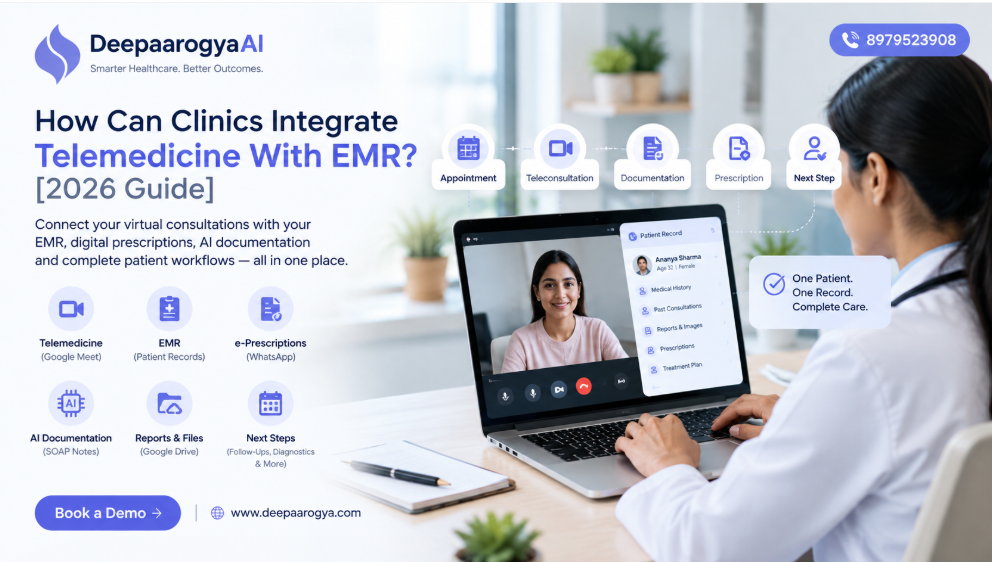
DeepaarogyaAI is designed as an AI-powered healthcare operating environment that connects EMR, OPD, IPD, pharmacy, billing, radiology, physiotherapy, nutrition, e-prescriptions, AI-assisted workflows and integrations around the patient record. Its platform supports Google Meet for telemedicine, allowing online consultations to remain connected with the broader patient workflow.
Instead of treating telemedicine as a separate video call, clinics can make it another way for a patient to enter the same digital healthcare workflow:
Appointment → Teleconsultation → EMR → Documentation → Prescription → Next Step
That shift can make virtual care more organized for doctors, staff and patients.
What Is the Problem With Standalone Telemedicine?
Telemedicine itself is not the problem.
The problem is what happens before, during and after the video consultation.
Imagine a patient who has already visited a clinic several times.
Today, the patient is unable to come physically, so the clinic schedules an online consultation.
The doctor joins the video call.
But then the team may need to:
- Find the patient’s previous records
- Search for earlier prescriptions
- Locate investigation reports
- Record the new consultation
- Prepare a prescription
- Share it with the patient
- Schedule the next appointment
- Update the patient’s medical record
If these activities happen through separate tools, the video consultation becomes another disconnected workflow.
The clinic has successfully conducted a virtual appointment—but the patient’s information journey is still fragmented.
A better approach is to connect the virtual consultation with the same EMR environment used for physical visits.
Why Should Telemedicine Be Connected to the EMR?
Telemedicine is most useful when it becomes part of the patient’s existing care workflow rather than an isolated communication channel.
Consider two different approaches.
Traditional Approach
Appointment → Video Call → Notes Somewhere Else → Prescription Message → Manual Record Update
Connected Approach
Appointment → Patient Record → Teleconsultation → Clinical Documentation → Prescription → Next Step
The second approach reduces the number of places where healthcare teams need to manage the same patient information.
With DeepaarogyaAI, telemedicine can be connected with the patient’s EMR workflow through supported integrations such as Google Meet.
This means a virtual consultation does not have to exist outside the patient’s broader healthcare journey.
How Can DeepaarogyaAI Support a Telemedicine Workflow?
The value of telemedicine increases when the surrounding workflow is also organized.
DeepaarogyaAI can bring several parts of that workflow together.
1. Start With the Patient’s Existing Record
Before a teleconsultation begins, the doctor may need relevant information such as:
- Previous consultation notes
- Medical history
- Prescriptions
- Investigation reports
- Radiology information
- Treatment information
- Relevant department records
Instead of treating an online consultation as a completely new interaction, the clinic can work from the patient’s existing digital record.
This is particularly useful when the patient has already interacted with the clinic through OPD, diagnostics, pharmacy or specialty services.
The goal is simple:
The patient should remain the same digital record whether the consultation happens inside the clinic or online.
2. Connect the Appointment With the Consultation
A telemedicine workflow should begin with a properly organized appointment.
The clinic can manage the appointment and then initiate the virtual consultation through the supported telemedicine integration.
DeepaarogyaAI supports Google Meet integration, allowing telemedicine consultations to be connected to the broader patient workflow.
This creates a more structured process:
Appointment → Patient Record → Google Meet → Consultation
Instead of:
Appointment → Separate Video Tool → Manual Record Update
The difference may appear small.
For a clinic conducting dozens of virtual consultations, however, workflow consistency becomes increasingly important.
3. Keep Consultation Documentation Connected
A video call is only one part of a clinical encounter.
The consultation still needs documentation.
The doctor may need to record:
- Symptoms
- Clinical observations
- Assessment
- Diagnosis
- Treatment plan
- Recommendations
- Follow-up instructions
This is where an integrated EMR becomes more useful than a standalone video platform.
DeepaarogyaAI also provides AI-assisted documentation workflows, including SOAP note generation, where AI can assist in creating structured documentation for professional review. The clinician remains responsible for reviewing and approving the final information.
The workflow can therefore become:
Teleconsultation → AI-Assisted Draft → Doctor Review → Final EMR
The objective is not to let AI make clinical decisions.
It is to reduce repetitive documentation work while keeping the healthcare professional in control.
4. Generate Digital Prescriptions After the Consultation
A teleconsultation often ends with a prescription or treatment recommendation.
If the prescription process is separate from the EMR, staff may have to manually transfer information.
A connected digital workflow can make the process simpler.
DeepaarogyaAI supports e-prescriptions that can be shared with patients through WhatsApp after clinician approval.
The workflow can look like:
Consultation → Prescription → Doctor Approval → Digital Delivery
This is particularly useful for patients who are already consulting remotely and do not need to physically return to the clinic just to collect a prescription.
5. Keep Reports and Clinical Documents Accessible
Telemedicine can become difficult when doctors need information that is stored somewhere else.
A patient may have:
- Laboratory PDFs
- X-rays
- Scan reports
- Surgery photographs
- Previous medical documents
DeepaarogyaAI supports Google Drive synchronization that can associate clinical files with the appropriate patient record while keeping them stored in the organization’s Google Drive environment.
This creates another useful connection:
Patient → EMR → Clinical Documents → Teleconsultation
The doctor does not need to treat every virtual appointment as an isolated encounter.
Relevant information can remain connected to the patient record.
6. Connect Telemedicine With the Next Step
A consultation should not end simply because the video call ends.
Depending on the doctor’s recommendation, the patient may need:
- Another consultation
- Diagnostic testing
- Physiotherapy
- Nutrition support
- Medication
- An in-person visit
- A future follow-up
This is where a connected healthcare platform becomes more valuable.
For example:
Scenario
A patient has an online consultation with an orthopedic doctor.
The doctor reviews the patient’s existing information and discusses the current concern.
The doctor recommends an imaging investigation.
The recommendation becomes part of the patient’s workflow.
The patient completes the investigation.
The report becomes available within the connected record.
The doctor can then review the result during another consultation or in-person visit.
The telemedicine appointment has therefore become part of a larger care workflow rather than a standalone video conversation.
Telemedicine for Multi-Specialty Clinics
Telemedicine becomes even more interesting when a clinic provides multiple specialties.
A patient may interact with:
- General physician
- Orthopedic specialist
- Physiotherapist
- Nutritionist
- Radiology team
- Pharmacy
- Billing team
The consultation format may change, but the patient’s record does not need to become fragmented.
DeepaarogyaAI supports workflows across areas such as OPD, IPD, pharmacy, billing, radiology, physiotherapy and nutrition, alongside telemedicine integrations.
This allows clinics to think about telemedicine as another access point into their healthcare ecosystem.
Physical Consultation
Patient → Clinic → Doctor → EMR
Virtual Consultation
Patient → Online Appointment → Doctor → EMR
The method of consultation changes.
The underlying patient workflow remains connected.
What Does a Connected Telemedicine Journey Look Like?
Let’s follow a patient from beginning to end.
Step 1: Appointment
The patient schedules an online consultation.
The appointment is recorded in the clinic’s workflow.
Step 2: Patient Record
The doctor can work with the relevant information already available in the patient’s record.
Step 3: Teleconsultation
The online consultation is conducted through the supported telemedicine workflow.
Step 4: Documentation
The doctor records the consultation in the EMR.
AI-assisted documentation can help prepare structured drafts where appropriate.
Step 5: Prescription
If medication is required, the doctor creates and approves the digital prescription.
Step 6: Patient Receives the Prescription
The prescription can be delivered digitally through the supported WhatsApp workflow.
Step 7: Next Step
The patient may need diagnostics, another consultation, physiotherapy, nutrition support or an in-person visit.
The next step can remain part of the same broader patient workflow.
This is what makes connected telemedicine different from simply adding video calling to a clinic.
How Telemedicine Can Benefit Doctors
For doctors, the biggest advantage is not simply being able to see patients remotely.
It is having the surrounding information organized.
A connected workflow can help doctors:
Access relevant patient information
Previous records and relevant clinical information can remain associated with the patient.
Reduce unnecessary administrative work
AI-assisted documentation can help with structured clinical notes.
Continue using the same EMR
Doctors do not need a completely different documentation process simply because the consultation is online.
Support hybrid care
A patient can move between virtual and physical consultations while remaining within the same broader patient record.
How Telemedicine Can Benefit Patients
Patients also benefit when virtual care is connected to the clinic’s existing workflow.
They can potentially experience:
Less repetition
Patients do not need to treat every online consultation as a completely new interaction.
Digital prescriptions
Prescriptions can be delivered electronically after clinician approval.
Easier access
Patients can consult remotely when an in-person visit is not necessary.
Connected care
Online consultations can remain part of the patient’s broader clinical journey.
The goal is not to make every consultation virtual.
The goal is to make virtual care work smoothly when it is appropriate.
What Should Clinics Look for in Telemedicine Software?
Choosing a telemedicine solution should involve more than asking:
“Does it provide video calls?”
Clinics should also ask:
1. Is the consultation connected to the patient record?
A video call without clinical context can create additional work.
2. Can doctors document the consultation in the EMR?
Documentation should not require unnecessary duplication.
3. Can prescriptions be generated digitally?
This can make the post-consultation process smoother.
4. Can reports be accessed during the workflow?
Doctors may need existing investigations or documents during a virtual consultation.
5. Can the patient continue with another workflow?
A consultation may lead to diagnostics, pharmacy, physiotherapy, nutrition or an in-person visit.
6. Can AI assist with repetitive documentation?
AI can support documentation workflows while leaving clinical decisions to healthcare professionals.
7. Can the system support hybrid care?
The same patient may need both online and physical consultations at different points.
A strong healthcare platform should support both.
Why DeepaarogyaAI Takes a Different Approach
A standalone telemedicine application solves one problem:
How do we conduct a video consultation?
But healthcare organizations need to solve a bigger problem:
How do we manage the patient’s entire workflow around that consultation?
DeepaarogyaAI approaches this through a connected healthcare platform that brings together:
- AI-powered EMR
- OPD management
- IPD management
- Pharmacy
- Billing
- Radiology
- Physiotherapy
- Nutrition
- Digital prescriptions
- AI-assisted documentation
- Patient summaries
- WhatsApp workflows
- Google Drive integration
- Google Meet telemedicine
- Google Calendar
- AI agents
These capabilities are designed to work as parts of a broader healthcare operating environment rather than isolated tools.
The underlying idea is straightforward:
One patient. One record. Multiple ways to provide care.
The Future of Telemedicine Is Connected Care
Telemedicine has already changed how patients access doctors.
The next challenge is making sure virtual consultations do not become another disconnected information silo.
A video call alone does not create connected healthcare.
The real value comes when the consultation connects with:
Patient Record → Clinical Documentation → Prescription → Diagnostics → Pharmacy → Follow-Up → Future Care
That is where an AI-powered healthcare operating system can become more valuable than a standalone telemedicine tool.
DeepaarogyaAI brings telemedicine into a broader connected healthcare environment, allowing online consultations to work alongside EMR, OPD, IPD, pharmacy, billing, radiology, physiotherapy, nutrition and AI-assisted workflows.
The goal is not to replace in-person healthcare.
It is to make healthcare more connected—whether the patient is sitting in the doctor’s room or joining from home.
Frequently Asked Questions
1. Does DeepaarogyaAI support telemedicine?
Yes. DeepaarogyaAI supports telemedicine through Google Meet integration, with online consultations connected to the broader patient workflow.
2. Can telemedicine consultations be connected to the EMR?
Yes. DeepaarogyaAI is designed to keep telemedicine consultations connected with the patient’s EMR and broader healthcare workflow.
3. Can doctors create digital prescriptions after an online consultation?
Yes. DeepaarogyaAI supports e-prescriptions that can be shared with patients through WhatsApp after clinician approval.
4. Can AI help with telemedicine documentation?
AI-assisted documentation workflows can help generate structured drafts such as SOAP notes for professional review. The clinician remains responsible for reviewing and approving the final documentation.
5. Can patients move from telemedicine to an in-person consultation?
A connected healthcare workflow can support both virtual and physical interactions around the same patient record, helping the patient’s care continue across different consultation formats.
6. Can clinical reports be accessed through the connected workflow?
DeepaarogyaAI supports linking clinical files such as laboratory PDFs, X-rays, photographs and reports with the relevant patient record through its Google Drive integration.
7. Is telemedicine useful for multi-specialty clinics?
Yes. When telemedicine is connected with EMR and specialty workflows, virtual consultations can become part of broader care involving diagnostics, pharmacy, physiotherapy, nutrition and other departments.
Make Telemedicine Part of Your Connected Healthcare Workflow
Telemedicine should not create another information silo.
Your patients should be able to move between online consultations, in-person visits, prescriptions, diagnostics and other healthcare services without losing the continuity of their record.
With DeepaarogyaAI, clinics and hospitals can explore a connected approach to EMR, healthcare workflows, AI assistance and telemedicine.
Explore DeepaarogyaAI and see how your clinic can build a more connected digital healthcare workflow.
Book a Demo | Try DeepaarogyaAI | Visit Deepaarogya.com