
A patient gets a diagnostic test done. The report is generated. Then someone has to make sure the right report reaches the right doctor, stays attached to the correct patient record, and remains available when it is needed again.
Sounds simple.
But in a busy clinic or hospital, diagnostic information can quickly become difficult to manage.
Reports may arrive through different channels. Some may be uploaded as PDFs, others may come from diagnostic systems, and some may still be handled manually. Doctors may need to search through previous records before reviewing a patient’s investigation history.
The problem is not simply generating diagnostic reports.
The bigger challenge is organizing, accessing, and connecting diagnostic information with the patient’s clinical workflow.
This is where an Electronic Medical Record (EMR) can play an important role.
Instead of treating a diagnostic report as a separate document, an EMR can help keep investigation-related information connected to the patient’s broader clinical record.
For healthcare organizations using multiple departments and diagnostic workflows, this can create a more organized way to manage patient information.
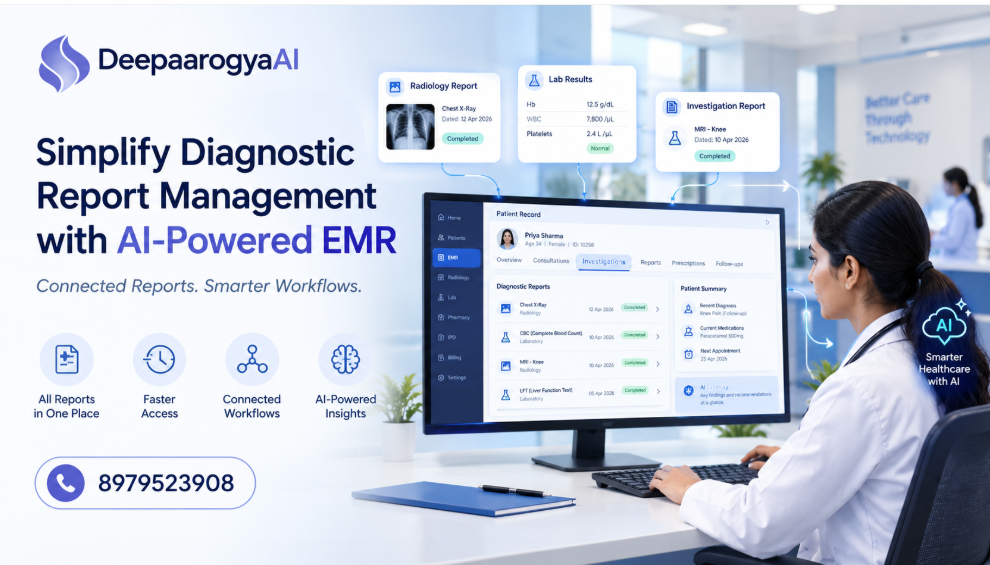
DeepaarogyaAI brings EMR together with OPD, IPD, radiology, pharmacy, billing, physiotherapy, nutrition, e-prescriptions and AI-assisted healthcare workflows around a connected patient record.
The question is:
How can EMR make diagnostic report management simpler for doctors, staff, and patients?
What Is Diagnostic Report Management?
Diagnostic report management involves more than storing a report.
A healthcare organization may need to manage:
- Laboratory reports
- Radiology reports
- Imaging-related records
- Investigation requests
- Test results
- Previous diagnostic information
- Reports associated with different consultations
- Documents uploaded to a patient’s record
For a single patient, the amount of information can grow significantly over time.
Imagine a patient who has visited a hospital several times.
Their record may contain:
Visit 1 → Blood investigation
Visit 2 → X-ray
Visit 3 → MRI
Visit 4 → Follow-up investigation
Visit 5 → Additional diagnostic report
If these reports are stored separately, finding the relevant information can take additional effort.
An EMR can provide a structured environment where diagnostic information can be associated with the patient’s clinical record.
That changes the workflow from:
Test → Separate Report → Manual Search
to:
Test → Patient Record → Diagnostic Information → Clinical Review
Why Can Diagnostic Reports Become Difficult to Manage?
Healthcare teams deal with a large amount of information every day.
Diagnostic information creates another layer because reports may originate from different departments, systems, or external sources.
Some common challenges include:
1. Reports Are Stored Separately
A report may exist as a PDF, printed document, email attachment, or file in another system.
When doctors need to review it later, staff may have to locate it manually.
2. Previous Reports Can Be Difficult to Find
A patient may have multiple investigations over months or years.
Finding the correct previous report can become time-consuming when records are not organized consistently.
3. Doctors Need Clinical Context
A diagnostic report is rarely useful in complete isolation.
A doctor may need to consider the patient’s:
- Symptoms
- Previous consultation
- Clinical notes
- Diagnosis
- Medications
- Earlier investigations
- Treatment history
The value of the report comes from understanding it within the patient’s broader clinical context.
4. Patients May Carry Reports Between Departments
In fragmented workflows, patients can become the messenger between different parts of the healthcare system.
They may need to carry printed reports, forward files, or explain where a previous investigation was performed.
A connected digital workflow can reduce unnecessary information movement.
How Can an EMR Simplify Diagnostic Report Management?
A well-designed EMR can help organize diagnostic information as part of the patient’s digital record.
Here are some ways this can work.
1. Keep Diagnostic Information With the Patient Record
Instead of storing reports as isolated files, diagnostic information can be associated with the relevant patient record.
For example:
Patient Record
→ Consultation
→ Investigation
→ Diagnostic Report
→ Prescription
→ Follow-up
This makes it easier for authorized healthcare professionals to find relevant information within the patient’s workflow.
DeepaarogyaAI’s platform brings radiology and other healthcare workflows into the broader connected patient-record environment.
2. Make Previous Reports Easier to Access
Consider a patient returning after six months.
The doctor may want to review an earlier investigation before deciding what information is relevant for the current consultation.
With a structured EMR, previous reports can remain part of the patient’s digital history.
Instead of asking:
“Where is the patient’s previous report?”
the workflow can become:
Open Patient Record → Review Previous Investigation → Continue Consultation
This does not replace clinical judgment.
It simply makes the information easier to access.
3. Connect Diagnostic Workflows With Clinical Workflows
Diagnostics should not exist as a completely separate part of healthcare software.
A typical patient journey may look like:
Registration
↓
OPD Consultation
↓
Investigation
↓
Diagnostic Report
↓
Doctor Review
↓
Treatment / Prescription
↓
Follow-Up
When these steps are connected, the diagnostic report becomes part of the patient’s overall clinical workflow rather than an isolated document.
This is particularly relevant for hospitals where patients may interact with OPD, radiology, pharmacy, physiotherapy, billing and other departments during the same care journey.
DeepaarogyaAI’s platform is designed around this broader connected model.
4. Reduce Manual Searching for Healthcare Teams
One of the less visible problems in healthcare is information retrieval.
A doctor may not spend a large amount of time creating a report.
But finding an old report can still take time.
Staff may need to:
- Search folders
- Check patient files
- Look through messages
- Ask another department
- Search another software system
- Contact the diagnostic team
A structured EMR can bring relevant information closer to the point where it is needed.
This can make the workflow more organized without requiring additional manual coordination for every report.
5. Support Different Diagnostic Workflows
Not every healthcare organization handles diagnostics in exactly the same way.
A diagnostic center may focus heavily on investigations.
A multi-specialty hospital may have radiology, laboratory and other diagnostic workflows.
An orthopedic clinic may frequently work with imaging reports.
A physiotherapy practice may need access to relevant diagnostic information from the referring clinical workflow.
Therefore, diagnostic management should ideally fit into the organization’s actual workflow.
DeepaarogyaAI emphasizes configurable healthcare workflows across specialties and departments rather than treating every organization as identical.
Where Does AI Fit Into Diagnostic Report Management?
EMR organizes the information.
AI can potentially help healthcare professionals work with that information more efficiently.
This distinction is important.
AI should not independently diagnose a patient simply because a diagnostic report exists.
Instead, AI can be used for information organization and workflow assistance, with qualified professionals remaining responsible for clinical interpretation and decisions.
For example, AI-assisted workflows can help organize relevant patient information so that a doctor can review the appropriate context more efficiently.
DeepaarogyaAI already combines AI-assisted workflows with EMR and diagnostic-related healthcare modules. Its platform includes AI capabilities such as patient summaries and clinical documentation alongside radiology and other workflows.
The principle is simple:
EMR stores and organizes.
AI assists with information.
The healthcare professional reviews and decides.
What Happens When Diagnostic Information Is Disconnected?
Consider two different workflows.
Fragmented Workflow
Patient
↓
Consultation
↓
Diagnostic Test
↓
Report generated
↓
Report stored elsewhere
↓
Doctor searches for report
↓
Patient explains previous history
↓
Manual review
This can create unnecessary information movement.
Now consider:
Connected Workflow
Patient
↓
EMR
↓
Consultation
↓
Investigation
↓
Diagnostic Report
↓
Patient Record
↓
Doctor Review
↓
Treatment Workflow
↓
Follow-Up
The second approach creates a more structured information flow.
The objective is not simply to add another software feature.
It is to make diagnostic information part of the patient’s broader digital workflow.
How DeepaarogyaAI Approaches Diagnostic Workflows
DeepaarogyaAI positions its platform as an AI-powered healthcare operating environment that brings multiple healthcare functions together.
These include:
- AI-powered EMR
- OPD management
- IPD management
- Radiology
- Pharmacy
- Billing
- Physiotherapy
- Nutrition
- e-Prescriptions
- AI-powered workflows
The platform is built around the concept of keeping healthcare information connected around the patient record.
For diagnostic workflows, this means investigation-related information can exist within the broader healthcare environment instead of being treated as an entirely separate process.
Imagine the workflow:
Patient Registration
↓
Doctor Consultation
↓
Investigation Ordered
↓
Diagnostic Workflow
↓
Report Available
↓
Report Associated With Patient Record
↓
Doctor Reviews Relevant Information
↓
Treatment / Prescription
↓
Follow-Up
The exact workflow can vary by organization, but the underlying principle remains:
Diagnostic information should be available where it is relevant to patient care.
Why This Matters for Multi-Specialty Hospitals
Diagnostic information often crosses departmental boundaries.
A patient may begin with one specialist and later interact with another department.
For example:
Orthopedics
↓
Radiology
↓
Specialist Review
↓
Physiotherapy
↓
Follow-Up
Each stage may require relevant information from the earlier stage.
A connected EMR can provide a common digital information layer for authorized healthcare workflows.
This can be particularly useful when healthcare organizations have multiple departments working around the same patient.
DeepaarogyaAI’s broader platform connects EMR with departments and workflows including radiology, physiotherapy, nutrition, pharmacy and billing.
What Should Clinics Look for in Diagnostic EMR Software?
Before choosing an EMR, healthcare organizations can ask several practical questions.
1. Can diagnostic reports be associated with the correct patient?
Patient identification and record organization are fundamental.
2. Can doctors access previous reports easily?
Historical information should be accessible through an organized workflow.
3. Can diagnostics connect with clinical workflows?
The diagnostic process should not operate as an isolated island.
4. Can multiple departments access relevant information?
Authorized departments should be able to work with the information they need.
5. Can the system support different specialties?
A multi-specialty organization may need different workflows for different departments.
6. Can AI assist without replacing professional review?
AI should support healthcare professionals rather than remove clinical oversight.
7. Can the platform grow with the organization?
As patient volume and departments increase, the system should be able to support broader workflows.
Diagnostic Reports Should Be Part of the Patient Story
A diagnostic report is not just a PDF.
It can represent an important part of a patient’s clinical journey.
When diagnostic information is disconnected, healthcare teams may spend unnecessary time finding, transferring, and organizing information.
When diagnostic information becomes part of a structured EMR workflow, it can become easier to access within the appropriate clinical context.
That is the larger opportunity with modern healthcare technology.
The goal is not simply:
“Store more reports digitally.”
The goal is:
“Make the right diagnostic information easier to access within the patient’s healthcare workflow.”
And when EMR is combined with AI, the system can go beyond storage toward more organized information workflows.
DeepaarogyaAI brings EMR, radiology, OPD, IPD, pharmacy, billing, physiotherapy, nutrition and AI-assisted workflows together around a connected patient-record environment.
The Future of Diagnostic Management Is Connected
Healthcare organizations are generating more digital information than ever.
But more information does not automatically mean better information management.
The real challenge is making information:
Available.
Organized.
Connected.
Relevant.
Accessible at the right point in the workflow.
An EMR can provide the foundation.
Diagnostic workflows can become part of the patient record.
AI can assist with information organization.
And healthcare professionals remain responsible for reviewing information and making clinical decisions.
That is the direction in which modern healthcare software is moving.
For clinics and hospitals looking beyond basic digital record storage, the next question is not simply:
“Do we have an EMR?”
It is:
“Can our EMR connect diagnostic information with the way our healthcare team actually works?”
With DeepaarogyaAI, organizations can explore a connected healthcare environment combining EMR, diagnostic workflows, hospital management and AI-assisted capabilities.
Frequently Asked Questions
1. What is diagnostic report management in an EMR?
Diagnostic report management refers to organizing investigation-related information within a patient’s digital healthcare record so authorized healthcare professionals can access relevant reports and information as part of the clinical workflow.
2. Can EMR store diagnostic reports?
An EMR can provide a structured environment for storing and associating diagnostic information with patient records. The exact file types and integrations depend on the platform and implementation.
3. How can EMR help doctors access previous diagnostic reports?
A structured EMR can keep previous diagnostic information associated with the patient’s record, making it easier for authorized professionals to locate relevant historical information.
4. Can AI interpret diagnostic reports?
AI can assist with information organization and workflow support, but diagnostic interpretation and clinical decisions should remain under qualified professional oversight.
5. Does DeepaarogyaAI support radiology workflows?
Yes. Radiology is listed among the healthcare workflows supported within DeepaarogyaAI’s broader connected platform.
6. Is DeepaarogyaAI only an EMR?
No. DeepaarogyaAI combines EMR with OPD, IPD, pharmacy, billing, radiology, physiotherapy, nutrition, e-prescriptions and AI-assisted workflows.
7. Can diagnostic information be connected with other departments?
A connected healthcare platform can allow relevant patient information to remain available across authorized workflows. DeepaarogyaAI’s platform is designed around this connected patient-record approach.
8. Can DeepaarogyaAI support specialty-specific workflows?
DeepaarogyaAI describes configurable workflows across different specialties and healthcare organizations, allowing workflows to be adapted to organizational requirements.
Ready to Make Diagnostic Workflows More Connected?
Your diagnostic reports should not become isolated files that disappear into folders.
They should be part of the patient’s organized digital healthcare journey.
Explore DeepaarogyaAI and see how AI-powered EMR and connected healthcare workflows can fit into your clinic or hospital.
Website: https://www.deepaarogya.com/
Phone: +91 89795 23908