
A patient may visit a clinic with a problem that requires another specialist.
A general physician may refer a patient to an orthopedic specialist. An orthopedic doctor may refer the patient for physiotherapy. A specialist may recommend radiology or another clinical service before the next consultation.
The referral itself may take only a few minutes.
But managing everything between the referral and the next consultation can become surprisingly complicated.
Was the referral created?
Did the patient receive the referral information?
Was the specialist appointment scheduled?
Did the referred doctor receive the relevant patient context?
Was the consultation completed?
Did the report or recommendation return to the original doctor?
For growing clinics, referral management is therefore not simply about sending a patient somewhere else. It is about creating a structured referral-to-consultation workflow so that information and responsibility do not get lost between two healthcare interactions.
This is where connected healthcare technology such as DeepaarogyaAI can help clinics organize the workflow around the patient record rather than relying on disconnected communication and manual tracking.
What Is a Referral-to-Consultation Workflow?
A referral-to-consultation workflow covers the steps between identifying the need for another healthcare professional and completing that consultation.
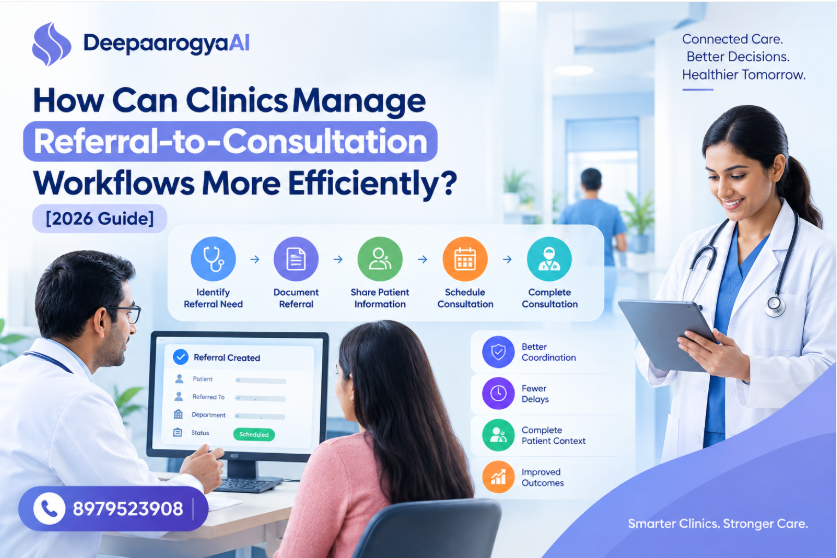
A typical workflow may look like:
Doctor identifies referral need
↓
Referral is documented
↓
Relevant patient information is shared
↓
Patient receives referral instructions
↓
Consultation is scheduled
↓
Specialist reviews available context
↓
Consultation takes place
↓
Findings and recommendations are recorded
↓
Information becomes available for the next stage of care
The exact process differs between clinics.
For example, a small specialty clinic may only need internal referrals, while a larger hospital may have referrals moving between multiple departments and external specialists.
The important part is that the workflow should make the status and context of the referral visible.
Why Do Referral Workflows Become Difficult?
Referrals often involve more than one person, department, or system.
A doctor may document the referral in an EMR, while the receptionist communicates with the patient through a phone call or WhatsApp. The specialist may receive information through another channel, and the outcome may later return as a separate report.
This creates several potential gaps.
1. Referral information can become fragmented
The reason for referral may be documented in the patient’s record, but other relevant information may remain somewhere else.
The specialist may then need to ask the patient for information that was already available to the referring clinic.
2. Referral status may be unclear
A clinic may know that a patient was referred but not immediately know whether:
- The patient received the referral
- An appointment was scheduled
- The consultation happened
- The specialist provided recommendations
- The patient needs another step
Without structured tracking, referrals can become difficult to monitor.
3. Important clinical context may not travel with the patient
A referral is more useful when the receiving doctor has the relevant context behind it.
That could include previous consultation information, investigation reports, prescriptions, or the reason for referral.
The objective isn’t to send every piece of patient information to everyone.
It is to make relevant information available to the appropriate healthcare professional.
What Does an Efficient Referral Workflow Look Like?
A well-organized referral workflow does not necessarily require a complicated process.
It requires clear stages.
Stage 1: Identify the Referral
During consultation, the doctor determines that another specialist, department, or service is required.
The referral reason should be documented as part of the patient’s clinical workflow.
Stage 2: Capture the Referral in the Patient Record
Instead of maintaining referral details in a separate notebook or spreadsheet, the referral should remain associated with the patient’s digital record.
This creates a reference point for the clinic team.
Stage 3: Provide the Patient With Clear Next Steps
The patient should understand:
- Why the referral was recommended
- Which specialist or department they need to consult
- What they may need to carry
- Whether an appointment needs to be scheduled
- What the next step is after the consultation
Clear communication can make the referral process easier for both patients and staff.
Stage 4: Schedule the Consultation
The next consultation can then be connected to the referral workflow.
This is particularly useful when the clinic manages multiple doctors, departments, or specialties.
Stage 5: Give the Receiving Doctor Relevant Context
The specialist should have access to the information appropriate for the consultation.
A connected patient record can help avoid treating the referral as an entirely new patient interaction.
Stage 6: Record the Outcome
After the consultation, the findings, recommendations, prescriptions, or next steps can become part of the patient’s ongoing record, depending on the clinic’s workflow and permissions.
This creates a more complete chain:
Referral → Consultation → Outcome → Next Step
Why Is Referral Tracking Important for Growing Clinics?
As patient volume increases, informal processes become harder to maintain.
A doctor may remember a referral made earlier in the day.
A receptionist may remember that a patient was supposed to contact another specialist.
But when dozens or hundreds of patients are moving through the clinic, relying entirely on memory or manual communication becomes difficult.
A structured workflow gives the team a clearer picture of where referrals stand.
For example:
| Referral Stage | What the Clinic Needs to Know |
|---|---|
| Referral created | Why was the patient referred? |
| Referral communicated | Has the patient received the information? |
| Appointment pending | Does the patient still need to schedule? |
| Consultation scheduled | When is the specialist visit? |
| Consultation completed | Has the referral been acted upon? |
| Outcome recorded | What did the specialist recommend? |
| Next step | What happens now? |
The purpose is not to create more administrative work.
It is to make the existing workflow more visible and organized.
How Can a Connected EMR Support Referral Workflows?
A referral works better when it is part of the broader patient record rather than an isolated administrative activity.
DeepaarogyaAI is designed around a connected patient record that brings together workflows such as EMR, OPD, IPD, pharmacy, billing, radiology, physiotherapy and nutrition.
This creates an important foundation for referral management.
For example:
Initial Consultation
↓
Referral Documented
↓
Relevant Patient Context
↓
Specialist Consultation
↓
Updated Patient Record
↓
Next Clinical Step
Instead of creating a completely separate information trail for every referral, the clinic can maintain continuity around the patient record.
How Can Clinics Reduce Manual Referral Coordination?
Referral coordination often involves small administrative tasks.
Staff may need to:
- Check patient details
- Locate previous reports
- Communicate appointment information
- Share relevant documents
- Update referral status
- Record consultation outcomes
- Inform the original doctor
When these tasks are handled through disconnected tools, staff may spend considerable time moving information from one place to another.
A connected healthcare platform can help organize these workflows within the broader digital environment.
DeepaarogyaAI also supports integrations such as WhatsApp workflows, Google Drive, Google Calendar, Google Meet and Google Docs, which can be useful depending on the clinic’s configured workflow.
The specific referral process should still be configured around the clinic’s actual operations rather than assuming every practice needs the same workflow.
Where Can AI Fit Into Referral Management?
AI does not need to make the referral decision.
That remains a healthcare professional’s responsibility.
Instead, AI can assist with documentation and information organization around the referral workflow.
For example, AI-assisted workflows can help create structured summaries from available patient information, subject to professional review.
A possible workflow is:
Patient information
↓
AI-assisted summary/draft
↓
Doctor reviews
↓
Referral or consultation documentation
↓
Final record
DeepaarogyaAI’s AI workflows include tools such as SOAP, Visit Summary and Patient Summary, with AI-generated outputs intended for professional review rather than autonomous diagnosis. Deepaarogya AI Blogs
This distinction is important.
AI can assist the workflow. The healthcare professional remains in control.
Referral Management Is More Than Appointment Scheduling
One common mistake is treating a referral as simply:
“Send patient to another doctor.”
In practice, a referral can involve several information exchanges.
The referring doctor needs to communicate the reason.
The patient needs clear instructions.
The receiving doctor needs relevant context.
The clinic may need to know whether the consultation occurred.
The patient’s record may need to reflect the specialist’s recommendations.
Therefore, a stronger referral workflow considers the complete lifecycle of the referral.
Referral created
What is the reason?
Referral communicated
Does the patient know what to do next?
Referral scheduled
Has the consultation been arranged?
Referral completed
Did the patient meet the specialist?
Referral outcome
What information came back?
Next action
Does the patient return to the original doctor, begin treatment, undergo an investigation, or continue with another specialist?
This is where structured workflow design becomes valuable.
How DeepaarogyaAI Can Support a Referral-Centric Workflow
DeepaarogyaAI is positioned as an AI Hospital OS for Indian clinics and hospitals, bringing multiple healthcare workflows together around a connected patient record. Deepaarogya AI Blogs
For referral-related workflows, the value can come from combining several capabilities rather than relying on a standalone referral tool.
🩺 Connected EMR
Maintain relevant clinical information within the patient’s electronic record.
📋 OPD Workflows
Connect referral decisions with the consultation workflow.
🩻 Radiology
Keep relevant imaging workflows and reports associated with the patient record.
💊 Pharmacy
Keep prescriptions and medication-related information within the broader patient context.
💗 Physiotherapy
Support specialty workflows when a referral leads to rehabilitation or therapy.
🤖 AI-Assisted Documentation
Use AI-generated drafts and summaries where appropriate, with professional review.
📱 Digital Communication
Use supported communication workflows such as WhatsApp where configured for the clinic.
🔗 Integrations
Connect relevant tools and information sources where required by the clinic’s workflow.
The goal is not to add another isolated referral application.
It is to make the referral part of the patient’s broader digital workflow.
7 Practical Ways to Improve Referral-to-Consultation Workflows
1. Define clear referral stages
Create standard stages such as:
Created → Communicated → Scheduled → Completed → Outcome Recorded
This gives staff a common workflow language.
2. Keep referral information connected to the patient
Avoid maintaining critical referral information only in spreadsheets, paper notes, or informal messages.
3. Standardize referral documentation
Create structured fields for information such as referral reason, specialty, relevant clinical context and next step.
4. Give the receiving doctor relevant information
Avoid sending unnecessary information while ensuring that important context is available.
5. Track incomplete referrals
A referral that has been created but never completed should remain visible to the appropriate team.
6. Record the outcome
The referral workflow should not end when the patient reaches another doctor.
The outcome can be important for the patient’s continuing care.
7. Review the workflow periodically
Clinic managers can examine where referrals are getting delayed or where staff repeatedly perform manual steps.
The objective is continuous workflow improvement rather than simply digitizing an inefficient process.
Common Referral Management Mistakes
❌ Treating every referral as a separate patient record
This can create unnecessary fragmentation.
❌ Using informal communication as the only tracking mechanism
Messages can communicate information, but they should not necessarily become the only source of referral status.
❌ Not defining who owns the next step
If nobody knows whether the patient, receptionist, referring doctor, or specialist is responsible for the next action, referrals can stall.
❌ Sending too much or too little information
The receiving professional needs relevant context, not an unstructured dump of the entire patient history.
❌ Forgetting the outcome
A referral should ideally have a clear endpoint or next step.
A Simple Referral Workflow Checklist for Clinics
Before implementing or improving a referral workflow, ask:
Referral Creation
- Is the referral reason documented?
- Is the destination specialty clear?
- Is the next step defined?
Patient Communication
- Does the patient know where to go?
- Do they know what to do next?
- Are relevant instructions available?
Consultation
- Can the receiving doctor access appropriate patient context?
- Is the consultation recorded?
Outcome
- Is the specialist’s recommendation documented?
- Is the next action clear?
- Can the referring team access relevant information?
Tracking
- Can staff identify pending referrals?
- Can completed referrals be distinguished from incomplete ones?
If several answers are “no,” the problem may not be the referral itself.
It may be the workflow around the referral.
Why Referral Workflows Matter for the Future of Connected Healthcare
Healthcare is increasingly moving from isolated software applications toward connected digital workflows.
A patient does not experience healthcare as separate software modules.
They experience:
Appointment → Consultation → Referral → Investigation → Specialist → Treatment → Follow-Up
For clinics, the challenge is connecting these stages without creating unnecessary administrative complexity.
That requires more than an EMR.
It requires workflows that help information move with the patient while keeping healthcare professionals in control.
DeepaarogyaAI’s approach combines EMR, operational workflows, specialty modules, integrations and AI-assisted capabilities around a connected patient record. Deepaarogya AI Blogs
For clinics exploring referral workflow improvements, the first step is therefore not necessarily buying another referral tool.
It is understanding:
Where does the referral start, where does it go, who handles each step, what information needs to move, and how does the clinic know the referral is complete?
Once those questions are clear, technology can be configured around the actual workflow.
Conclusion
An effective referral process is not simply about sending a patient from one doctor to another.
It is about maintaining continuity between the referral and the next consultation.
When referral information, appointments, clinical context and outcomes are handled through disconnected processes, staff can spend more time coordinating information.
A structured digital workflow can provide greater visibility into what has happened, what is pending, and what needs to happen next.
With a connected healthcare platform such as DeepaarogyaAI, clinics can bring relevant EMR, OPD, specialty, documentation, communication and integration workflows into a broader digital environment. Deepaarogya AI Blogs
The goal is simple: make every referral a connected step in the patient’s care journey—not another information gap.
Ready to explore a more connected healthcare workflow?
Explore DeepaarogyaAI: https://www.deepaarogya.com/
Book a Demo: https://calendar.google.com/calendar/u/0/appointments/schedules/AcZssZ0vSKKPxgfM4xlTbdYy6tpV9-iXMfsKmiOK87Q7JtKd3RWIndSlKV-CPisfq2AtrXm8Xywsc57a
Call: 8979523908
DeepaarogyaAI — One Platform. Complete Care.
FAQs
1. What is referral-to-consultation workflow management?
It is the process of managing the steps from identifying a referral need through scheduling, specialist consultation, documentation and the next clinical action.
2. Why should referral information remain connected to the patient record?
Keeping relevant referral information within the patient record can help the appropriate healthcare team access context without creating a completely separate information trail.
3. Can AI manage referrals independently?
AI should not independently make clinical referral decisions. AI can instead assist with suitable documentation and summarization workflows, while healthcare professionals review and approve outputs.
4. Can DeepaarogyaAI support specialty workflows?
DeepaarogyaAI supports workflows including EMR, OPD, radiology, physiotherapy, nutrition, pharmacy and other healthcare operations, with workflows configurable around different practice requirements.
5. Can referral workflows be customized?
The appropriate workflow depends on the clinic’s operations. DeepaarogyaAI emphasizes configurable workflows rather than requiring every specialty to operate in exactly the same way.
6. What should clinics track after creating a referral?
Clinics can define stages such as referral creation, communication, scheduling, consultation completion, outcome documentation and the next action.
7. How can clinics identify referral bottlenecks?
Reviewing pending referrals, scheduling delays, incomplete documentation and unclear ownership of next steps can help identify where the workflow needs improvement.