
Running a modern clinic or multi-specialty hospital involves much more than the doctor-patient consultation.
A patient may begin with a front-desk registration, move to an OPD consultation, require laboratory or radiology investigations, continue with physiotherapy or nutrition support, receive medicines from the pharmacy, and finally complete billing and follow-up.
The challenge is that each department may handle a different part of the same patient journey.
When patient information is scattered across paper files, messaging apps, spreadsheets, and disconnected software, teams may spend unnecessary time searching for information or entering it again.
A connected patient record brings these workflows together.
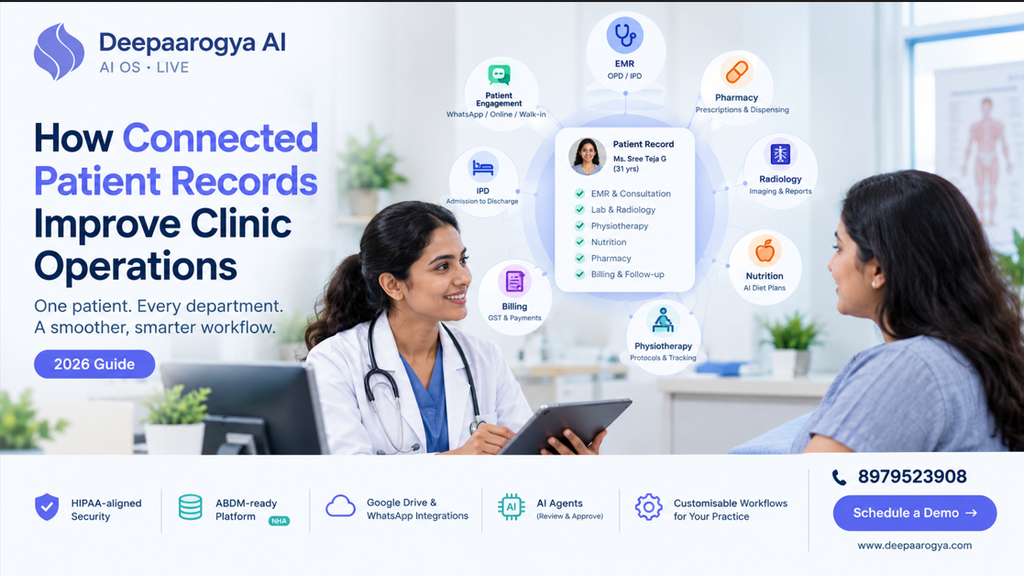
With Deepaarogya AI, EMR, OPD, IPD, pharmacy, billing, physiotherapy, nutrition, radiology, e-prescriptions, and AI-assisted workflows can work from the same patient record.
What Is a Connected Patient Record?
A connected patient record is a digital patient record that can be accessed and updated across relevant departments instead of keeping information isolated in separate systems.
For example, a patient’s:
- Demographics
- Vitals
- Diagnosis
- Clinical notes
- Physiotherapy information
- Nutrition information
- Medicines
- Laboratory information
- Radiology reports
- Billing information
- Follow-up details
can remain associated with the same patient journey.
This reduces the need to repeatedly enter the same information into different systems.
Deepaarogya AI describes this approach as “one record, every department,” with EMR, OPD, IPD, pharmacy, and billing sharing the same patient record.
Why Disconnected Systems Create Operational Problems
Many clinics gradually accumulate different tools for different tasks.
One application may handle appointments. Another may be used for billing. Patient reports may be stored in email or Google Drive, while communication happens through WhatsApp.
Individually, these tools can be useful.
The difficulty appears when the information needs to move between them.
1. Repeated Data Entry
When departments work independently, staff may have to enter patient information multiple times.
This can consume staff time and introduce inconsistencies.
A connected record allows information entered during one stage of the patient journey to remain available to the relevant departments.
2. Information Gaps Between Departments
A doctor may need to know what happened during a previous physiotherapy session.
A dietitian may need access to relevant patient vitals.
The pharmacy may need the latest prescription.
Radiology reports may need to be accessible from the patient’s clinical record.
When information is stored separately, staff have to locate it manually.
3. Slower Patient Movement
Healthcare workflows often involve several handoffs.
If every handoff requires a phone call, paper file, message, or manual data transfer, the patient journey can become unnecessarily fragmented.
A connected patient record gives different teams access to the information relevant to their workflow.
4. Difficulty Maintaining a Complete Patient History
A patient record is more useful when it represents the patient’s journey rather than a single consultation.
Connecting clinical, operational, and departmental information can give the healthcare team a more continuous view of the patient’s interactions with the clinic.
How Deepaarogya AI Connects the Patient Journey
Deepaarogya AI is designed around the idea that every input and output should remain connected to one patient chart.
The platform maps the patient journey from engagement and intake through consultation, coordination, billing, and follow-up.
1. Patient Engagement
The journey can begin through:
- Online booking
- Clinic walk-in
This gives the clinic multiple ways to bring a patient into the workflow.
2. Patient Intake
During intake, the system can capture information such as:
- Demographics
- Vitals
- Habits
- Body composition
This information becomes part of the patient’s digital record.
3. Consultation
The consultation stage can use:
- EMR case sheets
- SOAP AI
- Specialty-specific desks
The platform also supports specialty workflows for areas such as orthopedics, ENT, physiotherapy, nutrition, and multi-specialty practices.
4. Department Coordination
This is where a connected record becomes particularly valuable.
Laboratory, radiology, physiotherapy, nutrition, and pharmacy workflows can remain associated with the same patient record.
Instead of creating a separate information trail for every department, the clinic can work around a shared chart.
5. Billing and Follow-Up
The journey can continue into:
- GST billing
- Package billing
- Payments
- Appointment reminders
- Medicine follow-ups
- Next-visit reminders
Deepaarogya connects these activities to the same EMR chart.
One Patient Chart, Multiple Departments
Consider a patient visiting an orthopedic clinic.
The front desk registers the patient and the doctor records the consultation.
The patient then requires imaging and physiotherapy.
In a disconnected setup, each department may maintain its own information.
With a connected patient record, the patient’s clinical information can remain linked across the workflow.
The case sheet can contain sections for:
- Diagnosis
- Vitals
- Clinical information
- Investigations
- Treatment
- Physiotherapy
- Medicine
- Follow-up
Deepaarogya’s case-sheet workflow is designed so different departments can work from the same patient record without repeated entry.
This means the record becomes more than an electronic version of a paper file.
It becomes a shared operational layer for the clinic.
Connecting Clinical and Operational Workflows
A healthcare platform should not only store clinical notes.
The operational side of healthcare is equally important.
Deepaarogya AI combines clinical and operational modules including:
EMR
Structured electronic medical records for different specialties.
OPD & Token Queue
Digital token queues, visit intake, and doctor workflows.
IPD & Case Sheets
Admission-to-discharge workflows, orders, and nursing notes.
Pharmacy
Inventory, dispensing, and prescriptions connected to the EMR.
Billing & GST
Package billing, partial payments, and GST-ready reporting.
Physiotherapy
Protocol tracking, outcomes, team assignment, and session billing.
Nutrition AI
AI-generated diet plans that are reviewed by clinicians.
Radiology
Imaging orders, queues, and reports linked to the patient chart.
e-Prescription
One-click prescription generation with WhatsApp delivery after clinician sign-off.
These modules are presented as parts of the same connected platform rather than isolated systems.
How AI Adds Another Layer to the Patient Record
A connected record also provides a foundation for AI-assisted workflows.
Deepaarogya AI includes agents for tasks such as:
- Discharge summaries
- Nutrition
- Voice reception
- WhatsApp follow-up
- Visit summaries
- SOAP notes
The platform states that these AI outputs remain in review, with the healthcare team reviewing and approving them before they are used with patients.
For example, the SOAP Agent can create structured SOAP-note drafts from the workflow, while the clinician remains responsible for review.
Similarly, the Nutritional Agent can support diet-plan creation using information available through the patient’s record.
The objective is not to replace the clinical team.
It is to reduce repetitive administrative and documentation work while keeping clinicians in control.
Google Drive and WhatsApp Without Creating Separate Silos
Connected workflows do not necessarily mean abandoning tools that clinics already use.
Deepaarogya AI supports integrations designed to keep commonly used workflows connected to the patient record.
Google Drive Patient Sync
Clinical files such as:
- X-rays
- Surgery photos
- Lab PDFs
- Reports
can be linked to the appropriate patient chart while remaining stored in the hospital’s own Google Drive.
WhatsApp e-Prescription
Clinicians can generate an e-prescription and send it to the patient through WhatsApp after sign-off.
WhatsApp Follow-Up
Appointment reminders, medicine follow-ups, and revisit nudges can be automated from the same EMR chart.
Google Meet
Telemedicine consultations can be connected with the patient’s EMR record.
Google Calendar
OPD slots and follow-ups can be synchronized with the team’s calendar.
This approach helps clinics connect existing digital workflows rather than creating another isolated system.
What Does This Mean for Clinic Staff?
The biggest benefit of a connected patient record is not simply having more software.
It is reducing unnecessary movement of information.
For Front-Desk Teams
The team can work with digital registration, token queues, appointments, and patient information instead of depending entirely on paper-based processes.
For Doctors
Clinical information, investigations, prescriptions, and relevant departmental information can remain accessible through the patient’s chart.
For Physiotherapists
Protocols, outcomes, team assignments, and session billing can be connected to the patient’s record.
For Dietitians
Nutrition workflows can use relevant information from the patient’s record, while AI-generated drafts remain available for clinician review.
For Pharmacy Teams
Prescriptions and dispensing workflows can remain connected to the EMR.
For Billing Teams
Billing information can remain part of the broader patient workflow rather than being isolated from clinical activity.
Why Connected Records Matter as Clinics Grow
A small clinic may initially manage information using a combination of spreadsheets, paper records, messaging applications, and separate software.
As the clinic grows, however, the number of:
- Patients
- Doctors
- Departments
- Staff members
- Visits
- Services
- Records
also increases.
This is where fragmented workflows can become increasingly difficult to coordinate.
Deepaarogya AI is designed for multi-specialty, orthopedic, chronic-disease, physiotherapy, nutrition, and other practices across India, with workflows configured around the clinic’s actual operations.
Instead of forcing every practice into the same workflow, the platform emphasizes customization across OPD, IPD, physiotherapy, nutrition, and billing.
Connected Records and Better Workflow Visibility
Another important advantage is visibility.
When different departments work from a connected record, clinic administrators can see more of the patient journey in one place.
For example:
Patient registration → Consultation → Investigation → Treatment → Physiotherapy/Nutrition → Pharmacy → Billing → Follow-up
Instead of each stage existing as a separate information trail, the stages can be connected.
That can make it easier for teams to understand where a patient currently is in the workflow and what needs to happen next.
Security and Access Control
Connecting more information also makes appropriate access controls important.
Deepaarogya AI states that its platform includes:
- ABDM-ready workflows
- HIPAA-aligned security practices
- Encryption
- Role-based access
- Desktop and mobile access
Role-based access allows different users, such as doctors, nurses, front-desk staff, pharmacy teams, and administrators, to access information according to their role.
The platform also states that ABHA-linked health records can use consent-based sharing.
For clinics adopting digital healthcare workflows, security and access should therefore be considered alongside functionality.
How to Start Moving Toward a Connected Clinic Workflow
A clinic does not necessarily need to transform every workflow at once.
A practical approach can begin with the core patient journey.
Step 1: Map Your Current Workflow
Identify how information moves from:
Registration → Consultation → Departments → Billing → Follow-Up
Step 2: Identify Repeated Data Entry
Look for information that staff repeatedly enter into different systems.
Step 3: Identify Department Handoffs
Find points where staff depend on paper files, messages, phone calls, or manual transfers.
Step 4: Connect the Patient Record
Move toward a system where relevant departments can work from the same patient record.
Step 5: Add AI Where It Helps
Once the underlying workflow is connected, AI agents can assist with repetitive documentation and administrative tasks.
Deepaarogya’s deployment process includes workflow mapping, migration of existing patient records, role setup, and team training before AI-assisted workflows are introduced.
The Future of Clinic Operations Is Connected
Healthcare is becoming increasingly digital, but simply adding more software does not necessarily solve workflow problems.
The more important question is:
Can different parts of the clinic work from the same patient information?
A connected patient record brings clinical and operational workflows closer together.
Instead of separate systems for EMR, OPD, pharmacy, billing, physiotherapy, nutrition, radiology, and follow-up, a clinic can build its workflow around a shared patient record.
That is the approach behind Deepaarogya AI.
From the first patient interaction to consultation, coordination, billing, and follow-up, the goal is to keep every input and every output connected to one chart.
Frequently Asked Questions
What is a connected patient record?
A connected patient record is a digital patient record that can be accessed and updated across relevant departments, allowing clinical and operational information to remain connected throughout the patient’s journey.
How is Deepaarogya AI different from a basic EMR?
Deepaarogya AI combines EMR with OPD, IPD, pharmacy, billing, physiotherapy, nutrition, radiology, integrations, and AI agents on a connected patient record.
Can Deepaarogya AI support specialty-specific workflows?
Yes. The platform is designed to be customized for workflows including orthopedics, ENT, physiotherapy, nutrition, and multi-specialty practices.
Can clinics connect Google Drive with Deepaarogya AI?
Yes. Deepaarogya states that patient files such as X-rays, surgery photos, lab PDFs, and reports can be synced from the clinic’s own Google Drive to the relevant patient chart.
Does Deepaarogya AI support WhatsApp?
Yes. The platform supports WhatsApp e-prescriptions as well as appointment, medicine, and revisit reminders connected to the EMR workflow.
Are AI-generated clinical documents automatically sent to patients?
No. Deepaarogya’s AI agents are designed to create drafts for clinician review and approval. Outputs are not sent to patients without sign-off.
Can a clinic customize its workflow?
Yes. Deepaarogya emphasizes customized workflows rather than forcing clinics to use a rigid EMR template.
Final Takeaway
A modern clinic needs more than digital records.
It needs connected workflows.
When the front desk, doctors, physiotherapists, dietitians, pharmacy, radiology, billing, and follow-up teams can work from the relevant information within one connected patient record, the entire patient journey becomes easier to coordinate.
Deepaarogya AI brings these capabilities together through a connected healthcare platform designed for clinics and multi-specialty hospitals across India.
Ready to see how a connected workflow could fit your clinic?
Schedule a complimentary workflow optimization consultation with the Deepaarogya AI deployment team.
Explore: https://www.deepaarogya.com/
Book a Demo: https://calendar.google.com/calendar/u/0/appointments/schedules/AcZssZ0vSKKPxgfM4xlTbdYy6tpV9-iXMfsKmiOK87Q7JtKd3RWIndSlKV-CPisfq2AtrXm8Xywsc57a