
A patient’s healthcare journey does not end when the doctor completes a consultation.
Behind the scenes, clinics and hospitals also have to manage billing, insurance information, payments, documentation, packages, and financial records.
When these workflows are handled separately, even a digitally enabled clinic can end up with disconnected information.
A doctor may document a service.
The billing team may record it separately.
The insurance desk may need supporting information.
The patient may then have to provide the same details again.
This creates a bigger question:
Can clinics connect clinical information with billing and insurance workflows without adding more administrative complexity?
This is where an integrated healthcare platform can help.
DeepaarogyaAI positions its platform around a connected patient record that brings together EMR, OPD, IPD, pharmacy, billing, physiotherapy, nutrition, radiology, e-prescriptions and AI-powered workflows. Its website also lists Insurance AI as part of the platform. deepaarogya.com
The goal is not to let AI make financial or clinical decisions independently.
Instead, AI can help teams organize information, identify items requiring attention, and reduce repetitive administrative work, while healthcare professionals and authorized staff remain responsible for review and approval.
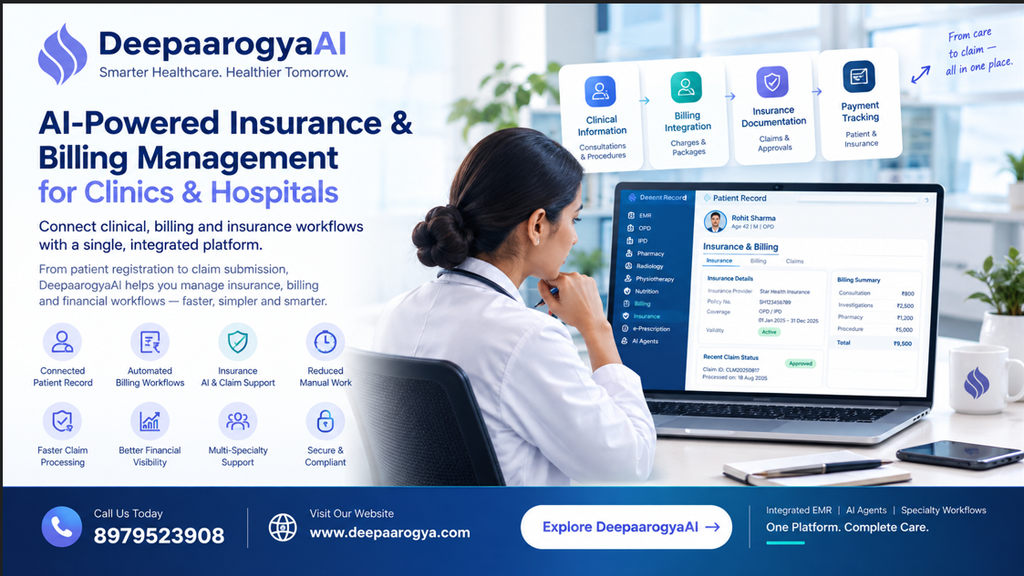
What Is Connected Insurance & Billing Management in Healthcare?
In a traditional workflow, different teams may maintain different parts of a patient’s financial and clinical information.
For example:
Doctor → Clinical notes
Billing team → Invoice
Pharmacy → Medication charges
Diagnostics → Investigation charges
Insurance team → Claim documentation
When these workflows are disconnected, staff may need to repeatedly collect and reconcile information.
A connected healthcare platform takes a different approach.
The patient’s activities can remain associated with the same digital patient record.
This can create a workflow such as:
Registration → Consultation → Investigation → Treatment → Pharmacy → Billing → Insurance → Payment → Follow-up
Instead of treating each stage as an independent process, the information can remain connected around the patient.
Why Do Clinics Struggle With Billing and Insurance Workflows?
Billing and insurance management involve more than generating an invoice.
Healthcare teams may need to coordinate:
- Patient registration details
- Consultation information
- Procedures
- Investigations
- Pharmacy items
- Packages
- Additional services
- Payments
- Insurance details
- Supporting documentation
- Claim-related information
When these details are maintained across different tools, spreadsheets, paper documents, or disconnected applications, reconciliation becomes more difficult.
Common workflow challenges include:
Repeated data entry
The same patient information may need to be entered in multiple places.
Information gaps
Billing or insurance teams may need to contact another department for missing details.
Documentation delays
A claim or financial process may have to wait for supporting information.
Limited visibility
Administrators may not have one place to understand the status of billing and insurance-related workflows.
Manual reconciliation
Teams may spend time comparing information from different records.
The problem isn’t necessarily a lack of software.
It can be a lack of connected workflows.
How Can AI Help With Healthcare Billing and Insurance?
AI can support healthcare financial workflows in several ways.
The important distinction is that AI should assist with information processing and workflow support, while authorized professionals review and approve important decisions.
1. Connect Clinical Information With Billing
A healthcare service begins in the clinical workflow.
For example:
Consultation → Investigation → Procedure → Pharmacy → Follow-up
Each step may generate information relevant to billing.
If these activities are connected to the patient’s record, billing teams can work from information generated during the actual care process rather than relying entirely on separate manual entries.
AI can potentially help identify information that requires reconciliation or review.
For example:
- A documented service that needs billing verification
- An incomplete package
- Missing information
- Differences between records
- Items requiring staff attention
This can give billing teams a more structured review process.
2. Make Insurance Documentation More Organized
Insurance workflows often require information from multiple parts of the patient record.
Depending on the case, teams may need to review:
- Diagnosis
- Treatment
- Procedures
- Investigations
- Medications
- Admission details
- Discharge documentation
- Billing information
When this information is scattered, staff may have to manually collect it.
An AI-assisted workflow can help organize available information into a structured draft or summary for review.
The process can look like:
Patient Record
↓
Relevant Clinical Information
↓
AI-Assisted Summary
↓
Staff/Clinician Review
↓
Final Documentation
This approach keeps human oversight in the workflow.
3. Reduce Repeated Data Entry
Imagine a patient has already provided their basic information during registration.
If the same information must then be entered again for billing or insurance, staff are doing work that technology could potentially reduce.
A connected patient record can allow relevant information to flow between workflows.
For example:
Registration
↓
Patient details
↓
OPD
↓
Consultation information
↓
Billing
↓
Financial information
↓
Insurance
↓
Relevant documentation
The objective is not to duplicate data across departments.
It is to let authorized teams work with the appropriate information from the connected record.
4. Help Teams Identify Missing Information
Insurance and billing processes can sometimes be delayed because information is incomplete.
An AI-assisted system can help identify records that may need additional review.
For example:
Before submission
Patient information ✓
Diagnosis information ✓
Treatment information ✓
Investigation information ✓
Supporting documentation ⚠ Review required
Instead of discovering the issue later, the team can investigate it earlier.
AI should not automatically decide that a claim is valid or invalid.
It can help bring potentially incomplete areas to the attention of the appropriate team.
5. Create Better Visibility Into Financial Workflows
A connected healthcare platform can also help administrators understand what is happening across the organization.
For example, management may need visibility into:
- Billing activity
- Outstanding payments
- Insurance-related workflows
- Department activity
- Collection information
- Operational trends
DeepaarogyaAI has also published material describing AI dashboards for clinical, operational and financial visibility. Deepaarogya AI Blogs
This type of visibility can help administrators move from manually collecting reports toward reviewing information in a more centralized environment.
6. Connect Pharmacy and Diagnostics With Billing
Healthcare billing does not exist only inside the billing department.
A patient’s journey may include:
Doctor consultation
↓
Laboratory investigation
↓
Radiology
↓
Pharmacy
↓
Procedure
↓
Billing
Each department can generate information relevant to the overall patient record.
DeepaarogyaAI brings workflows including pharmacy, radiology, billing and clinical records into its broader platform.
When these workflows are connected, teams have a stronger foundation for coordinating information.
7. Support Different Healthcare Organizations
Billing and insurance workflows differ depending on the organization.
A single-doctor clinic may have a relatively simple process.
A multi-specialty hospital may have:
- Multiple departments
- OPD and IPD
- Pharmacy
- Diagnostics
- Procedures
- Insurance desk
- Multiple billing rules
- Different staff roles
This is why healthcare software needs to support different workflows rather than assuming every organization operates in exactly the same way.
DeepaarogyaAI describes its platform as being built for multi-specialty, orthopedic, chronic-disease and other practices across India, with OPD, IPD, pharmacy, billing, physiotherapy and nutrition workflows on one patient record.
A Traditional vs AI-Assisted Workflow
Traditional disconnected workflow
Doctor
↓
Clinical documentation
↓
Separate billing system
↓
Manual information checking
↓
Insurance desk
↓
Additional document collection
↓
Claim preparation
↓
Manual follow-up
This can create multiple points where information needs to be transferred manually.
Connected AI-assisted workflow
Patient Record
↓
Consultation
↓
Investigation / Treatment
↓
Billing
↓
AI-assisted information organization
↓
Insurance workflow
↓
Human review
↓
Final submission / payment workflow
The second approach does not remove people from the process.
Instead, it aims to reduce unnecessary information movement between systems.
Why the Patient Record Is the Foundation
AI is only useful when it has appropriate information to work with.
A standalone AI tool may require staff to manually collect patient information before every task.
That can create another administrative layer.
A connected EMR provides a different foundation.
For example, a patient’s record can contain:
Clinical
- Medical history
- Consultation notes
- Diagnoses
- Treatment information
Diagnostic
- Laboratory reports
- Radiology information
- Investigation history
Medication
- Prescriptions
- Pharmacy information
Financial
- Billing
- Payments
- Package information
Follow-up
- Previous visits
- Future care requirements
When relevant information is connected, AI-assisted workflows can operate within a broader healthcare context.
How DeepaarogyaAI Approaches Insurance & Billing Workflows
DeepaarogyaAI describes itself as an AI Operating System for clinics and hospitals, with EMR, OPD, IPD, pharmacy, billing, physiotherapy, nutrition and other workflows built around an ABDM-ready patient record. Its website also lists Insurance AI among its platform capabilities. deepaarogya.com
The broader ecosystem includes:
🩺 EMR
Digital patient records and specialty-focused clinical workflows.
🧑⚕️ OPD
Patient intake and consultation workflows.
🛏️ IPD
Hospital admission and inpatient workflows.
💊 Pharmacy
Prescription and medication workflows.
🩻 Radiology
Imaging-related workflows connected with patient information.
🧾 Billing
Billing workflows associated with the broader patient record.
🛡️ Insurance AI
AI-assisted insurance-related workflows.
🤖 AI Workflows
AI capabilities for documentation, summaries and other healthcare processes.
The key idea is connection.
Instead of adding another isolated insurance application, insurance-related workflows can be part of the larger healthcare information ecosystem.
What Should Clinics Look for in Healthcare Billing & Insurance Software?
Before selecting a platform, healthcare organizations should evaluate several factors.
1. Connected Patient Records
Can clinical, billing and other relevant information work from a shared patient record?
2. Role-Based Access
Can different healthcare roles access the information appropriate to their responsibilities?
3. AI With Human Review
Does AI produce information that authorized staff can review and approve?
4. Specialty Support
Can the platform accommodate different clinical departments and workflows?
5. Reporting and Visibility
Can administrators understand billing and operational activity without manually combining multiple reports?
6. Workflow Customization
Can the system adapt to how the organization actually operates?
7. Data Export and Integrations
Can the platform work with the organization’s broader digital ecosystem?
These questions are often more important than simply asking whether software has an “AI” label.
AI Should Assist the Insurance Workflow—Not Replace Accountability
Healthcare financial processes require accuracy and oversight.
A useful AI workflow should therefore follow a human-in-the-loop model.
AI can help:
Collect relevant information
Organize records
Identify potential gaps
Prepare drafts
Surface items for review
Authorized professionals should:
Verify information
Correct errors
Approve documentation
Make financial or clinical decisions
Complete final submissions where required
This balance allows organizations to use automation without removing professional accountability.
The Future of Healthcare Billing Is Connected
Healthcare organizations are generating more digital information every day.
But simply storing more information does not automatically make operations easier.
The next step is connecting that information across workflows.
Imagine:
One patient
↓
One connected record
↓
Multiple departments
↓
Clinical + operational + financial information
↓
AI-assisted workflows
↓
Human review
This model can help healthcare teams work with information more systematically.
For clinics and hospitals, the opportunity is not just to digitize billing.
It is to create a connected financial workflow around the patient record.
Conclusion
Billing and insurance management are deeply connected to the clinical workflow.
A consultation generates clinical information.
Investigations generate reports.
Pharmacy generates medication records.
Procedures generate service information.
And all of these can contribute to the financial and insurance workflow.
When every department works separately, staff may spend significant time collecting, re-entering and reconciling information.
A connected healthcare platform can bring these workflows together.
AI can then assist with organizing information, identifying potential gaps and preparing structured outputs for human review.
DeepaarogyaAI brings EMR, OPD, IPD, pharmacy, radiology, billing, specialty workflows and AI capabilities into one connected healthcare environment. deepaarogya.com
The future of healthcare billing is not simply more automation.
It is better-connected information and smarter workflows.
Ready to explore connected healthcare management?
🌐 Visit: https://www.deepaarogya.com/
📞 Call: 8979523908
🚀 Book a Demo: [Add Demo Link]
Frequently Asked Questions
1. What is AI-powered insurance management in healthcare?
It refers to using AI to assist with organizing patient, clinical, billing and insurance-related information and identifying areas that may require review.
2. Can AI automate hospital billing?
AI can assist with parts of the billing workflow, such as organizing information and identifying potential inconsistencies. Final financial decisions and approvals should remain with authorized personnel.
3. How can connected EMR help insurance teams?
A connected EMR can make relevant clinical and patient information available within the appropriate workflow, reducing the need to repeatedly collect information from separate systems.
4. Can AI identify missing insurance documentation?
AI-assisted workflows can help flag potentially incomplete information for staff review. The final verification should be performed by the appropriate healthcare or insurance team.
5. Does DeepaarogyaAI have Insurance AI?
Yes. DeepaarogyaAI’s current website lists Insurance AI among its platform capabilities.
6. Can billing and pharmacy workflows be connected?
DeepaarogyaAI describes pharmacy and billing as part of its broader healthcare platform built around a connected patient record.
7. Is AI replacing insurance or billing staff?
AI-assisted healthcare workflows are designed to support repetitive information-management tasks. Human staff remain important for verification, approvals, exceptions and accountability.