
Introduction
Electronic Medical Records (EMRs) have become essential for modern healthcare practices. However, not all EMRs are created equal. While general EMRs are designed to serve multiple specialties, orthopedic clinics have unique workflows, documentation requirements, imaging needs, and treatment plans that demand specialized functionality.
Choosing the right orthopedic EMR can significantly improve physician productivity, patient outcomes, and clinic profitability. In this article, we’ll compare must-have orthopedic EMR features with standard general EMRs and explain why specialty-specific solutions provide a competitive advantage.
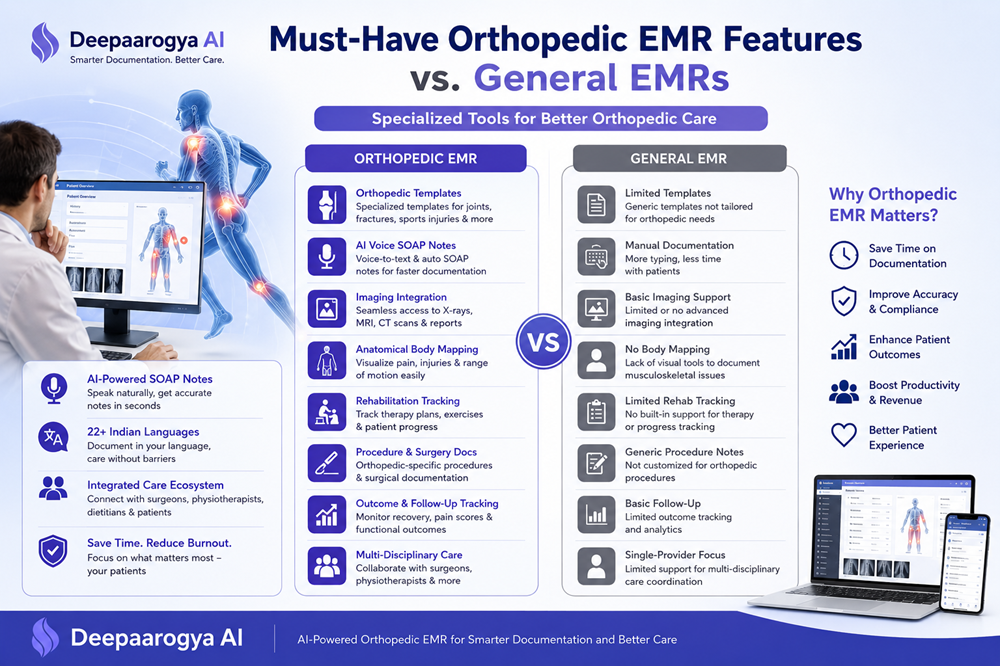
Why General EMRs Often Fall Short for Orthopedics
General EMRs are built to accommodate a broad range of specialties, including family medicine, pediatrics, dermatology, and internal medicine. While they offer basic charting and patient management capabilities, they often lack orthopedic-specific tools.
Common challenges include:
- Excessive manual documentation
- Generic SOAP note templates
- Limited musculoskeletal examination workflows
- Poor integration with imaging studies
- Time-consuming procedure documentation
- Inadequate support for rehabilitation tracking
As a result, orthopedic physicians spend more time documenting and less time treating patients.
Must-Have Features in an Orthopedic EMR
1. Specialty-Specific Orthopedic Templates
Orthopedic practices require documentation tailored to musculoskeletal conditions.
A quality orthopedic EMR should include:
- Joint examination templates
- Fracture assessment forms
- Sports injury documentation
- Post-operative follow-up templates
- Physical therapy progress tracking
These templates reduce charting time while maintaining clinical accuracy.
2. Voice-Powered Clinical Documentation
Orthopedic physicians often see high patient volumes, making documentation a major burden.
Modern orthopedic EMRs should provide:
- AI voice-to-text transcription
- Automatic SOAP note generation
- Real-time clinical documentation
- Hands-free charting
This allows physicians to focus on patient care rather than typing notes.
3. Imaging and Radiology Integration
Imaging is central to orthopedic diagnosis and treatment planning.
An orthopedic-focused EMR should seamlessly integrate:
- X-rays
- MRI reports
- CT scans
- Ultrasound imaging
Physicians should be able to access and review imaging studies directly within the patient chart.
4. Procedure and Surgery Documentation
Orthopedic clinics frequently perform procedures such as:
- Joint injections
- Fracture reductions
- Arthroscopy
- Knee replacement surgery
- Hip replacement surgery
The EMR should include customizable procedure templates and surgical documentation workflows to streamline record-keeping.
5. Anatomical Body Mapping
Unlike general EMRs, orthopedic systems should offer visual body diagrams that allow physicians to:
- Mark pain locations
- Document injuries
- Track recovery progress
- Record range-of-motion findings
Visual documentation improves clinical communication and patient understanding.
6. Rehabilitation and Physiotherapy Tracking
Orthopedic care often extends beyond surgery or medication.
An advanced orthopedic EMR should support:
- Physical therapy plans
- Exercise recommendations
- Rehabilitation progress monitoring
- Functional outcome assessments
This creates continuity between orthopedic surgeons, physiotherapists, and patients.
7. Fast SOAP Note Generation
Documentation is one of the biggest productivity challenges in orthopedic practices.
Orthopedic-specific EMRs should automate:
- Subjective findings
- Objective examination results
- Assessment generation
- Treatment plans
This can reduce note-writing time from 10–15 minutes to just a few minutes per patient.
8. Follow-Up and Outcome Tracking
Orthopedic treatment often requires multiple visits over months.
Key tracking capabilities include:
- Recovery milestones
- Pain scores
- Mobility assessments
- Surgical outcomes
- Rehabilitation adherence
These insights help physicians evaluate treatment effectiveness.
9. Multi-Disciplinary Care Coordination
Orthopedic patients frequently interact with multiple healthcare providers, including:
- Orthopedic surgeons
- Physiotherapists
- Dietitians
- Sports medicine specialists
An ideal EMR should facilitate collaboration among all stakeholders involved in patient care.
10. Automated Prescription and Clinical Workflow Support
Orthopedic physicians prescribe medications, braces, rehabilitation plans, and diagnostic tests regularly.
The EMR should support:
- E-prescriptions
- Investigation ordering
- Follow-up scheduling
- Treatment plan generation
Automation improves efficiency and reduces administrative workload.
General EMRs vs Orthopedic EMRs: Quick Comparison
| Feature | General EMR | Orthopedic EMR |
|---|---|---|
| Orthopedic Templates | Limited | Comprehensive |
| Imaging Integration | Basic | Advanced |
| Body Mapping | Rare | Standard |
| Rehabilitation Tracking | Limited | Built-in |
| Procedure Documentation | Generic | Specialty-Specific |
| AI SOAP Notes | Sometimes | Optimized |
| Orthopedic Workflow Support | Minimal | Extensive |
| Multi-Disciplinary Care | Basic | Specialized |
How Deepaarogya AI Helps Orthopedic Clinics
At Deepaarogya AI, we understand the unique documentation and workflow challenges faced by orthopedic practices.
Our AI-powered EMR platform is specifically designed to help orthopedic clinics improve efficiency and patient care through:
AI Audio SOAP Notes
Doctors can simply speak during consultations, and the platform automatically generates structured SOAP notes.
Support for 22+ Indian Languages
Physicians can document patient encounters in multiple regional languages, making clinical documentation easier and more accurate.
Custom Orthopedic Templates
Create specialty-specific templates for:
- Knee injuries
- Hip disorders
- Spine conditions
- Sports medicine
- Post-operative follow-ups
Integrated Care Ecosystem
Deepaarogya AI connects:
- Orthopedic surgeons
- Physiotherapists
- Dietitians
- Patients
within a single platform, ensuring seamless care coordination.
Faster Documentation
Reduce charting time significantly while maintaining high-quality clinical records.
Conclusion
While general EMRs can manage basic patient records, they often fail to meet the specialized requirements of orthopedic practices. Features such as orthopedic-specific templates, imaging integration, rehabilitation tracking, body mapping, and AI-powered documentation are no longer optional—they are essential for efficient patient care.
Investing in an orthopedic-focused EMR can improve productivity, reduce physician burnout, enhance patient outcomes, and streamline clinic operations. Solutions like Deepaarogya AI are helping orthopedic clinics embrace AI-powered documentation and connected care to build the future of orthopedic healthcare.
FAQs (Frequently Asked Questions)
1. What is the difference between an orthopedic EMR and a general EMR?
Orthopedic EMRs include specialty-specific templates, imaging integration, rehabilitation tracking, and musculoskeletal documentation tools that general EMRs often lack.
2. Why do orthopedic clinics need specialized EMR software?
Specialized EMRs streamline orthopedic workflows, reduce documentation time, improve accuracy, and enhance patient care.
3. Can AI generate orthopedic SOAP notes automatically?
Yes. AI-powered EMRs like Deepaarogya AI can generate SOAP notes from physician conversations and clinical encounters.
4. How does imaging integration benefit orthopedic practices?
It allows physicians to access X-rays, MRIs, CT scans, and radiology reports directly within patient records, improving clinical decision-making.
5. Does Deepaarogya AI support regional Indian languages?
Yes. Deepaarogya AI supports documentation in 22+ Indian languages, making it easier for doctors to record patient encounters naturally.