
Introduction
Healthcare organizations today face increasing pressure to deliver better patient outcomes while managing complex operational workflows. Many hospitals and clinics still rely on disconnected software systems for electronic medical records, billing, laboratory management, patient communication, physiotherapy tracking, and administrative operations. This fragmentation often results in inefficiencies, increased costs, and clinician burnout.
The next evolution in healthcare technology is the AI-Powered Hospital Operating System (Hospital OS)—a unified platform that connects clinical care, operations, financial management, and patient engagement through artificial intelligence.
What is an AI-Powered Hospital Operating System?
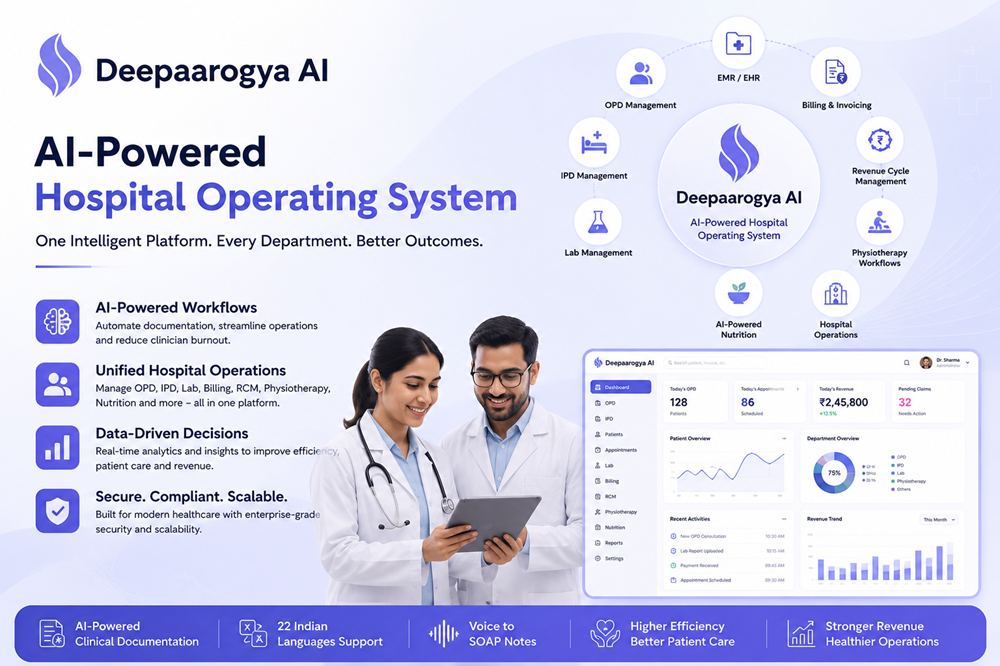
An AI-Powered Hospital Operating System is a comprehensive digital platform that manages every aspect of healthcare delivery from a single ecosystem. Unlike traditional EMRs or Hospital Management Systems (HMS), a Hospital OS integrates clinical workflows, operational processes, revenue management, and AI-driven automation into one intelligent platform.
A modern Hospital OS typically includes:
- Electronic Medical Records (EMR/EHR)
- Outpatient Department (OPD) Management
- Inpatient Department (IPD) Management
- Laboratory Information Management
- Billing and Invoicing
- Revenue Cycle Management (RCM)
- Appointment Scheduling
- Physiotherapy Management
- Nutrition and Diet Planning
- AI Clinical Documentation
- Analytics and Reporting
- Patient Engagement Tools
Why Traditional EMRs Are No Longer Enough
Most EMRs were designed primarily to store patient records. While they help digitize documentation, they often fail to address the broader operational challenges faced by healthcare organizations.
Common limitations include:
- Excessive manual data entry
- Siloed departmental systems
- Inefficient billing workflows
- Limited patient engagement capabilities
- Lack of automation in clinical documentation
- Poor coordination between departments
As healthcare organizations grow, these limitations can significantly impact productivity and patient satisfaction.
How AI is Transforming Hospital Operations
Artificial Intelligence is changing healthcare beyond diagnostics. AI now plays a critical role in administrative and operational efficiency.
AI-Powered Clinical Documentation
Doctors spend a significant portion of their day creating clinical notes. AI can automatically convert doctor-patient conversations into structured SOAP notes and specialty-specific documentation.
Intelligent Workflow Automation
AI can automate:
- Patient registration
- Appointment scheduling
- Billing workflows
- Follow-up reminders
- Clinical documentation
- Report generation
Revenue Optimization
AI-driven revenue cycle management helps reduce claim errors, improve collections, and accelerate payment processing.
Data-Driven Decision Making
Advanced analytics provide administrators with real-time insights into:
- Patient flow
- Department performance
- Revenue trends
- Resource utilization
- Clinical outcomes
How Deepaarogya AI Functions as an AI-Powered Hospital Operating System
Deepaarogya AI is designed to go beyond the traditional EMR model by providing a comprehensive AI-powered Hospital Operating System that connects every major function of a healthcare organization.
Unified EMR and EHR Platform
Deepaarogya AI centralizes patient records, ensuring healthcare providers have instant access to complete patient histories, treatment plans, prescriptions, and reports.
OPD and IPD Management
The platform streamlines both outpatient and inpatient workflows, improving coordination between departments and reducing administrative overhead.
AI-Powered Medical Documentation
Deepaarogya AI’s voice-enabled documentation system can automatically generate structured clinical notes from doctor-patient conversations.
Key benefits include:
- Faster documentation
- Reduced physician burnout
- Improved clinical accuracy
- Consistent note quality
Support for 22 Indian Languages
Healthcare providers can communicate naturally while Deepaarogya AI converts conversations into structured medical records, making documentation accessible across diverse healthcare settings in India.
Laboratory Integration
The platform integrates laboratory workflows, enabling seamless test ordering, report management, and result tracking.
Revenue Cycle Management
Deepaarogya AI helps healthcare organizations improve financial performance through:
- Automated billing workflows
- Faster claim processing
- Improved revenue tracking
- Reduced payment delays
Physiotherapy Workflow Management
Unlike generic healthcare software, Deepaarogya AI supports physiotherapy-specific workflows, helping therapists track patient progress, treatment plans, and rehabilitation outcomes.
AI-Powered Nutrition Management
Nutrition professionals can create and manage personalized diet plans while collaborating directly with physicians and physiotherapists through a unified patient record.
Connected Care Ecosystem
Deepaarogya AI enables collaboration between:
- Doctors
- Physiotherapists
- Dietitians
- Administrative Staff
- Billing Teams
This integrated approach improves continuity of care and enhances patient outcomes.
Benefits of an AI-Powered Hospital Operating System
Improved Clinical Efficiency
Automation reduces administrative burden and allows clinicians to focus more on patient care.
Better Patient Experience
Faster registration, streamlined appointments, and coordinated care improve overall patient satisfaction.
Increased Revenue
Optimized billing and revenue cycle management contribute to stronger financial performance.
Reduced Physician Burnout
AI-generated documentation significantly reduces charting time and after-hours paperwork.
Scalability
A unified Hospital OS supports growth across clinics, specialty centers, and multi-location hospital networks.
The Future of Healthcare Technology
Healthcare is rapidly moving from isolated software systems toward integrated, AI-driven platforms. Organizations that adopt AI-Powered Hospital Operating Systems will be better positioned to improve operational efficiency, enhance patient care, and remain competitive in an increasingly digital healthcare landscape.
Conclusion
The future of healthcare is not simply about digitizing records—it is about creating intelligent, connected healthcare ecosystems. An AI-Powered Hospital Operating System combines clinical workflows, operational management, financial processes, and artificial intelligence into a single platform.
Deepaarogya AI is helping healthcare providers make this transition by bringing together EMR/EHR, OPD, IPD, laboratory management, billing, revenue cycle management, physiotherapy workflows, nutrition management, and AI-powered documentation into one unified solution.
For hospitals and clinics looking to modernize their operations, improve efficiency, and deliver better patient experiences, the AI-Powered Hospital Operating System is the next step forward.
Frequently Asked Questions (FAQs)
1. What is an AI-Powered Hospital Operating System?
An AI-Powered Hospital Operating System is a unified healthcare platform that manages clinical, administrative, operational, and financial workflows using artificial intelligence. It integrates EMR/EHR, OPD, IPD, billing, laboratory management, revenue cycle management, and patient engagement into a single system.
2. How is an AI-Powered Hospital Operating System different from an EMR?
An EMR primarily focuses on storing and managing patient medical records. An AI-Powered Hospital Operating System goes beyond record management by connecting hospital operations, billing, laboratories, patient communication, revenue management, and AI-driven automation within one platform.
3. Is Deepaarogya AI an EMR or a Hospital Management System (HMS)?
Deepaarogya AI is positioned as an AI-Powered Hospital Operating System. It combines EMR/EHR, OPD, IPD, Lab Management, Billing, Revenue Cycle Management, Physiotherapy Workflows, Nutrition AI, and Hospital Operations into a single intelligent platform.
4. What are the benefits of using an AI-Powered Hospital Operating System?
Key benefits include:
- Reduced administrative workload
- Faster clinical documentation
- Improved patient experience
- Better revenue management
- Enhanced interdepartmental collaboration
- Reduced physician burnout
- Data-driven decision making
5. How does AI improve hospital operations?
AI automates repetitive tasks such as appointment scheduling, medical documentation, billing, claims processing, patient follow-ups, and analytics. This helps hospitals operate more efficiently while allowing clinicians to focus on patient care.
6. Can AI generate medical notes automatically?
Yes. Modern AI systems can convert doctor-patient conversations into structured clinical notes such as SOAP notes, progress notes, and specialty-specific templates, significantly reducing documentation time.
7. How does Deepaarogya AI help reduce physician burnout?
Deepaarogya AI offers AI-powered voice documentation that automatically creates clinical notes from consultations. This reduces manual charting time and allows healthcare providers to spend more time with patients.
8. Does Deepaarogya AI support multiple Indian languages?
Yes. Deepaarogya AI supports voice-based clinical documentation in 22 Indian languages, helping healthcare providers document patient encounters naturally and efficiently.
9. Can physiotherapists and dietitians use Deepaarogya AI?
Absolutely. Deepaarogya AI includes dedicated physiotherapy workflows and Nutrition AI modules, enabling multidisciplinary collaboration among doctors, physiotherapists, and dietitians.
10. How does Deepaarogya AI improve hospital revenue management?
Deepaarogya AI streamlines billing, claim processing, payment tracking, and revenue cycle management, helping healthcare organizations reduce claim errors and improve collections.
11. Is Deepaarogya AI suitable for small clinics and large hospitals?
Yes. Deepaarogya AI is designed to scale from individual clinics and specialty practices to multi-specialty hospitals and healthcare networks.
12. What modules are included in Deepaarogya AI Hospital Operating System?
The platform includes:
- EMR/EHR
- OPD Management
- IPD Management
- Lab Management
- Billing & Invoicing
- Revenue Cycle Management
- AI Medical Documentation
- Physiotherapy Management
- Nutrition AI
- Analytics & Reporting
- Hospital Operations Dashboard
13. Why are hospitals moving toward AI-powered healthcare software?
Hospitals are adopting AI-powered solutions to improve efficiency, reduce operational costs, enhance patient outcomes, automate documentation, and gain actionable insights from healthcare data.
14. What should hospitals look for in an AI-Powered Hospital Operating System?
Hospitals should evaluate:
- AI documentation capabilities
- Workflow automation
- EMR/EHR integration
- Billing and RCM features
- Multi-department support
- Analytics and reporting
- Scalability
- Security and compliance
15. What is the future of hospital management software?
The future of hospital management lies in AI-powered platforms that unify clinical care, operations, finance, and patient engagement into a single intelligent ecosystem, enabling smarter and more efficient healthcare delivery.