
Orthopedic specialists are among the busiest clinicians in healthcare. Every patient encounter requires detailed documentation of symptoms, physical examination findings, imaging results, diagnoses, treatment plans, and follow-up recommendations.
Unfortunately, much of a doctor’s time is often spent typing rather than treating patients.
Voice recognition technology is changing that.
Modern AI-powered voice recognition solutions are helping orthopedic clinics reduce documentation burden, improve note quality, and create a more efficient patient experience.
The Documentation Challenge in Orthopedics
Orthopedic consultations involve extensive documentation, including:
- Patient history
- Injury mechanisms
- Pain assessments
- Range of motion findings
- Joint examinations
- Imaging interpretations
- Surgical recommendations
- Rehabilitation plans
- Follow-up instructions
Traditional documentation methods require physicians to manually enter all this information into an EMR, often extending clinic hours and contributing to physician burnout.
What Is Voice Recognition in Healthcare?
Voice recognition technology converts spoken conversations into structured clinical documentation.
Instead of typing every detail, orthopedic doctors can simply speak naturally during or after a consultation. Advanced AI systems then transform those conversations into organized medical notes.
Today’s AI-powered voice recognition goes beyond simple transcription. It understands medical terminology, clinical context, and specialty-specific workflows.
The result is faster, more accurate documentation with significantly less effort.
Benefits of Voice Recognition for Orthopedic Practices
Faster Clinical Documentation
Doctors can complete notes in minutes instead of spending valuable time typing detailed patient encounters.
This allows clinicians to focus more on patient care and less on administrative work.
Improved Patient Interaction
When physicians are not constantly looking at a computer screen, they can maintain better eye contact and communication with patients.
This leads to improved patient satisfaction and stronger doctor-patient relationships.
Better Documentation Quality
Voice-enabled systems capture more clinical details than rushed manual typing.
Comprehensive notes support better clinical decision-making, continuity of care, and legal documentation.
Reduced Physician Burnout
Administrative workload is one of the leading causes of physician burnout.
Automating documentation allows orthopedic specialists to reclaim time and improve work-life balance.
How AI Voice Recognition Works in Orthopedics
Modern AI systems can:
- Listen to patient-doctor conversations
- Identify orthopedic terminology
- Generate SOAP notes automatically
- Capture examination findings
- Suggest diagnoses and ICD codes
- Create treatment plans
- Generate follow-up summaries
Instead of simply producing transcripts, AI converts conversations into structured clinical documentation that is ready for review.
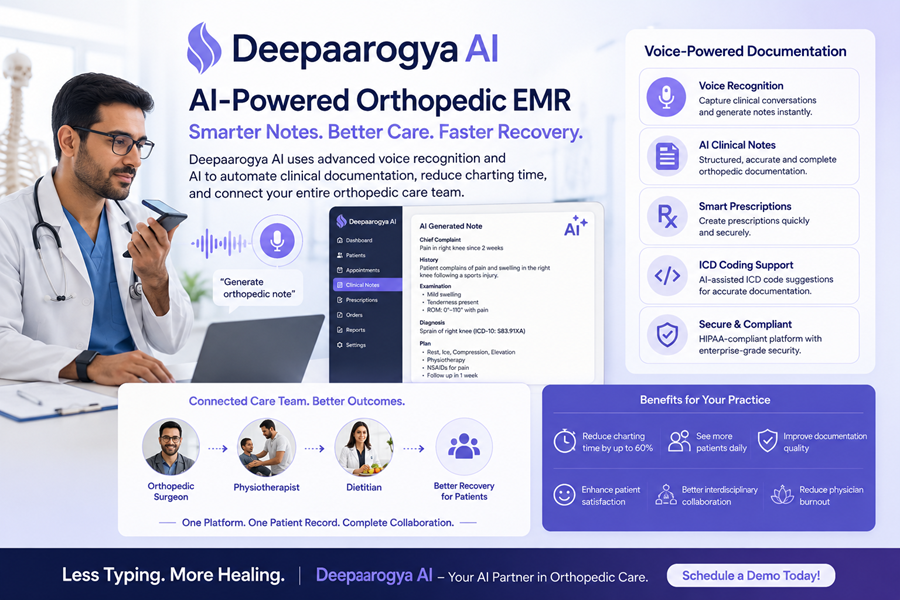
Deepaarogya AI: Voice-Powered Orthopedic Documentation
Deepaarogya AI brings advanced voice recognition directly into orthopedic workflows.
Our AI-powered EMR helps doctors create clinical notes automatically from spoken interactions, reducing charting time and improving documentation consistency.
AI-Generated Orthopedic Notes
Doctors can dictate findings naturally while Deepaarogya AI converts them into structured clinical records.
Smart Clinical Documentation
The platform organizes information into meaningful sections such as:
- Chief Complaint
- History
- Examination Findings
- Diagnosis
- Treatment Plan
- Follow-Up Recommendations
Faster Prescription Generation
Voice-assisted documentation can seamlessly connect with prescription workflows, reducing repetitive data entry.
ICD Coding Assistance
Deepaarogya AI helps clinicians generate documentation aligned with appropriate ICD codes, improving billing and insurance readiness.
Beyond Documentation: Connected Orthopedic Care
Orthopedic recovery rarely involves a single healthcare professional.
Patients often require coordinated care from:
- Orthopedic Surgeons
- Physiotherapists
- Dietitians
- Rehabilitation Specialists
Deepaarogya AI connects all these stakeholders within a unified AI-powered EMR.
Physiotherapy Integration
Physiotherapists can access treatment plans, update rehabilitation progress, and document recovery milestones within the same patient record.
Dietitian Collaboration
Dietitians can contribute nutritional recommendations for bone health, recovery, and weight management while remaining connected to the patient’s overall treatment journey.
Unified Patient Records
Every team member works from a shared patient timeline, ensuring better communication and continuity of care.
The Future of Orthopedic Documentation
Voice recognition is rapidly becoming the preferred documentation method for modern healthcare practices.
As AI technology continues to improve, orthopedic clinics will increasingly rely on intelligent voice-powered systems to automate note creation, reduce administrative burden, and improve patient outcomes.
The future is not about typing faster.
The future is about letting AI handle documentation while doctors focus on what matters most—caring for patients.
Conclusion
Voice recognition technology is transforming orthopedic documentation by making note creation faster, more accurate, and less burdensome.
With Deepaarogya AI’s voice-enabled EMR, orthopedic practices can reduce charting time, improve collaboration between doctors, physiotherapists, and dietitians, and deliver a better experience for both clinicians and patients.
As healthcare continues to evolve, AI-powered voice documentation will become an essential tool for every forward-thinking orthopedic practice.
Voice Recognition in Orthopedics
1. What is voice recognition in orthopedic documentation?
Voice recognition technology converts a doctor’s spoken words into structured clinical notes, reducing the need for manual typing during patient consultations.
2. How does voice recognition help orthopedic doctors?
It helps orthopedic doctors create notes faster, reduce administrative workload, improve documentation quality, and spend more time with patients.
3. Can AI generate orthopedic notes from voice recordings?
Yes. Modern AI systems can convert clinical conversations into structured orthopedic notes, SOAP notes, treatment plans, and follow-up summaries.
4. Is voice recognition accurate for orthopedic terminology?
Advanced healthcare voice recognition systems are trained on medical vocabulary and can accurately recognize orthopedic terms, diagnoses, procedures, and anatomical references.
5. Does voice recognition reduce charting time?
Yes. Many clinics report significant reductions in charting time by using voice-powered documentation instead of manual typing.
AI Medical Documentation
6. What is AI-powered medical documentation?
AI-powered medical documentation uses artificial intelligence to automatically create clinical notes, prescriptions, and patient records from doctor-patient interactions.
7. Can AI write SOAP notes automatically?
Yes. AI can generate structured SOAP notes by organizing clinical information into Subjective, Objective, Assessment, and Plan sections.
8. How does AI improve clinical documentation quality?
AI helps standardize notes, capture important details, reduce omissions, and ensure consistent documentation across providers.
9. Is AI documentation suitable for orthopedic clinics?
Yes. Orthopedic clinics often benefit from AI documentation because of the large amount of detailed examination and treatment information that must be recorded.
Orthopedic EMR Software
10. What features should an orthopedic EMR include?
An orthopedic EMR should include clinical documentation, imaging integration, voice recognition, prescription management, ICD coding, rehabilitation tracking, and patient follow-up management.
11. Why do orthopedic clinics need a specialized EMR?
Orthopedic practices have unique workflows involving musculoskeletal examinations, surgeries, rehabilitation, and imaging that require specialized documentation tools.
12. Can orthopedic EMRs improve clinic efficiency?
Yes. Modern orthopedic EMRs automate repetitive tasks, streamline workflows, and reduce documentation time.
ICD Coding & Insurance Documentation
13. Can AI help with ICD coding in orthopedics?
Yes. AI can suggest relevant ICD codes based on clinical documentation, helping improve coding accuracy and insurance claim readiness.
14. How does better documentation improve insurance approvals?
Complete and accurate documentation supports medical necessity, reduces claim denials, and improves reimbursement outcomes.
15. Can voice-generated notes support medical billing?
Yes. Structured voice-generated notes can improve coding accuracy and provide better support for billing and reimbursement processes.
Physiotherapy & Care Coordination
16. How can orthopedic surgeons collaborate with physiotherapists through an EMR?
A shared EMR allows physiotherapists to access treatment plans, document progress, and communicate directly with orthopedic specialists.
17. Why is physiotherapy integration important in orthopedic care?
Recovery often depends on rehabilitation progress. Integrated records ensure everyone involved in patient care stays aligned.
18. Can dietitians be connected to orthopedic patient records?
Yes. Integrated EMR systems allow dietitians to contribute nutritional plans that support bone healing and recovery.
19. What are the benefits of a shared patient record?
Shared records improve communication, reduce duplication of information, and provide a complete view of patient care.
Deepaarogya AI Related FAQs
20. What is Deepaarogya AI?
Deepaarogya AI is an AI-powered healthcare platform that helps doctors automate documentation, generate clinical notes, manage patient records, and coordinate multidisciplinary care.
21. Does Deepaarogya AI support voice-powered clinical documentation?
Yes. Deepaarogya AI enables doctors to create structured clinical notes using voice recognition and AI-assisted documentation.
22. Can Deepaarogya AI connect orthopedic surgeons, physiotherapists, and dietitians?
Yes. Deepaarogya AI provides a unified patient record that supports collaboration across the entire orthopedic care team.
23. How does Deepaarogya AI reduce physician burnout?
By automating repetitive documentation tasks and reducing charting time, doctors can focus more on patient care and less on administrative work.
24. Is Deepaarogya AI suitable for multi-specialty clinics?
Yes. The platform is designed to support collaboration across multiple healthcare departments while maintaining a unified patient record.