
Orthopedic specialists spend a significant portion of their day documenting patient encounters instead of focusing on patient care. From recording detailed musculoskeletal examinations to documenting treatment plans, rehabilitation progress, imaging findings, and follow-up notes, charting can consume valuable clinical time.
The challenge becomes even greater when multiple departments such as physiotherapy, nutrition, and rehabilitation services are involved in a patient’s recovery journey.
Why Orthopedic Documentation Takes So Much Time
Orthopedic consultations typically require detailed documentation, including:
- Patient history and chief complaints
- Physical examination findings
- Range of motion assessments
- Imaging interpretations
- Diagnosis and ICD coding
- Treatment plans
- Surgical notes
- Follow-up recommendations
- Rehabilitation progress tracking
Many orthopedic clinics still rely on manual data entry, resulting in longer consultation times, physician burnout, and incomplete records.
The Hidden Cost of Manual Charting
When doctors spend excessive time documenting:
- Patient waiting times increase
- Fewer patients can be seen each day
- Documentation errors become more common
- Follow-up coordination suffers
- Physician burnout increases
- Revenue opportunities are lost
For growing orthopedic practices, reducing charting time is no longer a convenience—it’s a necessity.
How AI-Powered EMRs Can Help
Artificial Intelligence is transforming healthcare documentation by automating repetitive tasks and generating structured clinical notes in seconds.
With AI-assisted charting, orthopedic doctors can:
- Generate consultation notes automatically
- Create SOAP notes instantly
- Capture examination findings using voice input
- Suggest diagnoses and ICD codes
- Generate prescriptions faster
- Maintain standardized documentation
- Reduce administrative workload
This allows clinicians to spend more time treating patients and less time typing.
Deepaarogya AI: Designed for Orthopedic Workflows
Deepaarogya AI offers an AI-powered EMR specifically built to simplify clinical documentation and care coordination.
Our platform helps orthopedic clinics reduce charting time through:
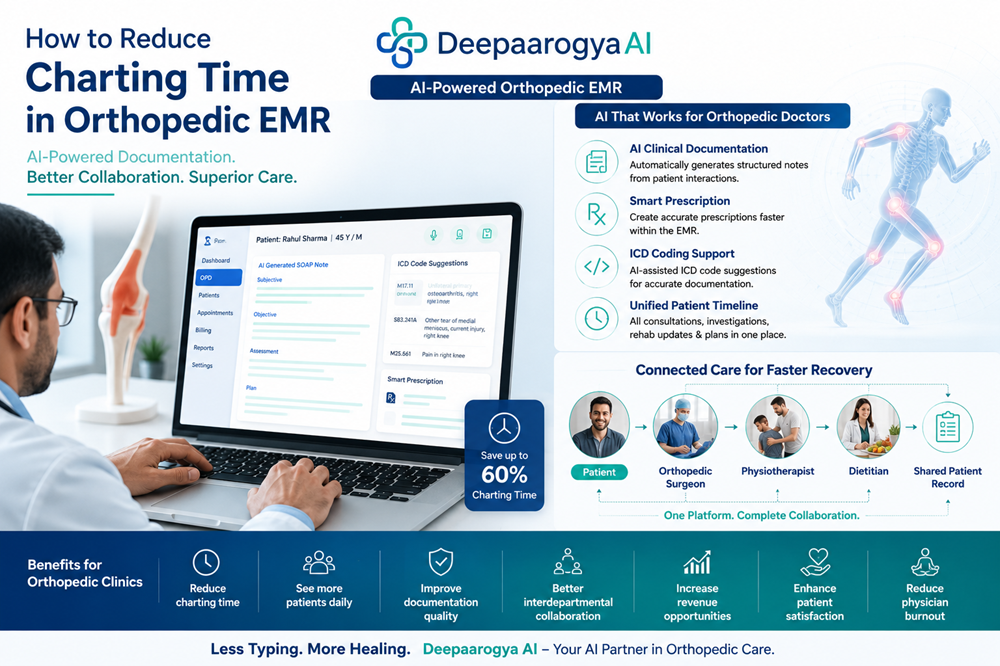
AI Clinical Documentation
Deepaarogya AI automatically generates structured consultation notes from clinical interactions, reducing manual documentation effort and improving consistency.
Smart Prescription Generation
Doctors can generate prescriptions quickly while maintaining complete clinical records within the EMR.
Automated ICD Coding Support
Accurate coding is essential for billing, insurance claims, and analytics. Deepaarogya AI assists clinicians with documentation aligned to appropriate ICD codes.
Unified Patient Timeline
Every consultation, prescription, investigation, rehabilitation update, and treatment plan is organized in a single patient record.
Connecting the Entire Orthopedic Care Team
Successful orthopedic treatment extends beyond the doctor’s consultation room.
Recovery often requires collaboration among:
- Orthopedic Surgeons
- Physiotherapists
- Dietitians
- Rehabilitation Specialists
- Care Coordinators
Traditional systems create information silos between these departments, forcing patients to repeat information multiple times.
Deepaarogya AI solves this challenge by connecting the entire care ecosystem through a single AI-powered platform.
Seamless Physiotherapy Integration
Physiotherapists can update rehabilitation progress, exercise compliance, mobility assessments, and treatment outcomes directly within the patient’s record.
Dietitian Collaboration
Dietitians can provide nutrition plans for post-surgical recovery, weight management, bone health, and chronic orthopedic conditions while keeping recommendations accessible to the entire care team.
Better Patient Engagement
Patients receive coordinated care because every provider has access to the latest treatment updates, ensuring continuity throughout the recovery journey.
Benefits for Orthopedic Clinics
Clinics using an integrated AI-powered orthopedic EMR can experience:
- Reduced charting time
- Faster patient consultations
- Improved documentation quality
- Better interdisciplinary collaboration
- Enhanced patient satisfaction
- Improved insurance claim readiness
- Higher operational efficiency
- Reduced physician burnout
The Future of Orthopedic Practice Management
As patient volumes continue to grow, orthopedic clinics need technology that reduces administrative burden while improving care quality.
AI-powered documentation combined with seamless coordination between orthopedic specialists, physiotherapists, and dietitians represents the future of integrated musculoskeletal care.
Deepaarogya AI is helping clinics move toward that future by transforming documentation from a time-consuming task into an automated, intelligent workflow.
Conclusion
Reducing charting time is not just about saving minutes—it is about creating more time for patient care, improving clinical outcomes, and enabling better collaboration across the entire care team.
With Deepaarogya AI’s integrated EMR platform, orthopaedic practices can streamline documentation, connect multidisciplinary teams, and deliver a superior patient experience from diagnosis to recovery.
Frequently Asked Questions (FAQs)
1. What is an orthopedic EMR?
An orthopedic EMR (Electronic Medical Record) is a specialized healthcare software designed to manage patient records, consultation notes, imaging reports, treatment plans, surgeries, and rehabilitation workflows for orthopedic practices.
2. Why does orthopedic charting take so much time?
Orthopedic documentation often includes detailed physical examinations, range-of-motion assessments, imaging interpretations, diagnoses, prescriptions, and rehabilitation plans. Manual entry of this information can significantly increase consultation time.
3. How can AI reduce charting time in orthopedic clinics?
AI can automatically generate clinical notes, SOAP notes, prescriptions, and ICD coding suggestions from patient interactions, reducing the time doctors spend on documentation and administrative tasks.
4. What is Deepaarogya AI?
Deepaarogya AI is an AI-powered EMR platform that helps healthcare providers automate documentation, generate prescriptions, manage patient records, and improve coordination across different departments involved in patient care.
5. Can Deepaarogya AI generate orthopedic consultation notes automatically?
Yes. Deepaarogya AI can create structured consultation notes and clinical documentation, helping orthopedic doctors complete charting faster while maintaining accuracy and consistency.
6. Does Deepaarogya AI support ICD coding?
Yes. The platform assists healthcare providers with ICD coding recommendations, improving documentation quality and helping with insurance and billing processes.
7. How does Deepaarogya AI connect orthopedic doctors, physiotherapists, and dietitians?
Deepaarogya AI provides a shared patient record where orthopedic surgeons, physiotherapists, and dietitians can access relevant treatment information, update progress, and collaborate seamlessly throughout the patient’s recovery journey.
8. Can physiotherapists update patient progress in the EMR?
Yes. Physiotherapists can document rehabilitation sessions, exercise compliance, mobility improvements, and treatment outcomes directly within the patient’s medical record.
9. Why is dietitian integration important for orthopedic patients?
Proper nutrition plays a critical role in bone healing, post-surgical recovery, weight management, and overall musculoskeletal health. Integrated dietitian notes help ensure coordinated patient care.
10. How does an integrated orthopedic EMR improve patient outcomes?
By allowing all care providers to access the same patient information, communication gaps are reduced, treatment plans stay aligned, and patients receive more coordinated and effective care.
11. Can Deepaarogya AI help reduce physician burnout?
Yes. By automating repetitive documentation tasks and reducing administrative workload, Deepaarogya AI allows doctors to spend more time with patients and less time on paperwork.
12. Is Deepaarogya AI suitable for small and large orthopedic clinics?
Yes. Deepaarogya AI is designed to support solo practitioners, multi-specialty clinics, rehabilitation centers, and growing orthopedic practices looking to improve efficiency and patient care.
13. Does Deepaarogya AI support teleconsultation and remote follow-ups?
Yes. The platform can be integrated into modern clinical workflows to support virtual consultations, follow-up management, and continuous patient engagement.
14. How much charting time can AI-powered EMRs save?
The exact time savings depend on the workflow, but many clinics experience significant reductions in documentation time, allowing providers to see more patients while maintaining quality records.
15. How can I schedule a demo of Deepaarogya AI?
You can contact the Deepaarogya AI team to schedule a personalized demonstration and explore how AI-powered orthopedic EMR can streamline your clinic’s operations and patient care processes.
People Also Ask
How do orthopedic clinics reduce documentation burden?
By adopting AI-powered EMRs that automate note generation, coding assistance, prescriptions, and care coordination.
What features should an orthopedic EMR have?
Clinical documentation, imaging integration, prescription management, ICD coding, rehabilitation tracking, and multidisciplinary care coordination.
Can AI write medical notes automatically?
Yes. Modern healthcare AI systems can generate structured clinical notes based on physician input while maintaining documentation standards.
What is the benefit of connecting physiotherapists and dietitians within an EMR?
It improves communication, reduces information silos, and enables coordinated patient care from diagnosis through recovery.
Is AI-powered EMR secure for healthcare practices?
Yes. Reputable AI EMR platforms implement healthcare-grade security, access controls, and data protection measures to safeguard patient information.