
Introduction: Why Cardiology Needs More Than Digital Patient Files
Cardiology departments manage patients who may require repeated consultations, diagnostic investigations, medication reviews, and long-term follow-up. Their care often involves information collected across multiple visits and departments.
Consider a patient who visits a cardiologist with recurring chest discomfort. The doctor reviews the patient’s history, documents symptoms, and examines available diagnostic reports. At a later appointment, the patient returns with additional information from another department.
If the records are scattered across paper files, separate applications, and disconnected departmental systems, retrieving the relevant information can become an administrative challenge.
The problem is not simply storing patient records. It is making relevant information accessible throughout the patient’s healthcare journey.
This is where cardiology-focused Electronic Medical Records (EMR) and a Hospital Management System (HMS) can help.
DeepaarogyaAI brings clinical documentation and participating hospital workflows together through a connected patient record. Its platform supports customizable case sheets, access to lab and radiology information from the patient chart, and coordination across departments.
For cardiology clinics and multi-specialty hospitals, this connected approach provides a foundation for organizing patient information and reducing unnecessary administrative fragmentation.
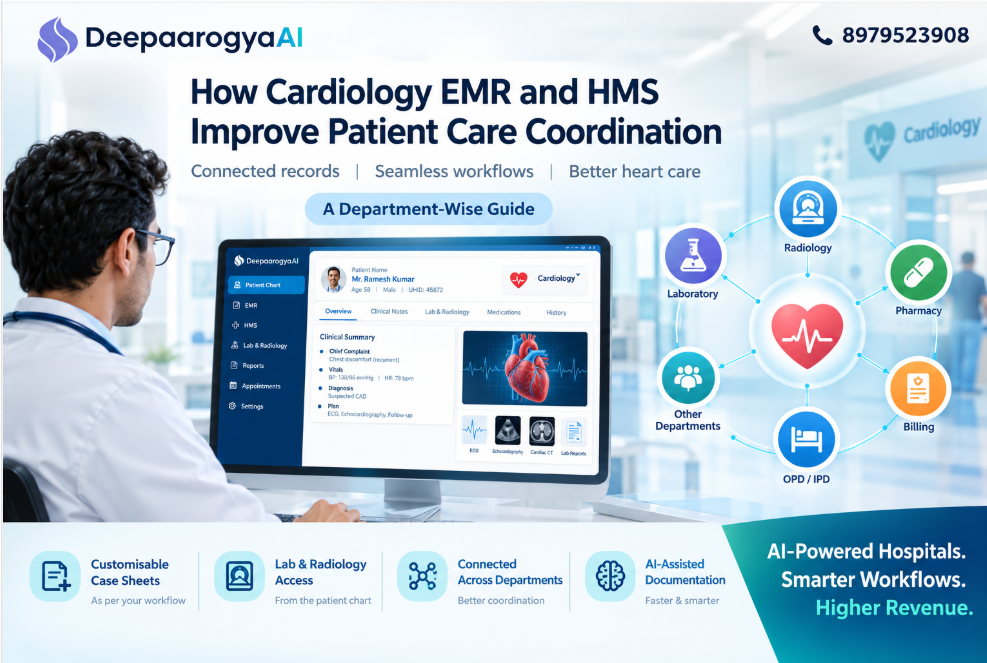
1. Understanding the Challenges of a Cardiology Department
Cardiology involves ongoing clinical documentation and coordination. Depending on the patient’s needs, a cardiology team may need to review:
- Patient history and previously documented symptoms.
- Vitals and relevant clinical notes.
- Available laboratory reports and radiology information.
- Medication records and prescriptions.
- Notes from previous consultations.
- Information recorded by other participating departments.
When this information is difficult to access, staff may need to spend additional time searching records or coordinating with other teams.
A connected EMR and HMS can help organize these workflows around a shared patient record.
2. Five Common Cardiology Workflow Problems—and How DeepaarogyaAI Helps
Problem 1: Patient History Is Scattered Across Multiple Records
A patient may visit a cardiologist several times over an extended period. Each consultation can add new symptoms, observations, diagnoses, and treatment-related documentation.
If these details are recorded in disconnected systems, the doctor may need to search multiple locations to review previous information.
How DeepaarogyaAI helps
DeepaarogyaAI provides a connected patient chart designed to bring relevant clinical information together.
Its customizable case sheets allow documentation to be organized according to the clinic’s workflow. This gives the cardiology team a structured foundation for reviewing available patient information across consultations.
The goal is to make clinical documentation easier to access without repeatedly reconstructing the patient’s history from separate records.
Problem 2: Diagnostic Information Is Difficult to Access During Consultations
Cardiologists may need to review relevant diagnostic information alongside the patient’s clinical history.
When laboratory reports and radiology information are stored separately, staff may need to locate the appropriate documents before the doctor can review them.
How DeepaarogyaAI helps
DeepaarogyaAI provides access to lab and radiology information from the connected patient chart.
This can help clinicians review available information alongside other recorded clinical details.
Hospitals should verify the availability of specific cardiology investigations, ECG records, echocardiography reports, cardiac imaging, and external diagnostic integrations before implementation. Access to lab and radiology information does not automatically mean every diagnostic device or specialized system is integrated.
Problem 3: Clinical Documentation Takes Time Away From Patient Interaction
Consultation documentation is an important part of cardiology practice. However, manually entering information into rigid templates can add to the administrative workload.
Different cardiologists may also have different documentation preferences.
How DeepaarogyaAI helps
DeepaarogyaAI supports customizable case sheets that can be arranged around the clinic’s documentation requirements.
Its platform also offers AI-assisted clinical documentation workflows, including SOAP-style drafting, with outputs retained for review and approval by the responsible team.
These capabilities can support documentation workflows where configured. AI-generated content should be checked by the clinician for accuracy and completeness before it becomes part of the finalized record.
Problem 4: Coordination Between Cardiology and Other Departments Is Fragmented
Cardiac patients may receive care from multiple departments, depending on their overall healthcare needs.
Information may need to be reviewed across general medicine, diagnostics, pharmacy, nutrition, rehabilitation, and other participating services.
When each team maintains disconnected records, the patient journey can become harder to coordinate.
How DeepaarogyaAI helps
DeepaarogyaAI connects participating departments through a shared patient record. Its platform supports workflows that include OPD, IPD, pharmacy, billing, physiotherapy, and nutrition.
This provides a common information foundation for teams involved in a patient’s care.
The exact information available to each department depends on the hospital’s configuration and access permissions. Clinical decisions remain the responsibility of qualified healthcare professionals.
Problem 5: Follow-Up Consultations Require Repeated Information Gathering
Follow-up visits are an important part of many cardiology care pathways. The doctor may need to review previous notes, available reports, and updated patient information.
If staff must repeatedly collect the same details from different sources, the process can become unnecessarily cumbersome.
How DeepaarogyaAI helps
A connected patient chart can help the team refer to previously recorded information when preparing for subsequent consultations.
By organizing clinical documentation and relevant departmental information in a shared record, DeepaarogyaAI provides a foundation for more continuous record-keeping across visits.
Appointment reminders, automated follow-up scheduling, and patient outreach should be evaluated separately according to the specific features and workflows enabled by the clinic.
3. How DeepaarogyaAI EMR and HMS Support Cardiology Workflows
A. Customizable Case Sheets for Clinical Documentation
Not every specialty documents consultations in the same way.
A cardiology clinic may require a different arrangement of history, vitals, clinical notes, diagnoses, and investigation-related information than an orthopedic or physiotherapy clinic.
DeepaarogyaAI supports customizable case sheets, allowing clinical sections and specialty panels to be organized according to the clinic’s requirements.
This flexibility helps the clinic evaluate a documentation structure that fits its workflow instead of relying entirely on a rigid template.
The specific fields should be configured with the clinical team to ensure they meet its documentation requirements.
B. Connected Access to Patient Information
A cardiologist may need to refer to previous clinical notes, relevant vitals, medications, and available diagnostic information.
DeepaarogyaAI organizes participating departments around a shared patient record and provides access to lab and radiology information from the patient chart.
This can reduce the need to treat every information source as an isolated record.
Access remains subject to the information available in the system and the permissions established by the healthcare organization.
C. EMR and HMS for Outpatient and Inpatient Workflows
Cardiology services may operate in outpatient clinics, hospitals, or settings that combine both.
EMR supports the clinical documentation side of patient care, while HMS supports broader hospital operations and departmental coordination.
DeepaarogyaAI provides OPD and IPD workflows within its wider platform. Hospitals can evaluate how these workflows fit their cardiology consultations, inpatient documentation requirements, and departmental handoffs.
The specific admission, procedure, monitoring, and discharge workflows should be confirmed for the hospital’s chosen configuration.
D. Coordination With Pharmacy and Billing
Clinical and administrative workflows are closely related, even though each department has its own responsibilities.
DeepaarogyaAI includes pharmacy and billing among its connected hospital workflows.
This gives participating teams a common patient-record foundation and can help reduce unnecessary duplication of information across configured workflows.
Hospitals should separately verify specific features such as medication inventory, prescription-to-dispensing connectivity, procedure billing, insurance claims, and payment integrations.
E. AI-Assisted Documentation With Clinician Review
AI can support selected documentation tasks, but it should not replace clinical judgment.
DeepaarogyaAI offers AI agents that use information from the connected chart to prepare outputs for team review.
In a cardiology setting, the potential value of AI-assisted documentation depends on the supported workflow and the information available to it.
Hospitals should confirm which agents are suitable for their cardiology use cases. They should not assume that the platform independently diagnoses heart conditions, interprets ECGs, detects cardiac abnormalities, or recommends treatment unless those specific capabilities have been verified.
4. A Practical Example: A Connected Cardiology Patient Journey
Consider a patient visiting a cardiology clinic for recurring symptoms and a scheduled follow-up.
Step 1: Patient registration
The front desk creates or accesses the patient’s record and records the required registration information.
Step 2: Cardiology consultation
The cardiologist documents the patient’s history, symptoms, relevant observations, and clinical assessment in the EMR.
Step 3: Review of available information
The doctor reviews relevant patient history and diagnostic information available through the configured patient-record workflow.
Step 4: Documentation and coordination
The consultation record is maintained within the connected system, helping participating departments access relevant information according to their permissions.
Step 5: Follow-up consultation
When the patient returns, the clinical team can refer to previously documented information and review the latest available records.
This example illustrates how a connected workflow can be organized. It does not imply that every test is automatically imported, every follow-up is scheduled automatically, or every clinical decision is generated by AI.
The objective is to make information continuity part of the cardiology workflow rather than a separate administrative task.
5. Cardiology EMR vs HMS: What Is the Difference?
| Requirement | Cardiology EMR | Cardiology within HMS |
|---|---|---|
| Clinical notes | Organizes consultation documentation | Supports documentation within broader hospital workflows |
| Patient history | Maintains recorded clinical information | Connects relevant information with hospital operations |
| Diagnostic information | Provides access when available in the patient record | Supports coordination across participating departments |
| OPD workflows | Supports clinical consultations | Coordinates broader operational activities |
| IPD workflows | Supports relevant clinical documentation | Supports hospital-level inpatient processes |
| Pharmacy and billing | Provides clinical context where relevant | Connects participating administrative workflows |
For a cardiology clinic, EMR is important for clinical documentation and patient records. HMS becomes especially relevant when the clinic also needs to coordinate registration, billing, pharmacy, and other hospital operations.
DeepaarogyaAI combines EMR and HMS capabilities around a connected patient record, allowing clinics and hospitals to evaluate clinical and operational workflows together.
The exact functionality depends on the selected modules and implementation.
6. Benefits of a Connected Cardiology Workflow
Better Access to Relevant Patient Information
A shared patient record can make available clinical documentation easier to review across consultations.
Less Repeated Administrative Work
Connected workflows can reduce unnecessary re-entry and searching when relevant information is already recorded in the system.
More Flexible Clinical Documentation
Customizable case sheets help clinics organize documentation according to their specialty requirements.
Improved Departmental Coordination
A common information foundation can support communication between cardiology and other participating hospital departments.
A Foundation for Ongoing Digital Improvement
An integrated EMR and HMS approach helps hospitals assess how additional workflows can be organized as their operational requirements evolve.
These are potential workflow benefits, not guarantees of better clinical outcomes or quantified savings. Actual results depend on implementation, data quality, staff adoption, and the availability of required integrations.
7. What Should a Cardiology Clinic Check Before Choosing EMR and HMS?
Before implementing a cardiology EMR or HMS, clinic owners and hospital administrators should ask:
- Can consultation notes and relevant patient history be organized according to cardiology workflows?
- Can case sheets be customized for the clinic’s requirements?
- How are laboratory and radiology reports accessed?
- Are ECG, echocardiography, PACS, or other specialist-system integrations required?
- Can the platform support the clinic’s OPD and, where applicable, IPD workflows?
- How are user roles and patient-data access permissions managed?
- Which AI-assisted documentation workflows are available, and what review steps are required?
- What onboarding, training, migration, and ongoing support are provided?
The clinic should request a demonstration using representative cardiology workflows and verify the exact availability of specialty-specific capabilities before implementation.
8. Why Consider DeepaarogyaAI for Cardiology?
A cardiology practice needs more than a place to store consultation notes. It needs a workable approach to organizing clinical information and coordinating the administrative activities surrounding patient care.
DeepaarogyaAI provides a connected EMR and HMS platform for clinics and multi-specialty hospitals.
Its relevant capabilities include:
- Connected patient records for participating departments.
- Customizable case sheets for specialty-specific documentation.
- Access to lab and radiology information from the patient chart.
- OPD and IPD workflows within the wider hospital platform.
- Connected pharmacy and billing workflows for participating teams.
- AI-assisted documentation workflows with review and approval.
DeepaarogyaAI also has a dedicated cardiology page where healthcare organizations can explore its specialty offering.
For cardiology clinics considering digital transformation, the important step is to evaluate how the platform fits their real documentation, coordination, and operational requirements.
Conclusion: Build a More Connected Cardiology Workflow With EMR and HMS
Cardiology care involves ongoing documentation, review of relevant clinical information, and coordination across the patient’s healthcare journey.
When records are scattered across disconnected systems, teams may spend additional time searching for information and coordinating manually.
A connected EMR and HMS can help organize clinical documentation and participating departmental workflows around a shared patient record.
DeepaarogyaAI brings clinical documentation, customizable case sheets, and connected hospital workflows together—with lab and radiology information accessible from the patient chart.
For cardiology clinics and multi-specialty hospitals, this provides a foundation for evaluating a more connected approach to patient information and departmental coordination.
Explore Cardiology EMR With DeepaarogyaAI
- Cardiology EMR: https://www.deepaarogya.com/for/cardiology
- Explore products: https://www.deepaarogya.com/products
- Schedule a demo: https://www.deepaarogya.com/demo
- Contact DeepaarogyaAI: https://www.deepaarogya.com/contact-us
Frequently Asked Questions
1. What is cardiology EMR software?
Cardiology EMR software helps cardiology teams organize electronic clinical records, consultation notes, and relevant patient information. The available features depend on the software and its configuration.
2. How does HMS help a cardiology department?
HMS supports broader hospital operations, including patient registration and coordination across participating departments. When connected with EMR, it can help link clinical documentation with administrative workflows.
3. How does DeepaarogyaAI support cardiology workflows?
DeepaarogyaAI offers a cardiology-focused solution within its EMR and HMS platform. Relevant capabilities include customizable case sheets, connected patient records, and access to lab and radiology information from the patient chart.
4. Can DeepaarogyaAI automatically interpret ECGs or echocardiograms?
Do not assume automated ECG or echocardiogram interpretation is included. Clinics should confirm specific diagnostic interpretation features and integrations directly with the DeepaarogyaAI team.
5. Can cardiologists access previous patient information?
DeepaarogyaAI’s connected patient-record approach supports access to available recorded information. The exact information accessible depends on the records maintained in the system and configured permissions.
6. Can a cardiology clinic customize its EMR case sheets?
DeepaarogyaAI supports customizable case sheets and specialty-specific workflows. The clinic should discuss its required fields, documentation templates, and workflow configuration during implementation planning.
7. Does cardiology EMR replace dedicated cardiac diagnostic systems?
Not necessarily. ECG equipment, echocardiography systems, cardiac imaging platforms, and other specialist tools may require separate software or integrations. Compatibility should be confirmed before implementation.
8. How can a cardiology clinic explore DeepaarogyaAI?
Visit https://www.deepaarogya.com/for/cardiology to explore the cardiology offering, or schedule a demonstration at https://www.deepaarogya.com/demo.