
Introduction: Patient Care Should Not End When the Consultation Does
A doctor completes a consultation, prepares a prescription, and explains the next steps to the patient. The patient leaves the clinic with a treatment plan, but what happens afterward? Will the prescription reach them? Will they remember their follow-up appointment? Will they receive a reminder to revisit the doctor when needed?
For many clinics and hospitals, maintaining communication after a consultation can be challenging. Reception teams manage incoming calls, doctors handle clinical responsibilities, and administrative staff coordinate appointments and patient records. As the number of patients grows, manually tracking every follow-up becomes increasingly difficult.
This is where a WhatsApp Follow-up Agent can support more connected patient communication.
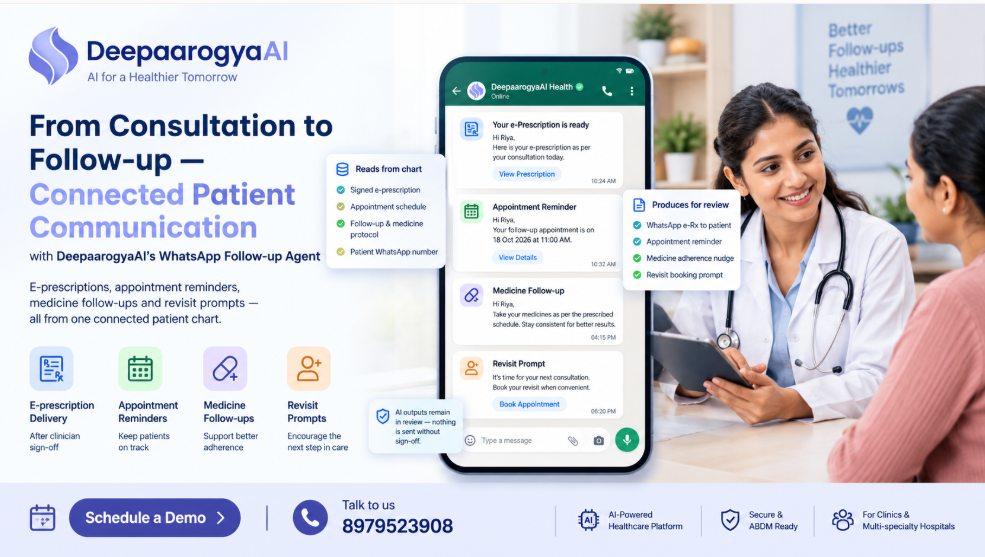
DeepaarogyaAI brings its WhatsApp Follow-up Agent into a connected patient-chart workflow. The agent supports e-prescription delivery through WhatsApp after clinician sign-off, appointment reminders, medicine follow-ups, and revisit booking prompts. It works with relevant information from the patient chart, including the signed e-prescription, appointment schedule, follow-up and medicine protocol, and the patient’s WhatsApp number.
Instead of treating every post-consultation interaction as a separate administrative task, DeepaarogyaAI helps healthcare teams organize these communications around the patient’s existing care record.
The goal is straightforward: help clinics maintain continuity between consultations while keeping healthcare professionals in control of clinical communication.
1. Why Patient Follow-ups Become Difficult for Healthcare Teams
A consultation is only one part of a patient’s healthcare journey. Patients may need prescriptions, medication-related follow-ups, reminders, or another appointment depending on their care plan.
However, the processes used to manage these interactions are not always connected.
Manual communication creates additional work
Receptionists and administrative teams may need to contact patients individually, check appointment schedules, confirm whether prescriptions have been shared, and identify upcoming revisit requirements.
When these tasks depend heavily on manual coordination, staff have less time for other responsibilities, including helping patients who are currently visiting the clinic.
Important information may be scattered
A patient’s prescription, appointment details, and follow-up instructions may be recorded in different places or communicated through separate channels.
Staff then need to locate the correct information before contacting the patient. This can make communication more complicated, particularly in busy clinics and multi-specialty healthcare facilities.
Patients may forget their next steps
After a consultation, patients may become occupied with their daily routines. They might forget an upcoming appointment or overlook a reminder to return for another consultation.
A reminder cannot guarantee that a patient will attend an appointment or follow a treatment plan. However, timely, relevant communication can help patients keep track of the next steps recommended by their healthcare team.
Growing patient volumes increase coordination demands
As clinics grow, the number of post-consultation interactions can also increase. Without a structured workflow, staff may find it difficult to manage prescription delivery, appointment reminders, medicine follow-ups, and revisit prompts consistently.
Healthcare teams therefore need a way to connect these communication tasks with the patient’s record instead of managing every interaction in isolation.
2. What Is a WhatsApp Follow-up Agent?
A WhatsApp Follow-up Agent is a healthcare workflow assistant designed to support relevant patient communications through WhatsApp.
In DeepaarogyaAI, the agent works with information from the patient chart to prepare and support specific post-consultation interactions. Its listed functions include delivering signed e-prescriptions, sending appointment reminders, providing medicine follow-up nudges, and prompting patients to book revisit appointments.
The agent’s workflow is connected to information such as:
- The clinician-signed e-prescription
- The patient’s appointment schedule
- The relevant follow-up and medicine protocol
- The patient’s WhatsApp number
Based on these inputs, the agent can prepare communications for review, including e-prescription messages, appointment reminders, medicine adherence nudges, and revisit booking prompts.
An important distinction is that AI assistance does not replace clinical responsibility. DeepaarogyaAI’s product description specifies that agent-generated outputs remain subject to review and that nothing is sent to patients without sign-off. This keeps professional oversight central to the workflow.
The agent is part of DeepaarogyaAI’s broader AI Agent OS, which brings clinical AI assistance into the connected patient chart.
Learn more about the platform: https://www.deepaarogya.com/products#agents
3. How DeepaarogyaAI’s WhatsApp Follow-up Agent Works
Consider a patient who visits a clinic for a consultation. The doctor evaluates the patient, documents the consultation, and prepares an e-prescription.
The patient’s journey continues after the consultation, and the clinic needs to coordinate the next communication steps.
Step 1: The consultation is documented
The healthcare professional completes the consultation and prepares the e-prescription.
The signed prescription becomes an important reference for subsequent communication. The follow-up workflow uses the relevant information from the patient’s chart rather than treating prescription delivery as an entirely separate activity.
Step 2: The e-prescription is prepared for WhatsApp delivery
After clinician sign-off, the WhatsApp Follow-up Agent can prepare the e-prescription message for the patient.
The clinician’s approval remains essential. This distinction matters because prescription-related communication must reflect the approved clinical information rather than an unreviewed AI-generated instruction.
Step 3: Appointment reminders support the next visit
When a patient has another appointment scheduled, the agent can prepare an appointment reminder using the relevant appointment information.
This gives the clinic a structured way to communicate upcoming visits without relying exclusively on staff to remember every reminder.
Step 4: Medicine follow-ups reinforce the communication plan
Where the relevant follow-up and medicine protocol calls for further communication, the agent can prepare medicine-related nudges.
These messages should remain consistent with the clinician-approved plan. They are intended to support communication, not independently diagnose a problem, change a prescription, or make treatment decisions.
Step 5: Revisit prompts help patients take the next step
Some patients need another consultation or review according to their care plan. A revisit booking prompt can remind them to arrange the next appointment when appropriate.
The prompt supports the booking process; it does not mean that a revisit has automatically been booked or that the patient has confirmed attendance.
Step 6: Delivery status and audit logs support visibility
DeepaarogyaAI lists delivery status and audit logs as part of its WhatsApp Follow-up Agent workflow.
This provides a way for the team to review communication activity and delivery information. It is particularly useful to distinguish between a message being prepared, a message being sent, and its recorded delivery status.
These steps help organize post-consultation communication around the patient record while preserving clinician oversight.
4. Four Ways the WhatsApp Follow-up Agent Supports Patient Communication
A. E-prescription delivery after clinician sign-off
Patients need access to the prescription prepared during their consultation. Sharing it through WhatsApp can make the approved prescription easier to access through a familiar communication channel.
With DeepaarogyaAI, the agent supports e-prescription delivery after clinician sign-off.
For healthcare teams, this connects prescription communication to the patient chart. For patients, it provides a convenient way to receive the approved prescription without requiring staff to handle every delivery interaction entirely manually.
B. Appointment reminders
Appointment coordination involves more than creating a booking. Clinics also need to communicate upcoming appointments to patients.
The WhatsApp Follow-up Agent supports appointment reminders based on the appointment schedule available in the patient chart.
This can help teams establish a more organized reminder workflow while allowing staff to focus on patient-facing responsibilities.
C. Medicine follow-up nudges
Communication around medicines may continue after the patient leaves the clinic. Depending on the care plan, patients may benefit from appropriate reminders or follow-up messages.
DeepaarogyaAI’s agent can prepare medicine-related adherence nudges using the relevant follow-up and medicine protocol.
Such messages should be accurate, appropriate to the patient, and consistent with clinician-approved instructions. They should not be treated as a substitute for medical advice or professional assessment.
D. Revisit booking prompts
Follow-up consultations can be important for reviewing progress, discussing concerns, or deciding the next steps in care.
However, patients may not always arrange their next appointment before leaving the clinic.
A revisit booking prompt gives the clinic another way to communicate the need to arrange a subsequent visit when indicated. By connecting this interaction to the patient’s chart, DeepaarogyaAI supports a more structured approach to post-consultation communication.
5. Why Connecting WhatsApp Communication With the Patient Chart Matters
Sending a message is only one part of an effective healthcare communication workflow. The message must also relate to the correct patient, reflect the appropriate information, and fit the patient’s care journey.
This is why the connection between communication and the patient chart matters.
Better access to relevant information
When prescription details, appointment schedules, and follow-up protocols are available through the connected workflow, the team has a clearer reference for preparing the next communication.
This reduces the need to approach each follow-up as a completely separate administrative activity.
More structured communication processes
A clinic may need to manage several types of interactions after a consultation. A connected agent workflow helps organize these into recognizable categories, such as prescription delivery, appointment reminders, medicine nudges, and revisit prompts.
This makes the communication process easier to structure and review.
Greater visibility into communication activity
Delivery status and audit logs can help teams review what happened during the communication workflow.
For example, if a patient says they did not receive a prescription message, staff can check the available communication records instead of relying only on memory.
The precise details available depend on the implemented workflow and recorded status.
Human oversight remains part of the process
Healthcare communication requires care, accuracy, and accountability. An AI agent can help prepare routine communications, but clinicians and authorized staff must retain responsibility for the relevant approvals and decisions.
DeepaarogyaAI’s review-and-sign-off approach keeps that distinction explicit.
6. How Clinics Can Use the WhatsApp Follow-up Agent in Daily Operations
The value of a follow-up workflow depends on how well it fits into a clinic’s existing operations.
Here are practical ways healthcare teams can approach implementation.
For general clinics: Organize prescription delivery and appointment reminders around the consultation record.
For multi-specialty hospitals: Establish a consistent communication approach across departments while respecting each specialty’s approved follow-up requirements.
For busy outpatient departments: Use structured workflows to support post-consultation communication without requiring staff to manage every routine interaction independently.
For clinics managing recurring visits: Use revisit prompts where a subsequent appointment is appropriate according to the clinician’s plan.
Before implementation, healthcare teams should define which messages require clinician approval, who is responsible for reviewing outputs, how patient contact details are verified, and how exceptions are handled.
They should also ensure that patient consent, privacy obligations, and applicable communication requirements are addressed.
7. How to Measure the Value of a WhatsApp Follow-up Workflow
A WhatsApp Follow-up Agent should be evaluated on operational usefulness and the quality of its communication workflow, rather than on automation alone.
Clinics can establish baseline measurements and review them after implementation.
| Metric | What it helps the clinic understand |
|---|---|
| Prescription delivery status | Whether prescription messages have a recorded delivery outcome |
| Reminder completion | How consistently planned appointment reminders are handled |
| Revisit booking rate | How many patients arrange another appointment after an appropriate prompt |
| Staff time spent on follow-ups | How much staff time is allocated to manual communication tasks |
| Communication exceptions | How often messages require correction, escalation, or manual intervention |
| Review and approval compliance | Whether the required sign-off process is being followed |
These are suggested evaluation metrics, not guaranteed DeepaarogyaAI outcomes. Actual results will depend on the clinic’s processes, patient population, configuration, and adoption.
The most useful starting point is to identify the clinic’s biggest communication bottleneck and measure whether the new workflow improves it.
8. Why Choose DeepaarogyaAI for Connected Patient Follow-ups?
DeepaarogyaAI positions its WhatsApp Follow-up Agent within a broader healthcare platform that combines hospital management, electronic medical records, specialty workflows, and clinical AI agents.
Its distinguishing workflow elements include:
- Patient-chart context: The agent uses relevant information from the patient’s chart to prepare communications.
- E-prescription delivery: Supports WhatsApp delivery after clinician sign-off.
- Multiple follow-up use cases: Covers appointment reminders, medicine follow-up nudges, and revisit booking prompts.
- Communication visibility: Includes delivery status and audit logs.
- Human review: Agent outputs remain subject to review, with sign-off required before messages are sent to patients.
- Connected product ecosystem: The follow-up agent sits within the broader DeepaarogyaAI AI Agent OS.
These capabilities are intended to help healthcare teams organize communication around existing patient information rather than managing every interaction as a disconnected task.
To understand how the agent fits into your clinic or hospital workflow, explore the DeepaarogyaAI Products page.
Conclusion: Build Continuity Beyond the Consultation
Patient care does not stop when a consultation ends. Prescription delivery, appointment reminders, medicine follow-ups, and revisit prompts can all play a role in helping patients navigate their next steps.
When these activities depend entirely on manual coordination, healthcare teams may struggle to maintain a consistent process as patient volumes grow.
DeepaarogyaAI’s WhatsApp Follow-up Agent supports a more structured approach by connecting post-consultation communications with the patient chart. From clinician-approved e-prescriptions to appointment reminders and revisit prompts, it helps organize routine interactions while preserving professional review and sign-off.
For clinics and hospitals looking to improve the way they manage communication after consultations, the next step is to evaluate how a connected follow-up workflow could fit into their existing operations.
Ready to explore connected patient communication?
- Schedule a Demo: https://www.deepaarogya.com/demo
- Explore Products: https://www.deepaarogya.com/products
- View Pricing: https://www.deepaarogya.com/pricing
- Contact DeepaarogyaAI: https://www.deepaarogya.com/contact-us
Frequently Asked Questions (FAQs)
1. What is a WhatsApp Follow-up Agent in healthcare?
A WhatsApp Follow-up Agent supports post-consultation communication, such as e-prescription delivery, appointment reminders, medicine follow-up nudges, and revisit booking prompts. DeepaarogyaAI connects these workflows with relevant information from the patient chart.
2. What does DeepaarogyaAI’s WhatsApp Follow-up Agent do?
It supports WhatsApp delivery of clinician-signed e-prescriptions, appointment reminders, medicine-related follow-up nudges, and revisit booking prompts. The workflow also includes delivery status and audit logs.
3. Does the agent send prescriptions without a doctor’s approval?
No. DeepaarogyaAI’s described workflow supports e-prescription delivery after clinician sign-off. Its AI agent outputs remain subject to review and are not sent to patients without sign-off.
4. Can the WhatsApp Follow-up Agent help with appointment reminders?
Yes. It can prepare appointment reminders using the appointment schedule available in the patient chart, helping clinics structure communication about upcoming visits.
5. How does the agent support medicine follow-ups?
The agent can prepare medicine-related adherence nudges based on the relevant follow-up and medicine protocol. These communications should remain consistent with clinician-approved instructions and do not replace medical advice.
6. Can it help patients book revisit appointments?
The agent can prepare revisit booking prompts to encourage patients to arrange another appointment when appropriate. A prompt does not itself confirm that an appointment has been booked.
7. Why is patient-chart integration important for WhatsApp follow-ups?
Patient-chart integration provides a relevant reference for prescription details, appointment schedules, and follow-up protocols. It can help organize communication and give staff access to available delivery records and audit information.
8. Is a WhatsApp Follow-up Agent suitable for small clinics and hospitals?
The workflow may be relevant to clinics and hospitals that need to coordinate prescription delivery, reminders, and revisit communication. Suitability depends on the organization’s existing systems, operational requirements, and implementation needs.
9. Does a WhatsApp reminder guarantee that a patient will attend an appointment?
No. Reminders can support communication, but they cannot guarantee attendance, medicine adherence, or treatment outcomes. Clinics should evaluate their actual results using appropriate operational metrics.
10. How can a clinic explore DeepaarogyaAI’s WhatsApp Follow-up Agent?
Visit DeepaarogyaAI’s Products page to explore its AI agents, or schedule a demo to discuss the platform and its fit with your clinic’s workflow.