
A modern clinic or multi-specialty hospital does not operate through just one department. Doctors, nurses, front-desk teams, pharmacy staff, billing teams, physiotherapists, dietitians, radiology teams, and administrators all contribute to the patient journey.
But there is a common technology question:
Should a healthcare organization use an EMR, an HMS, or both?
The answer becomes clearer when you look at how different departments actually work.
An EMR (Electronic Medical Record) primarily focuses on clinical information—patient history, diagnosis, vitals, consultation notes, prescriptions, investigations, treatment plans, and follow-ups.
An HMS (Hospital Management System) extends beyond clinical documentation into broader hospital operations such as OPD, IPD, pharmacy, billing, administration, and workflow coordination.
For growing clinics and hospitals, choosing between disconnected EMR and HMS tools can create another problem: departments may end up working with separate information instead of one connected patient journey.
This is where an integrated platform such as DeepaarogyaAI takes a different approach.
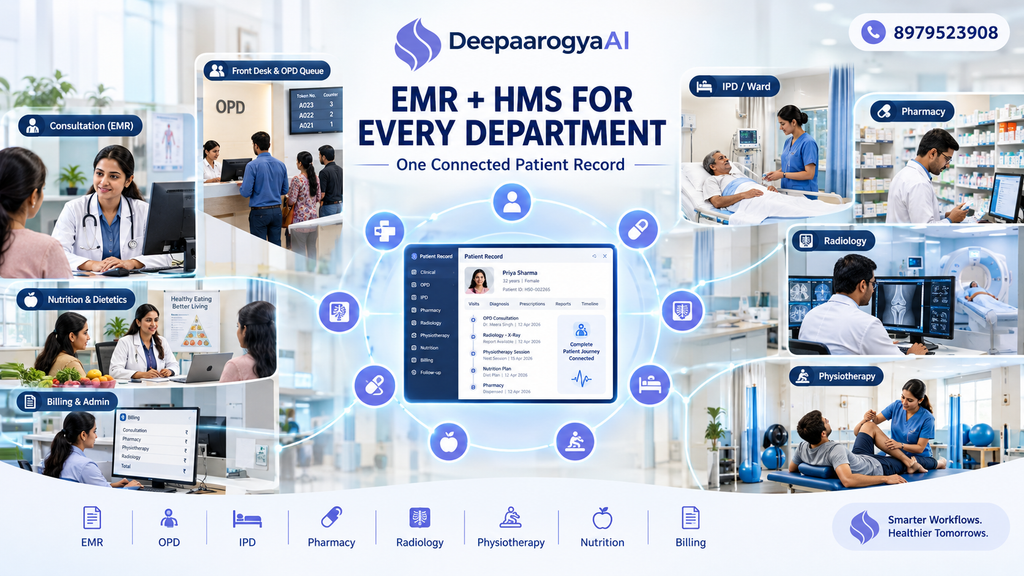
DeepaarogyaAI brings EMR, OPD, IPD, pharmacy, billing, physiotherapy, nutrition, radiology, e-prescriptions, and AI-powered workflows together around one patient record.
EMR vs HMS: What Is the Difference?
Before deciding what a healthcare organization needs, it is important to understand the difference.
What is an EMR?
An Electronic Medical Record is primarily designed to digitize and organize a patient’s clinical record.
Depending on the specialty and workflow, an EMR can contain:
- Patient demographics
- Medical history
- Vitals
- Clinical complaints
- Examination findings
- Diagnosis
- Investigation information
- Treatment plans
- Prescriptions
- Clinical notes
- Follow-up information
DeepaarogyaAI describes its EMR as structured and ABDM-ready, supporting different specialties and consultation workflows.
What is an HMS?
A Hospital Management System generally addresses the broader operational side of healthcare delivery.
This can include:
- OPD management
- IPD management
- Pharmacy
- Billing
- Patient registration
- Department coordination
- Administrative workflows
- Operational reporting
DeepaarogyaAI’s AI HMS brings OPD, IPD, pharmacy, billing, and administrative desks onto one patient record.
Why Do Clinics Need Both?
The distinction is useful, but in a real healthcare environment, clinical and operational workflows are closely connected.
For example:
A patient visits an orthopedic clinic.
The front desk registers the patient.
The doctor records the consultation.
Radiology may receive an imaging order.
The pharmacy processes medication.
The billing team generates the bill.
The physiotherapy department may manage rehabilitation sessions.
The patient eventually returns for follow-up.
If every department works from a different system, information may have to be entered repeatedly.
A connected EMR + HMS approach can allow these workflows to operate around the same patient record.
Why Every Department Needs a Connected Healthcare Workflow
Healthcare is not a collection of isolated departments.
It is a connected patient journey.
DeepaarogyaAI describes this model as “Every department, one connected record.” Front desk, doctors, pharmacy, and billing can work from the same patient record, while specialty departments such as physiotherapy and nutrition connect into the broader workflow.
This matters because a patient’s information often moves through multiple departments during one episode of care.
Consider a simple example.
A patient comes to a clinic with knee pain.
Registration → Consultation → Diagnosis → Radiology → Prescription → Physiotherapy → Billing → Follow-up
The patient may interact with several teams, but the patient remains the same.
The technology should reflect that continuity.
EMR or HMS for the Front Desk?
The front desk is often the first operational point in a patient’s journey.
A disconnected workflow can make registration, scheduling, and patient movement harder to coordinate.
A connected system can bring the patient’s intake and clinical journey into the same workflow.
DeepaarogyaAI supports digital token queues, visit intake, and doctor workflows through its OPD and token-queue module.
What the Front Desk Needs
A connected platform can help organize:
- Patient registration
- Appointment information
- OPD queues
- Visit status
- Patient intake
- Doctor assignment
- Follow-up scheduling
The objective is simple:
The patient should not have to repeatedly provide the same information to different departments.
EMR for Doctors and Clinical Departments
For doctors, the EMR is the core of the clinical workflow.
A doctor needs access to the information required for consultation without searching across multiple systems.
DeepaarogyaAI’s customizable case sheet allows departments to configure sections, specialty panels, and workflow elements around their actual practice. Its website describes a case sheet where vitals, physiotherapy, dietitian information, lab, and radiology can remain connected to the same patient record.
A Doctor’s EMR Can Bring Together
- Patient history
- Vitals
- Diagnosis
- Clinical examination
- Investigations
- Treatment
- Medication
- Physiotherapy information
- Follow-up
- Specialty-specific information
This reduces the need to repeatedly switch between unrelated applications.
IPD: Where HMS Becomes Especially Important
Outpatient consultations are only one part of hospital operations.
For admitted patients, hospitals also need to manage:
- Admission
- Case sheets
- Orders
- Nursing notes
- Vitals
- Procedures
- Medication
- Discharge
- Billing
DeepaarogyaAI’s IPD workflow supports admission-to-discharge case sheets, orders, and nursing notes.
Its Discharge Summary Agent can use information such as IPD case sheets, orders, nursing notes, vitals, and procedures to create a structured draft for clinician review.
This illustrates why an HMS and EMR cannot always be treated as completely separate systems.
The hospital’s operational workflow and clinical record need to work together.
Pharmacy: Connect Prescriptions With the Patient Record
Pharmacy is another department where disconnected workflows can create unnecessary repetition.
A prescription originates during the clinical consultation, but medication fulfillment happens elsewhere.
A connected system can link the prescription and pharmacy workflow to the patient’s EMR.
DeepaarogyaAI includes pharmacy inventory, dispensing, and prescriptions linked directly to the EMR.
It also supports one-click e-prescription generation that can be sent to patients through WhatsApp after clinician sign-off.
This creates a more connected flow:
Consultation → Prescription → Pharmacy → Patient
rather than treating each stage as a separate digital process.
Billing: Connect Clinical Activity With Financial Workflow
Billing is another major HMS function.
A patient’s treatment may involve:
- Consultation charges
- Packages
- Procedures
- Pharmacy
- Physiotherapy sessions
- Other services
If billing operates independently from clinical workflows, staff may need to manually reconcile what happened during the visit.
DeepaarogyaAI’s billing module supports package billing, partial payments, and GST-ready reporting.
Connecting billing with the broader patient workflow can give staff a more complete view of the patient’s journey.
Physiotherapy Needs More Than a Generic EMR
Not every department works in the same way.
Physiotherapy is a good example.
A physiotherapy department may need to track:
- Treatment protocols
- Sessions
- Patient progress
- Outcomes
- Team assignments
- Session billing
- Therapist notes
DeepaarogyaAI’s physiotherapy module is designed around protocol tracking, outcomes, team assignment, and session billing for physio-led clinics and orthopedic centres.
This is why a rigid, one-size-fits-all EMR may not fit every department.
The system should allow specialty workflows to connect to the central patient record without forcing every department to work identically.
Nutrition and Dietetics: Connect Clinical Data With Nutrition Workflows
Nutrition is increasingly part of multidisciplinary healthcare.
A dietitian may need relevant information such as:
- Patient demographics
- Diagnosis
- Vitals
- Body composition
- Clinical information
- Treatment context
DeepaarogyaAI includes a Nutrition AI module where diet plans can be generated through an AI-assisted pipeline and reviewed by clinicians.
The website also describes vitals and other patient information feeding into connected department workflows.
The benefit of integration is that nutrition does not have to operate as an isolated service.
Radiology: Keep Imaging Connected to the Patient Chart
Radiology workflows can generate important information during a patient’s treatment journey.
If imaging orders and reports are stored separately, doctors and other authorized teams may have to search across systems.
DeepaarogyaAI provides a radiology workflow where imaging orders, queues, and reports are linked to the same patient chart.
That supports a simple workflow:
Doctor orders imaging → Radiology processes it → Report becomes available within the connected record.
What About AI in Every Department?
Modern healthcare software is moving beyond simply storing information.
AI can also assist teams with repetitive documentation and workflow tasks.
DeepaarogyaAI describes an AI Agent OS with agents for areas including:
- Discharge summaries
- Nutrition
- Voice reception
- WhatsApp follow-up
- Visit summaries
- SOAP notes
The platform states that these outputs remain in review and require appropriate team or clinician approval before being sent to patients.
For example, its SOAP Agent generates structured SOAP-note drafts for clinician review, while its Discharge Summary Agent drafts discharge documentation from relevant IPD information.
The key idea is not replacing the clinical team.
It is bringing AI assistance inside the existing workflow.
One Patient Record Across Every Department
Imagine a patient moving through a multi-specialty hospital.
Step 1: Front Desk
The patient is registered and added to the OPD workflow.
Step 2: Doctor
The physician opens the patient’s EMR and records the consultation.
Step 3: Radiology
The doctor orders an investigation, and the imaging workflow remains linked to the patient chart.
Step 4: Pharmacy
The prescription is connected to the patient’s record.
Step 5: Physiotherapy
The patient is referred for rehabilitation, where sessions and progress can be tracked.
Step 6: Nutrition
The dietitian can work with relevant patient information available through the connected workflow.
Step 7: Billing
Services and payments are managed through the billing workflow.
Step 8: Follow-Up
The next visit and reminders can remain connected to the same patient journey.
This is the difference between having multiple digital tools and having a connected healthcare operating system.
Why a Customizable EMR + HMS Matters
Every clinic has a different workflow.
An orthopedic centre does not operate exactly like an ENT clinic.
A physiotherapy centre does not operate exactly like a multi-specialty hospital.
A nutrition desk has different requirements from a pharmacy.
DeepaarogyaAI states that its platform can configure OPD, IPD, physiotherapy, nutrition, and billing around a clinic’s actual workflow instead of forcing practices into a rigid template.
This customization can be particularly relevant for organizations with multiple specialties.
Instead of asking every department to change its workflow to match software, the software can be configured around the organization’s operational structure.
EMR or HMS: What Should Your Healthcare Organization Look For?
Rather than asking only “EMR or HMS?”, healthcare organizations can evaluate whether their platform provides the following:
1. One connected patient record
Clinical and operational information should remain connected across relevant departments.
2. Specialty-specific workflows
Different departments should be able to work according to their requirements.
3. OPD and IPD support
The platform should support both outpatient and inpatient workflows where required.
4. Pharmacy and billing integration
Operational departments should not have to work completely separately from clinical information.
5. AI assistance with human review
AI-generated documentation should fit into the clinical workflow and remain subject to appropriate review.
6. Role-based access
Different users should see the information relevant to their role. DeepaarogyaAI describes role-based access for doctors, nurses, desk staff, pharmacy, and administrators.
7. Mobile and desktop access
Healthcare teams may need access from consultation rooms, wards, front desks, or other locations. DeepaarogyaAI describes its workflow as available across desktop, tablet, and phone.
EMR + HMS: One Platform for the Complete Patient Journey
The real goal of healthcare digitization is not simply to replace paper.
It is to create a connected patient journey.
When the front desk, doctor, IPD team, pharmacy, radiology, physiotherapy, nutrition, and billing teams work from connected information, the organization can reduce unnecessary re-entry and improve visibility across the workflow.
DeepaarogyaAI brings these workflows together through its AI Hospital OS, combining EMR, OPD, IPD, pharmacy, billing, physiotherapy, nutrition, radiology, e-prescription, integrations, and AI agents.
For clinics and hospitals considering digital transformation, the question may therefore be less about choosing EMR versus HMS and more about finding a platform where EMR and HMS work together around the same patient record.
Final Takeaway
EMR manages the clinical story. HMS manages the broader operational story. A connected platform brings both stories together.
For a single-specialty clinic, an EMR may address many core clinical requirements.
For a growing clinic or multi-specialty hospital, however, departments often need more than clinical documentation. They need connected OPD, IPD, pharmacy, billing, radiology, physiotherapy, nutrition, and administrative workflows.
That is where an integrated EMR + HMS approach can become valuable.
With DeepaarogyaAI, the goal is to bring these workflows together on one connected patient record, while allowing different departments to use workflows relevant to their needs.
One patient. One connected chart. Multiple departments. One healthcare workflow.
Ready to Connect Your Healthcare Departments?
Explore how DeepaarogyaAI can be configured around your clinic or hospital workflow.
Schedule a demo: https://www.deepaarogya.com/demo
Website: https://www.deepaarogya.com/
Contact: 8979523908
Frequently Asked Questions
1. What is the difference between EMR and HMS?
EMR primarily manages electronic clinical records and consultation workflows, while HMS covers broader hospital operations such as OPD, IPD, pharmacy, billing, and administration. An integrated platform can connect both.
2. Can EMR and HMS be used together?
Yes. For multi-department healthcare organizations, connecting clinical and operational workflows can provide a more continuous patient journey.
3. Does DeepaarogyaAI provide both EMR and HMS?
Yes. DeepaarogyaAI presents both AI EMR and AI HMS as parts of its platform, alongside specialty modules and AI agents.
4. Can different departments have different workflows?
DeepaarogyaAI states that workflows can be customized for areas including OPD, IPD, physiotherapy, nutrition, and billing.
5. Which departments can be connected?
The platform describes connected workflows across OPD, IPD, pharmacy, billing, physiotherapy, nutrition, radiology, and other specialty workflows.
6. Does DeepaarogyaAI support specialty EMRs?
Its website lists specialty workflows including Orthopedics, Pediatrics, Physiotherapy, ENT, General Medicine, Nutrition & Dietetics, Dentistry, Dermatology, Ophthalmology, Cardiology, Pulmonology, and Oncology.
7. Can AI help with clinical documentation?
DeepaarogyaAI includes AI agents for tasks such as SOAP notes, discharge summaries, nutrition planning, and other workflow assistance, with outputs reviewed by the appropriate clinical team.
8. How can I see whether DeepaarogyaAI fits my clinic?
You can schedule a workflow consultation/demo with the DeepaarogyaAI team to discuss your clinic or hospital’s requirements.