
Introduction: Why Diagnostic Information Must Reach the Right Team
A diagnostic test is only one part of a patient’s healthcare journey. Its value also depends on whether the relevant information reaches the doctor, becomes accessible in the patient record, and supports the next step in care.
Imagine a patient who visits a hospital with persistent abdominal pain. The doctor reviews the patient’s history and requests diagnostic investigations. Later, the patient returns for a follow-up consultation, but the clinical team must search through separate records to locate the relevant reports.
The challenge is not necessarily the test itself. It is the coordination between the doctor, diagnostic services, and the rest of the hospital.
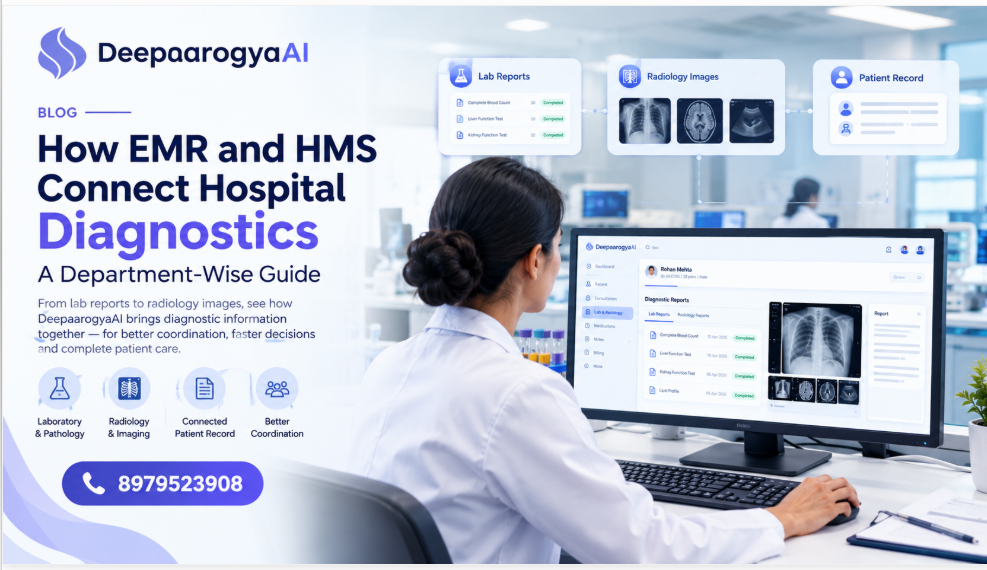
DeepaarogyaAI addresses this coordination challenge through a connected EMR and Hospital Management System (HMS), where patient information and participating departmental workflows can be organized around one patient record. Its platform makes lab and radiology information accessible from the patient chart, alongside clinical information used by other departments.
For hospitals and multi-specialty clinics, this connected approach can help reduce fragmented information and unnecessary manual coordination.
In this blog, we explore how EMR and HMS support diagnostic workflows and how DeepaarogyaAI can help connect diagnostic information with the broader patient journey.
1. Understanding the Role of the Diagnostic Department
Diagnostic services help clinicians gather information needed to assess a patient’s condition and plan appropriate care.
Depending on the hospital, diagnostic workflows may involve:
- Laboratory investigations and pathology reports.
- Radiology and medical imaging.
- Requests for diagnostic tests.
- Recording and reviewing test-related information.
- Sharing relevant findings with treating clinicians.
- Maintaining records for subsequent consultations.
These activities involve more than the diagnostic team alone. Doctors, nurses, front-desk staff, hospital administrators, and other authorized personnel may need access to different parts of the patient’s information.
When every department maintains disconnected records, staff may have difficulty locating the latest information or determining where relevant documentation has been recorded.
An integrated EMR and HMS provides a common information foundation for coordinating these activities.
2. Common Problems in Hospital Diagnostic Workflows
Problem 1: Diagnostic Reports Are Difficult to Locate
A doctor may need to review a patient’s previous test results before making a clinical decision. If reports are stored in different locations, finding the correct document can take additional effort.
This becomes especially challenging when patients receive care from multiple departments.
How DeepaarogyaAI helps
DeepaarogyaAI’s patient record brings clinical information together and provides access to lab and radiology information from the patient chart.
This connected approach can make relevant diagnostic information easier for authorized team members to locate during consultations, subject to the records available and the hospital’s configured workflow.
Problem 2: Doctors and Diagnostic Teams Work in Separate Information Systems
Diagnostic teams and treating clinicians have different responsibilities. However, both contribute to the same patient’s healthcare journey.
When their information is disconnected, staff may need to communicate manually to clarify where a report is recorded or whether relevant documentation is available.
How DeepaarogyaAI helps
DeepaarogyaAI connects participating departments through a shared patient record. Its customizable case sheets allow clinical information to be organized according to departmental needs.
The goal is to support continuity between the diagnostic information recorded for a patient and the clinical workflow in which that information is reviewed.
Specific laboratory system connections and automatic report transfers should be confirmed with the DeepaarogyaAI team before implementation.
Problem 3: Patient Information Is Repeated Across Workflows
Hospitals may maintain patient details across registration, consultation, diagnostic, and administrative processes. Repeated data entry can create unnecessary work and increase the possibility of inconsistent records.
How DeepaarogyaAI helps
DeepaarogyaAI is designed around a connected patient record that participating departments can use. Its platform aims to reduce repeated entry by connecting departmental information instead of requiring every team to work from an entirely separate record.
This can support more consistent information handling, depending on how the hospital configures its workflows.
Problem 4: Follow-Up Consultations Lack Convenient Access to Previous Information
A patient’s diagnostic journey does not end when an investigation is completed. The treating doctor may need to review available reports during a later appointment.
If information is fragmented, staff may need to retrieve records from different locations before the consultation can proceed smoothly.
How DeepaarogyaAI helps
With relevant diagnostic information accessible from the shared patient chart, the clinical team can refer to available records during subsequent consultations.
This supports information continuity across visits without implying that the platform independently interprets every report or makes clinical decisions.
Problem 5: Departmental Handoffs Depend on Manual Communication
A diagnostic workflow may involve several handoffs: a clinician requests an investigation, diagnostic personnel document their work, and the treating team reviews the available information.
When these stages are not well coordinated, staff may rely heavily on calls, messages, or manual record searches.
How DeepaarogyaAI helps
DeepaarogyaAI connects clinical and administrative workflows through its EMR and HMS platform. The shared patient record provides a common place for participating departments to access relevant documented information.
Hospitals can evaluate how this approach fits their diagnostic processes and determine which integrations or workflow changes are required.
3. How DeepaarogyaAI EMR and HMS Support Diagnostic Coordination
A. One Patient Record for Connected Information
A patient may interact with several departments during a single episode of care.
DeepaarogyaAI’s connected chart is designed to bring relevant patient information into one record, with clinical notes, vitals, medications, and access to lab and radiology information.
For clinicians, this can reduce the need to treat each departmental record as an isolated source of information.
For hospital administrators, it provides a common platform around which departmental workflows can be organized.
B. Customizable Case Sheets for Different Specialties
A general physician, an orthopedic surgeon, and a cardiologist may need different clinical information during a consultation.
DeepaarogyaAI supports customizable case sheets, allowing sections and specialty panels to be organized according to how a clinic or hospital works.
This flexibility matters because diagnostic information is useful only when it can be accessed in the context of the patient’s clinical workflow.
The precise fields and sections should be configured according to the hospital’s needs.
C. Coordination Across OPD and IPD
Diagnostic information can be relevant to both outpatient and inpatient care.
In OPD, doctors may need to review available reports during a consultation or follow-up visit. In IPD, clinical teams may need access to relevant patient documentation as care progresses.
DeepaarogyaAI supports OPD and IPD workflows within its broader hospital platform.
Connecting these workflows with the patient record can help participating teams maintain access to relevant information across different stages of care.
D. Access to Information Across Participating Departments
Diagnostics does not operate independently of the rest of the hospital.
Doctors need relevant findings for clinical review, while administrative staff may need information for their own authorized operational responsibilities.
DeepaarogyaAI connects the front desk, doctors, pharmacy, and billing workflows through a shared patient record. Its platform also provides access to lab and radiology information from the chart.
The exact access available to each department should follow the hospital’s role permissions, privacy requirements, and configured workflows.
E. AI-Assisted Documentation With Human Review
AI can support documentation-heavy healthcare workflows, but its role should be clearly defined.
DeepaarogyaAI offers AI agents that work with information from the connected chart and prepare outputs for team review. The platform states that these outputs remain subject to review and are not sent to patients without sign-off.
Hospitals should distinguish these documentation capabilities from automated laboratory analysis, image interpretation, diagnostic decision-making, or report validation. Those functions should not be assumed unless specifically confirmed for the selected product configuration.
4. A Practical Example: From Consultation to Diagnostic Review
Consider a patient visiting a multi-specialty hospital with recurring symptoms.
Step 1: Patient registration
The front desk creates or accesses the patient’s record and records the necessary details.
Step 2: Doctor consultation
The doctor documents the consultation, relevant history, vitals, and clinical assessment in the EMR.
Step 3: Diagnostic investigation
The doctor requests an appropriate investigation through the hospital’s established process. The diagnostic team carries out its responsibilities and records the relevant information through the applicable system.
Step 4: Diagnostic information becomes available
Where the information is recorded or connected through the configured workflow, relevant lab or radiology information can be accessed from the patient’s chart.
Step 5: Clinical review
The treating doctor reviews the available information alongside the patient’s recorded history and other relevant clinical details.
Step 6: Follow-up and continued documentation
The doctor records the next steps in the patient record, helping maintain continuity for subsequent visits.
This example illustrates the intended connected workflow. Actual test ordering, laboratory integration, report uploads, automatic notifications, and result delivery depend on the hospital’s setup and the integrations available.
The central principle is that diagnostic information should be connected to the patient’s broader record wherever the configured workflow supports it.
5. EMR vs HMS: What Does a Diagnostic Department Need?
Although EMR and HMS are related, they serve different purposes.
| Requirement | EMR | HMS |
|---|---|---|
| Patient clinical history | Organizes electronic clinical records | Provides access within broader hospital workflows |
| Consultation documentation | Supports clinical notes and relevant information | Coordinates operational processes around the consultation |
| Diagnostic information | Makes relevant information accessible through the patient record when available | Helps coordinate diagnostic-related workflows across departments |
| OPD and IPD coordination | Supports clinical documentation | Supports broader patient and departmental workflows |
| Departmental coordination | Connects clinical information in the shared record | Brings participating clinical and administrative workflows together |
A hospital may also need a dedicated Laboratory Information System (LIS) or Radiology Information System (RIS), depending on its operational requirements.
An EMR or HMS should not automatically be treated as a replacement for every specialized diagnostic system. Before implementation, hospitals should verify the required integrations, reporting workflows, equipment connections, and data exchange capabilities.
DeepaarogyaAI’s value proposition is its connected EMR and HMS approach, which helps participating departments work around a shared patient record.
6. Benefits of Connecting Diagnostic Information With EMR and HMS
Better Information Continuity
Relevant diagnostic information can be accessed alongside other available patient records, supporting continuity between investigations and consultations.
Less Manual Record Searching
A connected chart can reduce the need to search through multiple disconnected records for information already available in the configured system.
Improved Coordination Between Teams
The diagnostic workflow can be considered part of the complete patient journey rather than an isolated departmental process.
Flexible Departmental Workflows
Customizable case sheets help hospitals organize clinical documentation around specialty-specific requirements.
A Foundation for Digital Hospital Operations
A shared patient record can support further workflow improvements as hospitals expand their use of connected digital systems.
These are potential operational benefits, not guaranteed clinical or financial outcomes. Results depend on data quality, staff adoption, implementation, and the availability of relevant integrations.
7. What Should Hospitals Check Before Choosing Diagnostic EMR and HMS Software?
Before selecting a platform, hospital administrators should evaluate:
- Can doctors access relevant diagnostic information from the patient record?
- How are laboratory and radiology reports uploaded, stored, and retrieved?
- Does the hospital need LIS, RIS, or imaging-system integrations?
- Can the case sheet be customized for different specialties?
- Are OPD and IPD workflows supported?
- How are user roles and access permissions configured?
- Which processes are automated, and which require manual action?
- What onboarding, staff training, and ongoing support are available?
Hospitals should request a demonstration using representative diagnostic workflows and confirm the availability of any required integration before committing to an implementation.
8. Why DeepaarogyaAI Is Relevant to Diagnostic Coordination
A hospital’s digital transformation is not complete simply because each department has its own software. The systems also need to support the movement of relevant information across the patient’s healthcare journey.
DeepaarogyaAI brings together EMR and HMS workflows around a connected patient record.
Its platform supports:
- A shared patient chart for participating departments.
- Access to lab and radiology information from the patient record.
- Customizable case sheets for different clinical workflows.
- OPD and IPD workflows within the broader hospital platform.
- Connected pharmacy and billing workflows alongside clinical documentation.
- AI-assisted documentation workflows that retain human review and sign-off.
For hospitals evaluating diagnostic coordination, the important question is how the platform can fit into existing laboratory and radiology processes while making relevant information more accessible to treating clinicians.
DeepaarogyaAI can be evaluated as part of that broader EMR and HMS strategy.
Conclusion: Connect Diagnostic Information to the Complete Patient Journey
Diagnostic services play an important role in patient care, but their information must also be accessible to the clinicians and teams who need it.
Disconnected records can create additional administrative work and complicate coordination between diagnostic departments and treating doctors.
A connected EMR and HMS approach can help hospitals organize relevant clinical information around a shared patient record, supporting continuity across consultations and departmental workflows.
DeepaarogyaAI connects patient records, clinical documentation, and participating hospital workflows, with lab and radiology information accessible from the patient chart.
For hospitals planning to improve diagnostic coordination, the next step is to evaluate how the platform can be configured for their existing processes and whether additional diagnostic-system integrations are required.
Explore DeepaarogyaAI for Your Hospital
- Explore the platform: https://www.deepaarogya.com/products
- Schedule a demo: https://www.deepaarogya.com/demo
- Contact the team: https://www.deepaarogya.com/contact-us
Frequently Asked Questions
1. What is diagnostic department EMR software?
Diagnostic department EMR software helps healthcare teams access and manage relevant patient-related clinical information. Its capabilities depend on the product and its integration with laboratory or radiology systems.
2. How does EMR help doctors access diagnostic reports?
When diagnostic information is available in or connected to the patient record, doctors can review it alongside relevant clinical documentation. The availability of reports depends on how the hospital records and connects that information.
3. How does DeepaarogyaAI support diagnostic workflows?
DeepaarogyaAI provides a connected patient record with access to lab and radiology information, alongside clinical documentation and other departmental workflows.
4. Does DeepaarogyaAI automatically integrate with every laboratory machine?
Automatic connectivity with every laboratory machine should not be assumed. Hospitals should confirm compatibility, available integrations, and implementation requirements with the DeepaarogyaAI team.
5. Is HMS enough to manage a hospital laboratory?
An HMS can support broader hospital workflows, but laboratories may require specialized systems for sample tracking, instrument connectivity, quality control, and laboratory reporting. Hospitals should assess their specific requirements before choosing a solution.
6. Can radiology information be accessed through an EMR?
Radiology information can be made accessible through an EMR when the relevant records are available or connected. Image storage, PACS connectivity, and advanced image viewing capabilities depend on the system and its integrations.
7. Can DeepaarogyaAI support multiple hospital departments?
DeepaarogyaAI is designed to connect participating departments through a shared patient record and supports workflows including OPD, IPD, pharmacy, billing, physiotherapy, and nutrition. The platform’s website also identifies lab and radiology information as accessible from the patient chart.
8. How can hospitals evaluate DeepaarogyaAI for diagnostic workflows?
Hospitals can schedule a demonstration at https://www.deepaarogya.com/demo and discuss their diagnostic reporting processes, required integrations, clinical workflows, and access requirements.
Suggested internal links
- DeepaarogyaAI Products — EMR and HMS platform overview.
- Cardiology EMR — Specialty workflow example.
- Pulmonology EMR — Specialty workflow example.
- Oncology EMR — Specialty workflow example.
- Security & ABDM — Security and ABDM-related information.
- Schedule a Demo — Conversion CTA.