
Introduction: Why Hospital Billing Needs More Than Accounting Software
Hospital billing is not just about generating invoices. It depends on information coming from multiple departments, including reception, OPD, doctors, pharmacy, diagnostics, and inpatient services. When these departments work on disconnected systems, billing teams may need to search for missing information, verify entries manually, and repeatedly coordinate with other staff members.
These interruptions can make billing workflows unnecessarily complicated.
DeepaarogyaAI brings hospital workflows together through an integrated EMR and Hospital Management System (HMS), helping teams work from a connected patient record. Its platform connects the front desk, doctors, pharmacy, and billing workflows, while supporting department-specific customization.
Instead of treating billing as an isolated administrative task, hospitals can approach it as part of the complete patient journey—from registration and consultation to treatment documentation and payment-related processes.
In this guide, we explore common hospital billing challenges and how DeepaarogyaAI’s connected EMR and HMS approach can help address them.
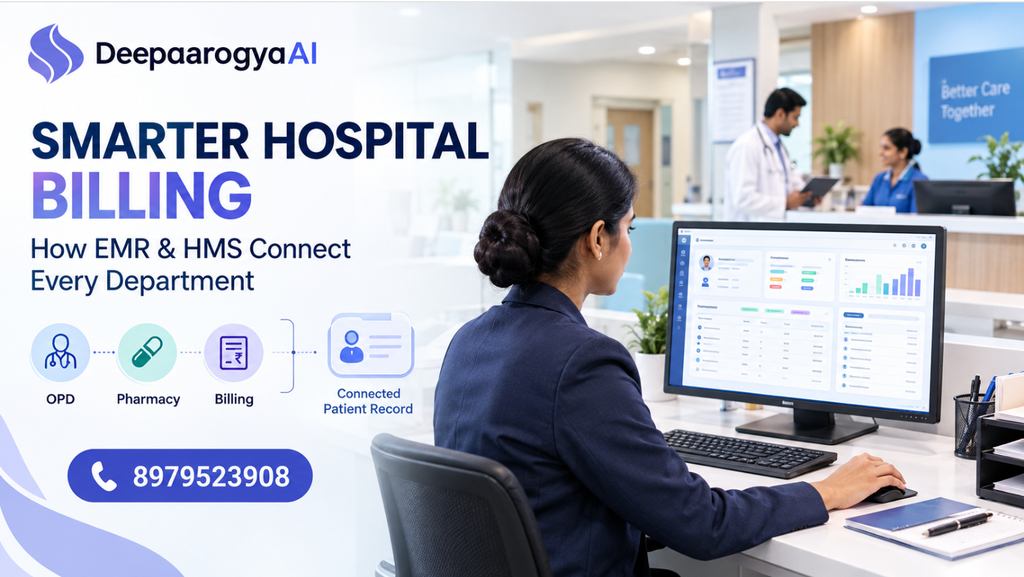
1. Understanding the Role of Billing in a Hospital
The billing department works at the intersection of clinical services and hospital administration. To perform its work effectively, the team needs accurate information about the services provided to each patient.
Consider a typical patient journey:
- The patient registers at the hospital reception.
- The doctor conducts a consultation and documents relevant clinical information.
- The patient may receive prescriptions, diagnostic services, or additional treatment.
- Other departments record their respective activities.
- The billing team processes the applicable charges and prepares the bill.
- The hospital maintains the necessary records for future reference.
Each stage can involve different staff members. When information is stored in separate systems or paper documents, the billing team may need to collect details from multiple sources.
A connected EMR and HMS can help make relevant patient and workflow information accessible across departments, reducing unnecessary dependence on repeated manual communication.
This is where hospital billing software needs to work alongside the hospital’s clinical and administrative workflows, rather than functioning as a completely separate system.
2. Common Problems Faced by Hospital Billing Departments
Problem 1: Repeated Data Entry Across Departments
When patient information is entered independently at reception, during consultation, and in administrative systems, staff may have to repeat the same work.
Repeated entry can also introduce inconsistencies, such as differences in patient details or mismatched records.
How DeepaarogyaAI helps:
DeepaarogyaAI supports a connected patient record that multiple departments can use. Its platform is designed to reduce repeated entry by connecting front-desk, doctor, pharmacy, and billing workflows.
With relevant information available through the shared record, teams can spend less time moving between disconnected records and more time completing their actual responsibilities.
Problem 2: Missing or Incomplete Service Information
A billing team may need to confirm what happened during a patient visit before completing administrative documentation.
If information is recorded in different places, staff may need to contact doctors or other departments to clarify the details.
How DeepaarogyaAI helps:
DeepaarogyaAI connects clinical documentation and administrative workflows through its EMR and HMS platform. This can help staff access relevant recorded information from the shared patient record.
The exact billing workflow depends on the hospital’s configuration, departmental processes, and the information documented by its teams.
Problem 3: Disconnected Pharmacy and Billing Workflows
Pharmacy-related information may be recorded separately from consultation details and other patient records. This can make it harder for hospital teams to coordinate their work.
How DeepaarogyaAI helps:
DeepaarogyaAI includes pharmacy and billing among the workflows supported by its hospital platform. Connecting these workflows with the broader patient record can help staff access relevant information without treating every department as an isolated system.
Hospitals should configure and verify their specific medication, inventory, charge calculation, and payment processes according to their operational requirements.
Problem 4: Difficulty Reviewing Patient Visit History
When a returning patient visits a hospital, the billing team may need to locate the appropriate visit or supporting documentation.
Searching through disconnected records can complicate the process, particularly when multiple departments have interacted with the same patient.
How DeepaarogyaAI helps:
The shared patient record provides a common information foundation for participating departments. Rather than relying entirely on separate departmental records, staff can work within a connected platform and refer to relevant recorded information.
Problem 5: Limited Coordination Between Clinical and Administrative Teams
Doctors and billing staff have different responsibilities, but their workflows are connected. Clinical documentation may provide context for administrative processes, while billing teams need reliable information to complete their work.
How DeepaarogyaAI helps:
DeepaarogyaAI brings clinical and administrative workflows together. Its customizable case sheets allow information to be organized according to departmental needs, helping teams use a system aligned with their work.
The objective is not to make every employee follow the same workflow. It is to make relevant information easier to access across the hospital.
3. How DeepaarogyaAI EMR and HMS Support Hospital Billing
DeepaarogyaAI’s approach combines connected patient records, customizable workflows, and department-level coordination.
A. One Connected Patient Record
A hospital may have several teams working with the same patient. When their information is scattered across disconnected systems, coordination becomes more difficult.
DeepaarogyaAI provides a connected record that supports workflows across the front desk, doctors, pharmacy, and billing.
For billing teams, this shared information foundation can help with accessing relevant patient and visit details without repeatedly searching for information across separate records.
B. Customizable Workflows for Different Hospitals
A small specialty clinic and a multi-specialty hospital do not necessarily follow identical billing procedures.
Their departmental structures, documentation needs, and service workflows can differ considerably.
DeepaarogyaAI supports customizable case sheets and department-specific workflows. This allows the platform to be configured around how a clinic or hospital operates rather than requiring every department to follow a rigid template.
For billing teams, the intended benefit is better alignment between the hospital’s established processes and its digital workflow.
C. Coordination With Other Departments
Billing depends on information generated throughout the patient journey.
DeepaarogyaAI connects multiple hospital workflows within the same platform, including OPD, IPD, pharmacy, and billing.
This creates a common operational foundation for departments that need to coordinate their work. The exact information available to each role will depend on the configured workflow and access permissions.
D. Desktop and Mobile Accessibility
Hospital staff may work at reception desks, consultation rooms, treatment areas, and administrative offices.
DeepaarogyaAI supports desktop and mobile use, providing flexibility for participating teams to access the platform in their working environments.
Access should be configured according to each employee’s responsibilities and the hospital’s data-security requirements.
E. AI-Assisted Administrative and Clinical Workflows
AI can support documentation-heavy healthcare workflows, but its role must be clearly defined.
DeepaarogyaAI offers AI agents that work with information from the connected patient record and prepare outputs for team review. Its website specifies that agent outputs remain subject to review and are not sent to patients without sign-off.
For hospital billing teams, the most appropriate use of connected AI is to support relevant documentation and information workflows where configured—not to assume that every invoice, insurance claim, or payment is automatically processed by AI.
Hospitals should confirm the availability of any billing-specific automation before adopting it as part of their financial operations.
4. What an Improved Hospital Billing Workflow Can Look Like
Consider a multi-specialty clinic that handles consultations, prescriptions, physiotherapy sessions, and nutrition services.
Before implementing a connected workflow, staff may need to switch between different records to find patient details and confirm which department has documented relevant information.
With a connected EMR and HMS approach, the workflow can be organized differently.
Step 1: Patient registration
The front desk creates or accesses the patient’s record and records the necessary registration information.
Step 2: Clinical consultation
The doctor documents the consultation and relevant clinical details in the EMR.
Step 3: Departmental services
Where applicable, pharmacy, physiotherapy, nutrition, or other configured departments record their respective information in the connected system.
Step 4: Billing coordination
The billing team accesses relevant patient and visit information through the configured workflow and completes the required billing activities.
Step 5: Record continuity
The hospital retains the relevant information within its connected patient-record workflow for authorized future reference.
This example illustrates how a connected workflow can be organized. The specific billing entries, automatic charge calculations, payment integrations, and claim-processing steps must be verified against the hospital’s actual DeepaarogyaAI configuration.
The broader principle is straightforward: billing should be connected to the patient journey, not isolated from it.
5. EMR vs HMS: What Does the Billing Department Need?
Electronic Medical Records (EMR) and Hospital Management Systems (HMS) serve related but distinct purposes.
| Area | EMR | HMS |
|---|---|---|
| Primary purpose | Organizes clinical records and documentation | Supports broader hospital operations |
| Doctor consultations | Records clinical information | Coordinates the operational workflow around visits |
| Patient history | Provides access to recorded clinical information | Helps connect patient information with administrative workflows |
| Billing | Provides relevant clinical context | Supports billing as part of hospital operations |
| Department coordination | Connects clinical information where configured | Connects participating clinical and administrative workflows |
For billing departments, the most useful solution is one that connects relevant clinical information with the hospital’s administrative processes.
DeepaarogyaAI brings EMR and HMS capabilities together in a platform designed for clinics and multi-specialty hospitals, with configurable workflows and a connected patient record.
The precise features available to a particular billing team depend on the modules and configuration selected by the hospital.
6. Benefits of a Connected Billing Workflow
When billing is supported by connected departmental information, hospitals can work toward several operational improvements.
Reduced Repetitive Administrative Work
Access to shared patient information can reduce the need to repeatedly enter or search for the same details.
Better Information Continuity
A connected patient record helps participating teams refer to relevant information documented across the patient journey.
Improved Departmental Coordination
Billing teams can work within a system that connects their processes with other hospital departments.
Greater Workflow Consistency
Customizable case sheets and departmental workflows help hospitals organize information according to their operating procedures.
A Foundation for Future Digital Improvements
A connected EMR and HMS platform can provide a common information foundation for additional configured workflows as the hospital’s requirements evolve.
These are potential operational benefits, not guaranteed financial outcomes. Actual improvements depend on workflow design, data quality, staff adoption, and implementation.
7. What Should Hospitals Evaluate Before Choosing Billing Software?
Before selecting a hospital billing solution, administrators should consider more than invoice generation.
Ask these questions:
- Can the billing workflow access relevant patient and visit information?
- Does the system connect billing with the departments that generate relevant records?
- Can workflows be customized to match the hospital’s operational requirements?
- Are staff access permissions and patient-data safeguards appropriately configured?
- Can the system support the hospital’s required payment, tax, insurance, and reporting processes?
- Which tasks are automated, and which require manual entry or approval?
- What onboarding, training, and ongoing support are available?
DeepaarogyaAI’s connected EMR and HMS approach addresses the importance of shared patient records and configurable departmental workflows. Hospitals should separately confirm specific financial features, regulatory requirements, integrations, and reporting capabilities during a product demonstration.
8. Why DeepaarogyaAI Is Relevant to Modern Hospital Billing
The challenge in hospital billing is not always the absence of software. Sometimes it is the lack of coordination between the systems that clinical and administrative teams use.
A billing tool that operates separately from the hospital’s patient records may solve one part of the process while leaving information gaps elsewhere.
DeepaarogyaAI takes a connected-platform approach by bringing clinical and administrative workflows together.
Its platform supports:
- Connected patient records across participating departments.
- Customizable case sheets designed around departmental requirements.
- EMR and HMS workflows for clinics and multi-specialty hospitals.
- Pharmacy, OPD, IPD, and billing modules within the broader platform.
- Desktop and mobile access for supported workflows.
- AI-assisted documentation workflows with review and sign-off requirements.
For hospitals looking to improve coordination, the key question is whether their billing process can work more effectively when relevant patient information is connected to the rest of the hospital’s operations.
That is the value of evaluating EMR and HMS together rather than considering billing in isolation.
Conclusion: Make Hospital Billing Part of a Connected Patient Journey
Hospital billing depends on information created by many teams. When records are fragmented, staff may spend additional time locating information, clarifying details, and repeating administrative work.
A connected EMR and HMS approach can help hospitals bring clinical and administrative workflows into a shared information environment.
DeepaarogyaAI helps connect patient records, clinical documentation, pharmacy, and billing workflows through a customizable hospital platform. For hospitals evaluating digital transformation, this provides a practical starting point for improving information continuity and departmental coordination.
The next step is to evaluate how the platform can be configured for your hospital’s existing billing procedures, financial requirements, and operational needs.
Ready to Explore Connected Hospital Workflows?
Discover how DeepaarogyaAI can support your hospital’s EMR and HMS requirements.
- Explore the platform: https://www.deepaarogya.com/
- Schedule a demo: https://calendar.google.com/calendar/u/0/appointments/schedules/AcZssZ0vSKKPxgfM4xlTbdYy6tpV9-iXMfsKmiOK87Q7JtKd3RWIndSlKV-CPisfq2AtrXm8Xywsc57a
- Contact the team: https://wa.me/918979523908?text=I’m%20interested%20in%20your%20AI%20Based%20EMR
Frequently Asked Questions
1. What is hospital billing software?
Hospital billing software helps healthcare organizations manage billing-related administrative processes, such as preparing bills and maintaining financial records. The available features vary by product and configuration.
2. How does EMR help hospital billing departments?
An EMR organizes patient-related clinical information. When connected to hospital administrative workflows, relevant recorded information can be easier for billing teams to access and verify.
3. What is the difference between EMR and HMS?
EMR primarily focuses on electronic clinical records and documentation. HMS supports broader hospital operations, including administrative and departmental workflows. An integrated platform can connect both functions.
4. How does DeepaarogyaAI support hospital billing?
DeepaarogyaAI includes billing within its broader EMR and HMS platform and connects participating departments through a shared patient record. The exact billing features depend on the hospital’s configured modules and workflows.
5. Can DeepaarogyaAI connect billing with other hospital departments?
DeepaarogyaAI is designed to connect front-desk, doctor, pharmacy, and billing workflows through the shared patient record. The specific information and permissions available to each department depend on the configuration.
6. Can hospital billing workflows be customized?
DeepaarogyaAI supports customizable case sheets and department-specific workflows. Hospitals should discuss their particular billing procedures and requirements with the team before implementation.
7. Does AI automatically generate every hospital bill or insurance claim in DeepaarogyaAI?
Hospitals should not assume that all billing or insurance tasks are automated. The platform offers AI-assisted workflows, but specific invoice generation, claim processing, payment automation, and insurance integrations must be confirmed with the DeepaarogyaAI team.
8. How can a hospital get started with DeepaarogyaAI?
Hospitals can visit https://www.deepaarogya.com/demo to schedule a demonstration and discuss their departmental workflows, billing requirements, and implementation needs.
- DeepaarogyaAI Products — EMR and HMS platform overview.
- Orthopedics EMR — Specialty workflow information.
- Physiotherapy EMR — Departmental coordination example.
- Nutrition & Dietetics — Connected nutrition workflow.
- Security & ABDM — Security and ABDM-related information.