
A doctor’s consultation may last only a few minutes, but the information created during that visit can remain important for weeks, months, or even years.
Symptoms discussed. Clinical observations. Investigations. Treatment decisions. Prescriptions. Advice. Next steps.
The challenge is that this information is not always captured in a way that makes the next patient interaction easier.
Doctors may have to review previous notes manually. Staff may spend time organizing information. Patients may repeat details they have already shared. And as the number of consultations increases, maintaining clear visit-by-visit documentation becomes increasingly difficult.
This is where AI-powered visit summaries can become useful.
Instead of treating every consultation as an isolated event, an AI-enabled EMR can help turn the encounter into a structured summary that remains connected to the patient’s record.
DeepaarogyaAI brings AI agents directly into the patient chart, including a Visit Summary Agent alongside agents for SOAP documentation, discharge summaries, nutrition and other healthcare workflows. The platform describes these AI outputs as drafts for professional review rather than autonomous clinical decisions.
The result is a simple workflow:
Consultation → AI-Assisted Summary → Professional Review → Structured Patient Record
What Is an AI Visit Summary?
An AI visit summary is a structured summary generated from information recorded during a patient encounter.
Instead of leaving a consultation as a collection of long notes, an AI system can help organize important information into a concise format.
Depending on the workflow, a visit summary may bring together information such as:
- Reason for the visit
- Relevant symptoms
- Clinical observations
- Investigations discussed
- Treatment decisions
- Prescriptions
- Recommendations
- Follow-up instructions
- Important changes since the previous visit
The purpose is not to replace the doctor’s clinical documentation.
The purpose is to reduce the effort required to organize information and make the patient’s record easier to understand.
For a growing clinic, this can become particularly valuable when doctors see many patients every day.
Why Traditional Consultation Documentation Can Become a Problem
A consultation does not end when the patient leaves the doctor’s room.
The information created during that consultation may need to support:
The next consultation → another department → pharmacy → billing → follow-up → future treatment
When documentation is inconsistent or difficult to review, every subsequent step can require additional effort.
1. Doctors spend time reviewing previous information
Before seeing a returning patient, the doctor may need to review previous notes, prescriptions, reports and treatment decisions.
If previous documentation is lengthy or inconsistent, finding the important information can take time.
2. Important information can get buried in long notes
A patient’s record may contain years of consultations.
The challenge is no longer simply storing information.
It is finding the relevant information at the right moment.
3. Patients may repeat information
When previous consultation details are difficult to access, patients may need to explain the same history again.
This can make the consultation feel repetitive.
4. Different team members may need different information
A doctor, physiotherapist, nutritionist, pharmacist or administrative team member may interact with the same patient.
Each professional may need a different part of the patient’s history.
5. Documentation quality can vary
Different doctors may document consultations in different styles.
One may write detailed notes.
Another may use short clinical terminology.
Another may structure information differently.
This can make longitudinal records harder to review.
What Changes When AI Creates a Visit Summary?
The biggest change is not simply automation.
It is structure.
Imagine a patient visits an orthopedic doctor.
During the consultation, the doctor records the relevant information and treatment plan.
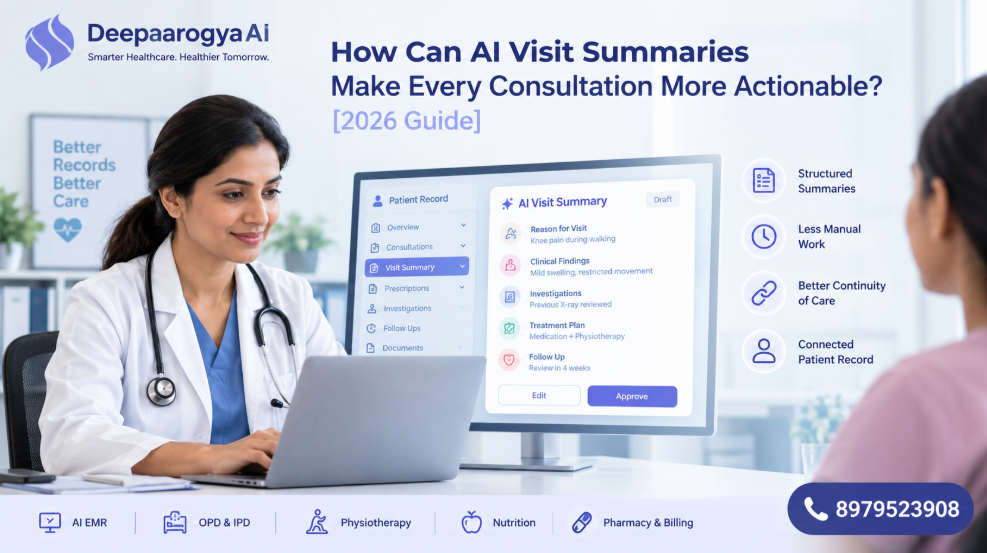
Instead of leaving that information as an unstructured block of notes, an AI-assisted system can generate a concise visit summary.
For example:
Patient Visit
Reason: Knee pain during walking
Clinical Information: Relevant findings documented during consultation
Investigation: Previous imaging reviewed
Treatment: Medication and rehabilitation recommended
Plan: Physiotherapy assessment and follow-up advised
The doctor can then review and modify the generated summary before it becomes part of the patient’s record.
This creates a workflow where AI handles part of the documentation workload while the healthcare professional remains responsible for the final information.
How DeepaarogyaAI Can Support AI-Assisted Visit Summaries
DeepaarogyaAI is positioned as an AI-powered hospital and clinic operating system that brings EMR, OPD, IPD, pharmacy, billing, physiotherapy, nutrition and AI agents into a connected healthcare environment.
One of the platform’s AI agents is designed for Visit Summaries.
The broader idea is important:
AI should work inside the patient record.
Instead of requiring a doctor to:
- Open a separate AI tool
- Copy patient information
- Generate a summary
- Copy the result back into the EMR
the AI workflow can operate around the existing chart.
This reduces unnecessary information movement between systems.
DeepaarogyaAI describes its AI agents as operating inside the chart, with outputs remaining subject to professional review and approval.
A Practical AI Visit Summary Workflow
Let’s look at how this can work in a real clinic.
Step 1: Patient Arrives
The patient is registered and their existing record is opened.
The doctor can access the relevant information already available in the EMR.
Step 2: Consultation Takes Place
The doctor discusses the patient’s symptoms, reviews relevant information and documents the consultation.
Step 3: AI Organizes the Visit
The Visit Summary Agent can assist in creating a structured summary from the information captured during the encounter.
Step 4: Doctor Reviews the Draft
The doctor checks the summary.
If necessary, they can edit, correct or add information.
Step 5: Final Record Is Maintained
After appropriate professional review, the summary becomes part of the patient’s structured digital record.
Step 6: Future Visits Become Easier to Review
During a later consultation, the healthcare professional can use the organized information to understand what happened previously.
This creates a continuous documentation cycle:
Visit → Summary → Review → Record → Next Visit
Why AI Visit Summaries Matter for Multi-Specialty Healthcare
The value becomes even more significant when patients interact with multiple departments.
Consider a patient who begins with an orthopedic consultation and later visits physiotherapy.
The orthopedic doctor may document:
- Diagnosis
- Clinical findings
- Treatment recommendations
- Restrictions
- Relevant investigations
The physiotherapist may then document:
- Functional assessment
- Therapy goals
- Treatment sessions
- Progress
- Outcomes
When both workflows are connected to the patient’s record, the information can remain part of the same broader patient journey.
DeepaarogyaAI supports connected workflows across areas including EMR, OPD, IPD, physiotherapy, nutrition, pharmacy, billing and other healthcare operations.
The objective is not to make every department use identical documentation.
Instead, each department can maintain its own workflow while contributing to the patient’s broader record.
AI Visit Summaries vs. Traditional Notes
| Traditional Documentation | AI-Assisted Visit Summary |
|---|---|
| Information may be lengthy | Information can be structured and concise |
| Manual organization | AI assists with organization |
| Doctor spends time formatting information | AI can prepare a draft |
| Previous notes may require extensive review | Key information can be easier to scan |
| Documentation style can vary | Structured summaries can improve consistency |
| Information may remain isolated within notes | Summary can remain connected to the patient record |
AI does not eliminate the need for professional documentation.
Instead, it can help make the documentation process more efficient.
AI Should Assist, Not Replace the Doctor
Healthcare documentation requires accuracy and professional responsibility.
That is why an AI-generated summary should not automatically become the final clinical record without appropriate review.
A safer workflow is:
Patient Information → AI Draft → Doctor/Authorized Professional Review → Approved Record
This distinction is important.
AI can help organize information, but clinical interpretation, correction and final approval should remain with the appropriately authorized healthcare professional.
DeepaarogyaAI’s platform specifically describes its AI outputs as drafts requiring clinician review rather than black-box autonomous diagnosis.
What Should Clinics Look for in an AI Visit Summary System?
Before adopting an AI-powered documentation workflow, healthcare organizations should consider several factors.
1. EMR Integration
The AI should work with the patient record rather than creating another disconnected information silo.
2. Professional Review
Healthcare professionals should be able to review, edit and approve generated information.
3. Structured Documentation
The system should make information easier to understand rather than simply generating longer text.
4. Department Compatibility
A multi-specialty organization may have different documentation requirements across OPD, IPD, physiotherapy, nutrition and other departments.
5. Patient Record Continuity
The summary should remain associated with the appropriate patient and encounter.
6. Data Security
Healthcare organizations should implement appropriate access controls and data-handling practices for sensitive patient information.
7. Workflow Fit
Technology should adapt to the clinic’s workflow instead of forcing doctors and staff to completely change how they work.
This is particularly relevant because DeepaarogyaAI describes its platform as configurable around workflows such as OPD, IPD, physiotherapy, nutrition and billing.
Beyond Documentation: Creating a More Useful Patient Record
The real opportunity with AI visit summaries is larger than saving a few minutes of typing.
It is about changing how healthcare organizations use their records.
A traditional EMR can store:
What happened.
An AI-assisted EMR can additionally help organize:
What happened → What was decided → What should be remembered → What comes next
That makes the patient record more useful as a working source of information.
For example:
First Visit
Patient presents with symptoms.
↓
Consultation
Doctor evaluates the patient and records findings.
↓
AI Visit Summary
The encounter is organized into a structured summary.
↓
Investigation
Relevant reports become part of the patient record.
↓
Treatment
Prescription or treatment plan is documented.
↓
Next Visit
The doctor can review the previous encounter more efficiently.
The record becomes a continuing clinical story rather than a collection of disconnected notes.
How DeepaarogyaAI Fits Into This Bigger Picture
DeepaarogyaAI is built around the idea of connecting healthcare workflows through one patient record.
Its platform combines:
AI EMR + AI HMS + Specialty Workflows + AI Agents
The website describes capabilities spanning OPD, IPD, pharmacy, billing, physiotherapy, nutrition and AI-assisted workflows.
Its AI agents include workflows for areas such as:
- SOAP documentation
- Visit summaries
- Discharge summaries
- Nutrition
- Voice reception
- WhatsApp follow-ups
The important distinction is that these are positioned as workflow assistants, not replacements for healthcare professionals.
This creates a model where:
Healthcare Team + Connected EMR + AI Assistance
work together instead of relying on disconnected tools.
The Future of Consultation Documentation
Healthcare documentation is moving beyond simply digitizing paper.
The next step is making digital records more useful.
AI-powered visit summaries can help healthcare organizations move toward:
Less manual organization
More structured information
Faster review of previous encounters
Better continuity between visits
More connected healthcare workflows
The goal is not to make doctors spend more time looking at technology.
It is to make technology handle appropriate documentation and information-organization tasks so healthcare professionals can focus on patient care.
With an AI-enabled EMR such as DeepaarogyaAI, the consultation can become more than a completed appointment.
It can become a structured, reviewable and connected part of the patient’s ongoing healthcare journey.
Final Takeaway
Every patient visit creates valuable information.
The challenge is making that information useful beyond the moment of consultation.
AI visit summaries can help transform individual consultations into structured patient records that are easier to review, maintain and connect with future healthcare workflows.
For clinics and hospitals, the opportunity is not simply to automate note-taking.
It is to build a healthcare environment where:
One consultation creates a clearer record.
One record supports the next interaction.
And every interaction contributes to a more connected patient journey.
That is where AI-powered EMR platforms like DeepaarogyaAI can become part of the next generation of healthcare workflows.
Ready to see how AI can fit into your clinic’s workflow?
Explore DeepaarogyaAI and discover how AI EMR, hospital workflows and AI agents can work together around one connected patient record.
👉 Book a DeepaarogyaAI Demo: https://calendar.google.com/calendar/u/0/appointments/schedules/AcZssZ0vSKKPxgfM4xlTbdYy6tpV9-iXMfsKmiOK87Q7JtKd3RWIndSlKV-CPisfq2AtrXm8Xywsc57a
Frequently Asked Questions
1. What is an AI visit summary?
An AI visit summary is a structured summary of information from a patient consultation that is generated with AI assistance and reviewed by an appropriate healthcare professional.
2. Can an AI visit summary replace a doctor’s notes?
No. AI-generated documentation should be treated as assistance. The healthcare professional should review, correct and approve the information as appropriate.
3. How can AI visit summaries help doctors?
They can help organize consultation information into a concise format, making previous encounters easier to review and reducing some repetitive documentation work.
4. Are AI visit summaries useful for returning patients?
Yes. A structured summary can make it easier to understand what happened during previous encounters and what information may be relevant to the next consultation.
5. Can visit summaries work with an EMR?
Yes. The most useful workflow is when the AI summary is connected to the patient’s existing digital record rather than being stored in a separate application.
6. Does DeepaarogyaAI have an AI Visit Summary Agent?
Yes. DeepaarogyaAI lists Visit Summary among its AI-agent workflows, alongside SOAP, discharge, nutrition, voice reception and other agents.
7. Does DeepaarogyaAI’s AI make autonomous clinical decisions?
The platform states that its AI outputs are drafts for professional review and are not intended to function as autonomous diagnosis.
8. Can DeepaarogyaAI support different healthcare departments?
DeepaarogyaAI describes connected workflows across areas including OPD, IPD, pharmacy, billing, physiotherapy, nutrition and other healthcare operations.
9. Is DeepaarogyaAI suitable only for hospitals?
No. The platform states that it is designed for individual clinics as well as multi-specialty hospitals, with different plans and modules based on organizational requirements.
10. How can I learn more about DeepaarogyaAI?
You can explore the platform and discuss your clinic or hospital workflow with the DeepaarogyaAI team through its website:https://www.deepaarogya.com/