
A patient may begin their healthcare journey with an orthopedic consultation and continue treatment through multiple physiotherapy sessions. But when clinical information is scattered across separate systems, notes, paper files, or conversations, maintaining continuity can become difficult.
The orthopedic doctor may document the diagnosis and treatment recommendation. The physiotherapist then needs to understand the patient’s condition, assessment requirements, restrictions, and therapy goals before creating a rehabilitation plan.
What happens when these two workflows are connected through one EMR?
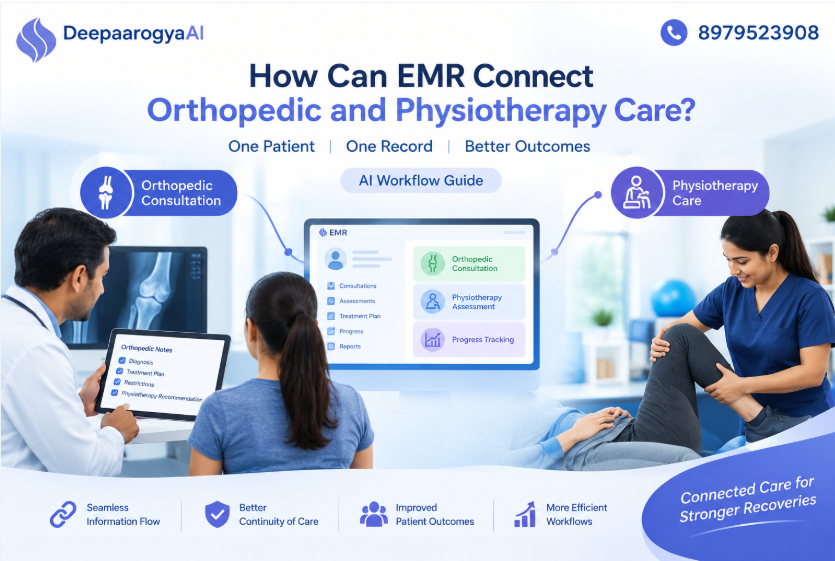
With DeepaarogyaAI, orthopedic and physiotherapy workflows can be connected around the patient’s clinical record. Instead of treating the consultation and rehabilitation process as two disconnected activities, the EMR can help create a more structured flow—from orthopedic assessment to physiotherapy evaluation, treatment planning, progress tracking, and continued clinical visibility.
The Problem: Orthopedic and Physiotherapy Care Can Become Disconnected
Consider a patient recovering from a knee injury.
The patient first visits an orthopedic doctor.
The doctor performs an examination, reviews the patient’s history, documents findings, and recommends physiotherapy.
The patient then visits a physiotherapist.
Now the physiotherapist needs to know:
- What was the orthopedic diagnosis?
- What treatment was recommended?
- Are there any restrictions?
- What areas need assessment?
- What is the expected rehabilitation goal?
- What should be monitored during therapy?
If this information isn’t easily available, the physiotherapist may have to depend on paper records, manually shared information, separate notes, or repeated conversations.
This creates unnecessary friction in the clinical workflow.
The challenge isn’t simply storing patient data.
The real challenge is making relevant clinical information available at the right point in the patient’s care journey.
What Should a Connected Orthopedic–Physiotherapy Workflow Look Like?
A connected workflow can follow the patient’s journey instead of forcing every department to work independently.
For example:
Orthopedic Consultation → Diagnosis → Physiotherapy Recommendation → Physiotherapy Assessment → Treatment Plan → Therapy Sessions → Progress Documentation → Orthopedic Review
Each stage contributes information to the patient’s overall record.
This means the physiotherapist doesn’t have to begin with an empty screen or reconstruct the patient’s history from scratch.
Instead, the workflow can begin with the clinical context already documented by the orthopedic team.
1. Start With the Orthopedic Consultation
The process begins with the orthopedic consultation.
The doctor can document relevant information such as:
- Patient history
- Presenting complaint
- Clinical findings
- Diagnosis
- Examination details
- Treatment recommendations
- Follow-up requirements
- Physiotherapy recommendation
The information becomes part of the patient’s digital clinical record.
This provides the foundation for the next stage of care.
Why does this matter?
When the physiotherapy workflow starts from the existing patient record, the therapist can work with existing clinical context rather than repeatedly collecting information that has already been documented.
2. Move From Referral to Physiotherapy Assessment
Once physiotherapy is recommended, the next step is assessment.
Physiotherapy isn’t simply about recording that a patient attended a session.
A physiotherapist may need to evaluate different aspects depending on the patient’s condition.
For example:
Musculoskeletal assessment
The workflow may include relevant observations around:
- Pain
- Range of motion
- Strength
- Mobility
- Functional limitations
- Movement patterns
- Treatment goals
Post-operative rehabilitation
The assessment may instead focus on:
- Surgical history
- Recovery stage
- Functional limitations
- Restrictions
- Mobility
- Rehabilitation goals
- Progress over time
A flexible EMR workflow allows the assessment process to be structured according to the clinical requirement.
3. Create a Structured Physiotherapy Treatment Plan
After assessment, the physiotherapist can create a treatment plan based on the patient’s documented condition and rehabilitation requirements.
The plan can organize information such as:
Assessment → Goals → Protocol → Exercises/Interventions → Frequency → Progress Tracking
This is important because physiotherapy is often an ongoing process rather than a single interaction.
A structured treatment plan creates a clearer connection between the patient’s initial condition and subsequent sessions.
Instead of having isolated session notes, the patient’s record can show how treatment progresses over time.
4. Different Conditions Can Follow Different Protocols
Not every orthopedic patient needs the same physiotherapy workflow.
A patient recovering from a knee condition may require a different rehabilitation approach from someone recovering from a shoulder injury.
Similarly, post-operative rehabilitation can have different clinical requirements from general pain-management therapy.
This is where workflow flexibility becomes important.
An EMR can support different assessment and treatment workflows based on the department, specialty, or clinical requirement.
For example:
Orthopedic Doctor
Diagnosis → Clinical Recommendation → Physiotherapy Requirement
↓
Physiotherapist
Assessment → Protocol → Treatment Plan → Session Tracking
↓
Follow-Up
Progress → Updated Plan → Continued Care
The workflow remains connected while allowing each professional to work within their own clinical process.
5. Keep the Orthopedic Doctor Connected to Rehabilitation Progress
The connection shouldn’t stop after the initial referral.
Suppose the patient has completed several physiotherapy sessions.
The physiotherapist may document:
- Current symptoms
- Functional progress
- Assessment findings
- Treatment performed
- Patient response
- Progress toward goals
- Further therapy requirements
This information can contribute to the patient’s ongoing clinical record.
When the patient returns to the orthopedic doctor, the doctor can have access to the relevant treatment history instead of relying only on what the patient remembers.
This creates a more continuous information flow between diagnosis and rehabilitation.
How DeepaarogyaAI Can Support This Workflow
DeepaarogyaAI brings the orthopedic and physiotherapy workflows into a connected EMR environment.
Instead of creating completely separate records for each interaction, the system can organize patient information around the broader care journey.
Orthopedic workflow
Patient → Consultation → Assessment → Diagnosis → Treatment Recommendation
Physiotherapy workflow
Patient → Assessment → Treatment Plan → Protocol → Sessions → Progress
Connected workflow
Orthopedic Recommendation → Physiotherapy Assessment → Treatment → Progress → Continued Clinical Context
The objective is simple:
One patient. One connected clinical record. Multiple stages of care.
AI Can Make the Workflow More Organized
An AI-enabled EMR can go beyond simply storing information.
AI capabilities can help reduce some of the repetitive work involved in managing clinical documentation and patient information.
For example, relevant information from the patient’s digital record can help clinicians work from a more organized view of the patient’s history and ongoing care.
Instead of spending time searching through disconnected information, clinicians can work within a structured digital workflow.
This becomes particularly valuable when a patient has:
- Multiple consultations
- Repeated physiotherapy sessions
- Previous treatment history
- Different clinical assessments
- Ongoing rehabilitation requirements
The goal isn’t to replace clinical judgment.
The goal is to help organize information so healthcare professionals can spend more attention on the patient and less on administrative friction.
From First Assessment to Progress Tracking
One of the biggest advantages of a connected EMR workflow is that treatment doesn’t exist as isolated events.
Consider this patient journey:
Visit 1: Orthopedic Consultation
The doctor evaluates the patient and recommends physiotherapy.
Visit 2: Physiotherapy Assessment
The physiotherapist reviews the available clinical context and performs the required assessment.
Visit 3–8: Therapy Sessions
Treatment sessions and patient progress are documented.
Follow-Up: Orthopedic Review
The doctor can review the patient’s available rehabilitation information as part of the ongoing clinical record.
This creates a longitudinal view of care.
Instead of seeing only the initial consultation, the patient’s record can reflect what happened afterward.
Why This Matters for Multi-Specialty Healthcare
Healthcare delivery increasingly involves multiple professionals.
An orthopedic patient may interact with:
- Orthopedic doctors
- Physiotherapists
- Nurses
- Diagnostic teams
- Other specialists
- Administrative teams
When every department maintains disconnected information, continuity becomes harder.
A connected EMR provides a foundation where relevant information can move through the patient’s care journey.
For healthcare organizations, this can help create more standardized digital workflows while still allowing individual departments to follow their specific processes.
What a Connected Physiotherapy EMR Workflow Can Look Like
A simplified DeepaarogyaAI workflow could look like this:
1. Patient Registration
↓
2. Orthopedic Consultation
↓
3. Diagnosis & Clinical Assessment
↓
4. Physiotherapy Recommendation
↓
5. Physiotherapy Assessment
↓
6. Protocol & Treatment Plan
↓
7. Therapy Sessions
↓
8. Progress Documentation
↓
9. Orthopedic Follow-Up
↓
10. Continued Care
This creates a digital connection between the patient’s initial clinical evaluation and rehabilitation journey.
Connected Care Doesn’t Mean One Workflow for Everyone
A common mistake in healthcare technology is trying to force every department into the same workflow.
Orthopedics and physiotherapy have different documentation requirements.
The better approach is to create a connected system where:
The patient record is shared, but workflows can remain specialty-specific.
The orthopedic doctor can follow an orthopedic workflow.
The physiotherapist can follow a physiotherapy workflow.
Yet both can remain connected through the patient’s broader digital record.
This balance between specialized workflows and connected information is essential for multidisciplinary healthcare.
How DeepaarogyaAI Changes the Approach
Traditional healthcare workflows often look like:
Department A → Separate Documentation → Department B → Re-enter Information → Separate Follow-Up
A connected AI-powered EMR can move toward:
Shared Patient Context → Specialty-Specific Workflow → Continuous Documentation → Connected Care
This isn’t just about replacing paper.
It is about creating a more organized digital infrastructure around the patient’s journey.
With DeepaarogyaAI, healthcare organizations can build workflows where orthopedic and physiotherapy teams can work within their respective processes while maintaining continuity around the patient record.
The Future of Orthopedic and Physiotherapy Care Is More Connected
Orthopedic treatment and physiotherapy are not isolated events.
For many patients, diagnosis is only the beginning.
The next stages—assessment, rehabilitation, therapy, progress monitoring, and follow-up—are equally important parts of the care journey.
A connected EMR can help bring these stages together.
DeepaarogyaAI helps healthcare teams move from disconnected documentation toward connected, specialty-specific digital workflows.
From the orthopedic consultation to physiotherapy assessment and treatment planning, the patient’s clinical journey can remain organized within a connected EMR environment.
Frequently Asked Questions
1. Can an EMR connect orthopedic and physiotherapy workflows?
Yes. A connected EMR can link the orthopedic consultation and physiotherapy workflow through the patient’s digital clinical record, while allowing each specialty to maintain its own workflow.
2. Can physiotherapists create structured assessments in an EMR?
A physiotherapy-focused workflow can be configured to capture relevant assessment information, treatment plans, protocols, and progress documentation.
3. Can orthopedic doctors access physiotherapy information?
When both workflows are connected within the same EMR environment, relevant physiotherapy documentation can form part of the patient’s ongoing clinical record and support continuity during subsequent consultations.
4. Does every physiotherapy patient need the same workflow?
No. Different conditions and rehabilitation requirements may require different assessment and treatment processes. A flexible EMR can support specialty- and workflow-specific configurations.
5. How can AI help orthopedic and physiotherapy workflows?
AI can assist with organizing and working with clinical information and reducing repetitive documentation-related tasks, while healthcare professionals remain responsible for clinical assessment and decisions.
6. Is DeepaarogyaAI only for orthopedic clinics?
DeepaarogyaAI is designed around broader healthcare workflows, with the ability to support different specialties and departments through connected digital workflows.
Conclusion
Orthopedic care doesn’t end when the patient leaves the consultation room.
For many patients, it continues through assessment, physiotherapy, rehabilitation, progress tracking, and follow-up.
When these stages operate in disconnected systems, valuable clinical context can become difficult to access and workflows can become repetitive.
A connected EMR changes that approach.
With DeepaarogyaAI, orthopedic and physiotherapy workflows can be connected through a structured digital patient record—allowing specialty-specific processes while maintaining continuity across the patient’s care journey.
From orthopedic consultation to physiotherapy treatment, connect the complete journey with DeepaarogyaAI.
Ready to build connected healthcare workflows?
Explore DeepaarogyaAI and discover how an AI-powered EMR can support your clinic or hospital’s digital workflow.
Website: https://www.deepaarogya.com/
Contact: 8979523908
Book a Demo: https://calendar.google.com/calendar/u/0/appointments/schedules/AcZssZ0vSKKPxgfM4xlTbdYy6tpV9-iXMfsKmiOK87Q7JtKd3RWIndSlKV-CPisfq2AtrXm8Xywsc57a