
Healthcare teams generate and handle a huge amount of patient information every day.
A patient registers at the front desk. A doctor records the consultation. The patient may then visit radiology, the laboratory, pharmacy, physiotherapy, nutrition, or billing.
But in many healthcare environments, the same patient information can end up being entered multiple times across different workflows.
A name is typed again.
A patient ID is searched again.
A diagnosis is copied into another system.
A prescription is manually shared with another department.
A report is downloaded and uploaded somewhere else.
Over time, these small tasks create a much bigger operational problem: duplicate data entry.
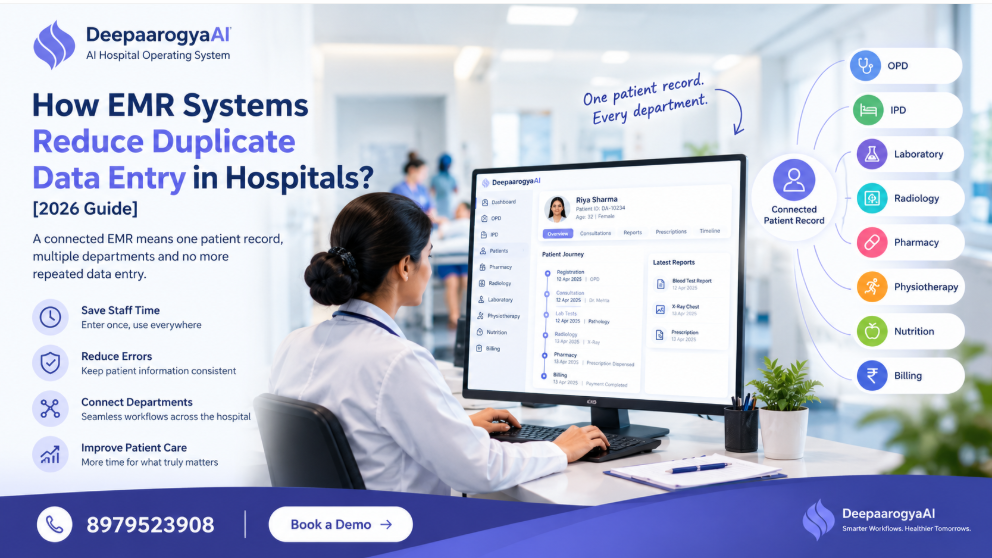
A modern EMR should not simply digitize paperwork. It should help healthcare teams work from a connected patient record, so information entered once can support the workflows that need it.
This is where DeepaarogyaAI takes a connected approach to healthcare management.
DeepaarogyaAI brings EMR, OPD, IPD, pharmacy, billing, radiology, physiotherapy, nutrition and AI-assisted workflows around a shared patient record.
What Is Duplicate Data Entry in Healthcare?
Duplicate data entry happens when the same patient or clinical information has to be entered, copied, or transferred manually into multiple systems.
For example:
- Reception registers the patient.
- The doctor enters patient information into the EMR.
- The laboratory asks for the same information.
- Radiology enters it again.
- Pharmacy searches for or re-enters prescription details.
- Billing creates another patient record.
- Another department may repeat the process.
Individually, each step may seem small.
Across hundreds of patients, however, these repeated actions can consume significant staff time.
More importantly, they can make healthcare workflows less connected.
Why Does Duplicate Data Entry Become a Problem?
1. Staff Spend Time Entering Information Instead of Using It
Healthcare professionals need patient information to make decisions and complete their responsibilities.
But when teams repeatedly enter the same information, valuable time goes toward data administration rather than workflow execution.
For example, a staff member may already have a patient’s details in one system but still need to manually enter them into another application.
A connected EMR can reduce unnecessary repetition by allowing departments to work around the same patient record.
2. Repeated Entry Can Create Inconsistencies
Imagine a patient’s information is entered into three different systems.
One system has an updated phone number.
Another contains an older address.
A third has a slightly different spelling of the patient’s name.
Now staff members have to determine which information is correct.
The more disconnected systems a hospital uses, the more difficult it can become to maintain consistent information across workflows.
3. Clinical Context Can Get Lost Between Departments
Healthcare is not a collection of independent departments.
A patient’s journey can move through:
Registration → OPD → Diagnostics → Pharmacy → Physiotherapy → Billing → Follow-up
Each stage can generate information relevant to the next stage.
If departments operate independently, staff may need to search for information, request it from another team, or manually transfer it.
A connected patient record creates a different model:
One patient → One connected record → Multiple departments
What Should a Modern EMR Do?
An effective EMR should do more than store medical records.
It should help connect the workflows surrounding those records.
A modern healthcare platform should ideally support:
- Patient registration
- OPD workflows
- IPD and case sheets
- Digital prescriptions
- Laboratory workflows
- Radiology
- Pharmacy
- Billing
- Physiotherapy
- Nutrition
- Patient communication
- AI-assisted documentation
DeepaarogyaAI brings these capabilities together around a connected patient record rather than treating every department as a separate digital silo.
How DeepaarogyaAI Helps Reduce Repetitive Data Entry
1. One Patient Record Across Departments
One of the biggest advantages of a connected EMR is that different teams can work from the same patient record.
For example, information recorded during an OPD consultation can remain connected to the patient’s broader chart.
The patient’s journey doesn’t need to become a series of disconnected records.
DeepaarogyaAI describes this approach as “Every department, one connected record.”
This can help reduce unnecessary re-entry and make relevant information easier to access.
2. EMR Connected With OPD and IPD
Patient information shouldn’t stop at the consultation screen.
OPD and IPD workflows can generate information throughout the patient’s journey.
With DeepaarogyaAI, EMR is connected with both OPD and IPD workflows, allowing healthcare organizations to manage outpatient and inpatient information within the same broader system.
This creates continuity between different stages of care.
3. Pharmacy Linked With the Patient Record
Pharmacy workflows often depend on prescription information.
Instead of treating pharmacy as a completely separate workflow, connecting it to the patient record allows prescriptions and dispensing activities to remain associated with the relevant patient.
DeepaarogyaAI includes pharmacy functionality linked directly to the EMR.
That means the patient record becomes more than a doctor’s documentation space—it becomes part of the broader healthcare workflow.
4. Radiology Information Stays Connected
Diagnostic information is an important part of the patient journey.
If imaging orders and reports are separated from the patient’s clinical record, doctors and staff may have to switch systems or manually locate reports.
DeepaarogyaAI connects radiology orders, queues and reports with the patient chart, reducing the need for separate information silos.
5. Physiotherapy and Nutrition Can Work From the Same Patient Context
Specialty workflows often have their own requirements.
A physiotherapy team may need treatment protocols, outcomes, assignments and session information.
A nutrition team may need relevant clinical information before preparing a plan.
DeepaarogyaAI supports physiotherapy workflows and Nutrition AI within the broader connected patient record.
This is particularly useful for clinics where patients move between multiple specialties.
What About Documents and External Tools?
Not every healthcare document necessarily lives inside the EMR itself.
Hospitals may already use tools such as Google Drive, WhatsApp, Google Meet, Google Calendar or Google Docs.
The challenge is making these tools work with the patient workflow rather than becoming disconnected information silos.
DeepaarogyaAI supports integrations including:
- Google Drive patient-file synchronization
- WhatsApp e-prescriptions
- WhatsApp follow-up and reminders
- Google Meet for telemedicine
- Google Calendar
- Google Docs
- Hospital connectors and APIs
For example, clinical files such as X-rays, surgery photos, laboratory PDFs and reports can be synchronized with the relevant patient chart through Google Drive integration.
AI Can Reduce Documentation Work Too
Duplicate data entry isn’t limited to patient demographics.
Doctors also spend time creating clinical documentation.
Consultation notes, SOAP notes, patient summaries and discharge documentation can all require significant manual work.
DeepaarogyaAI includes AI agents that work inside the patient chart, including a SOAP agent and other clinical workflow agents. The outputs are designed as drafts for clinician review rather than autonomous diagnosis.
For example, the SOAP Agent can create structured SOAP notes in 22 languages, which clinicians can review before finalizing.
This creates an important distinction:
AI assists documentation; the clinician remains responsible for reviewing and approving the final information.
Duplicate Data Entry vs Connected EMR
| Traditional Disconnected Workflow | Connected EMR Approach |
|---|---|
| Same information entered multiple times | Shared patient record |
| Separate departmental systems | Connected workflows |
| Manual transfer of information | Information available across connected modules |
| Reports searched in different locations | Reports linked to patient chart |
| Pharmacy works separately | Pharmacy connected with EMR |
| Specialty departments maintain isolated information | Specialty workflows connected to the patient journey |
| AI operates outside the clinical workflow | AI agents can work inside the chart |
The objective isn’t simply to eliminate every manual action.
The objective is to make sure that manual work happens where it adds value—not because systems cannot communicate with each other.
Why This Matters for Growing Clinics and Hospitals
As a healthcare organization grows, the number of patients, departments, employees and workflows increases.
A small amount of duplication can become a major operational burden at scale.
A growing multi-specialty hospital may have:
Front Desk → Doctors → Laboratory → Radiology → Pharmacy → Physiotherapy → Nutrition → Billing
If every department maintains isolated information, coordination becomes increasingly difficult.
A connected EMR provides a foundation where these workflows can operate around the same patient record.
DeepaarogyaAI is designed for both individual clinics and multi-specialty hospitals, with configurable modules and specialties that can grow with the organization.
How to Evaluate an EMR for Data Duplication
Before selecting an EMR, healthcare organizations can ask:
1. Does every department use the same patient record?
If not, understand how information moves between systems.
2. Does the EMR connect clinical and operational workflows?
Look beyond basic record storage.
3. Can laboratory and radiology information remain connected?
Diagnostic information should be easy to associate with the correct patient and visit.
4. Is pharmacy connected to prescriptions?
A connected prescription-to-pharmacy workflow can reduce unnecessary information transfer.
5. Can specialty workflows be configured?
Different departments may require different case sheets and workflows.
6. Can AI work inside the clinical workflow?
AI is more useful when clinicians don’t have to repeatedly move information between separate applications.
7. Can the system integrate with existing tools?
Hospitals may already depend on communication, document storage and telemedicine platforms.
The Bigger Idea: Enter Information Once, Use It Across the Journey
The goal of digital healthcare should not be:
“We replaced paper with software.”
It should be:
“We connected the information created throughout the patient’s journey.”
When registration, consultation, diagnostics, pharmacy, specialty care and billing can work around a connected patient record, healthcare teams can spend less time moving information between systems and more time using it.
That is the principle behind DeepaarogyaAI’s approach.
One patient. One connected record. Multiple healthcare workflows.
Why DeepaarogyaAI for Modern Healthcare Workflows?
DeepaarogyaAI combines an AI Hospital Operating System, EMR, OPD, IPD, pharmacy, billing, radiology, physiotherapy, nutrition and AI agents within one connected ecosystem.
Its platform is designed around the idea that healthcare organizations shouldn’t have to rebuild their processes around rigid software.
Instead, workflows can be configured around the way the clinic or hospital actually operates.
From connected patient records to AI-assisted documentation and integrated departmental workflows, the focus is on reducing fragmentation across the healthcare journey.
Ready to move beyond disconnected healthcare workflows?
Explore DeepaarogyaAI and see how a connected EMR can fit into your clinic or hospital.
Website: https://www.deepaarogya.com/
Frequently Asked Questions
1. What is duplicate data entry in healthcare?
Duplicate data entry occurs when the same patient or clinical information is manually entered into multiple systems or workflows.
2. Can an EMR reduce duplicate data entry?
Yes. A connected EMR can reduce unnecessary repetition by allowing multiple departments to access and work from a shared patient record.
3. Is DeepaarogyaAI only an EMR?
No. DeepaarogyaAI is positioned as an AI Hospital Operating System combining EMR, OPD, IPD, pharmacy, billing, radiology, physiotherapy, nutrition and AI agents.
4. Does DeepaarogyaAI support specialty workflows?
Yes. The platform supports configurable workflows for areas such as OPD, IPD, physiotherapy and nutrition, among others.
5. Can AI-generated clinical information be reviewed by doctors?
Yes. DeepaarogyaAI describes its AI-agent outputs as drafts for clinician review and approval rather than autonomous diagnosis.
6. Can patient documents be connected to the EMR?
Yes. DeepaarogyaAI supports Google Drive synchronization so clinical files such as X-rays, photos, laboratory PDFs and reports can be linked to the appropriate patient and visit.