
When a patient moves from one department to another, the quality of information transfer can directly affect how smoothly the next step of care begins.
A patient may first visit an OPD doctor, then be referred for radiology, physiotherapy, nutrition, another specialist, or inpatient care. If the next team has to search through separate systems, paper files, messages, or ask the patient to repeat information, the workflow becomes fragmented.
This is where an EMR system can become more than a digital record.
A well-connected EMR can help make relevant patient information available across authorized workflows, so each department can continue from the information already captured instead of starting from zero.
DeepaarogyaAI approaches healthcare management around a connected patient record, bringing EMR, OPD, IPD, pharmacy, billing, radiology, physiotherapy, nutrition, e-prescriptions, and AI-assisted workflows into one ecosystem.
The question is no longer simply:
“Does the hospital have an EMR?”
It is:
“Can the EMR help information move with the patient?”
What Is a Doctor Handover in Healthcare?
A doctor handover happens when responsibility for a patient’s care moves from one healthcare professional or department to another.
For example:
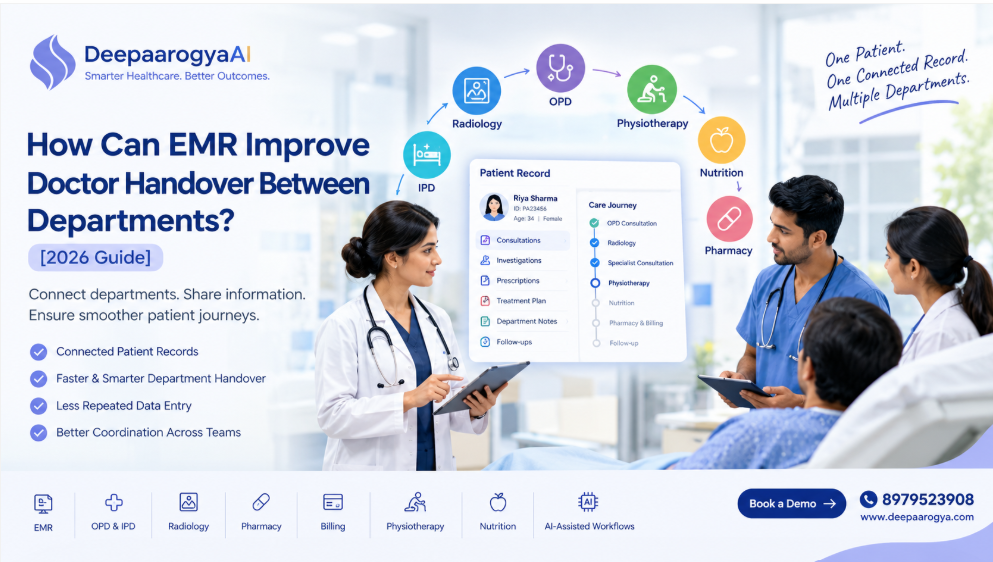
OPD → Specialist → Radiology → Physiotherapy → Follow-up
At every stage, the next professional may need relevant information about the patient’s previous interaction.
This can include:
- Patient history
- Diagnosis
- Symptoms
- Clinical observations
- Previous treatment
- Investigations
- Prescriptions
- Procedures
- Follow-up instructions
- Department-specific notes
When this information is available within the patient’s digital record, the next team can work with existing context.
When it is scattered across different systems, the handover can become dependent on manual communication.
Why Department-to-Department Handover Can Become Difficult
Healthcare organizations often have multiple teams working on the same patient’s journey.
A doctor may document the consultation in an EMR.
The radiology team may generate a report separately.
The physiotherapist may maintain session information in another workflow.
The billing team may use another system.
The patient may receive instructions through WhatsApp.
Each individual process may work, but the handoff between processes can still be difficult.
Common challenges include:
1. Repeated Information Entry
Staff may need to enter information that has already been recorded elsewhere.
2. Searching for Previous Records
Doctors and staff may spend time looking for previous consultations, reports, prescriptions, or notes.
3. Incomplete Context
The receiving department may not immediately have all the information relevant to the next step.
4. Manual Communication
Important information may have to be communicated through calls, messages, paper documents, or verbal instructions.
5. Disconnected Department Workflows
Different departments may maintain separate records instead of working around one patient chart.
These challenges become more significant as a healthcare organization adds doctors, departments, locations, and services.
How Can an EMR Improve Doctor Handover?
A modern EMR can create a shared digital information layer around the patient.
Instead of treating every department as an independent workflow, the patient’s record can connect the relevant stages of care.
For example:
Patient Registration
↓
OPD Consultation
↓
Investigation / Radiology
↓
Specialist Consultation
↓
Physiotherapy / Nutrition
↓
Pharmacy & Billing
↓
Follow-Up
The exact workflow can differ between organizations, but the principle remains the same:
The patient’s information should remain connected as the patient moves through the healthcare system.
DeepaarogyaAI is designed around this connected-record approach, with workflows spanning areas such as EMR, OPD, IPD, radiology, pharmacy, billing, physiotherapy and nutrition.
1. Give the Receiving Doctor Relevant Patient Context
Imagine an orthopedic patient being referred to physiotherapy.
Without a connected record, the physiotherapist may need to ask:
- What was the diagnosis?
- What treatment was prescribed?
- What investigations were completed?
- What did the doctor recommend?
- When should therapy begin?
- What follow-up is expected?
With relevant information available in the connected patient record, the physiotherapy workflow can start with existing context.
This does not eliminate the need for professional assessment.
Instead, it can reduce unnecessary information gaps between departments.
DeepaarogyaAI supports specialty-focused workflows, including orthopedic and physiotherapy workflows, within its broader healthcare platform.
2. Connect OPD and IPD Information
A patient’s journey can move between outpatient and inpatient care.
For example:
OPD Consultation → Admission → Treatment → Discharge → Follow-Up
If information is maintained separately, staff may have to manually transfer important details between workflows.
A connected EMR can keep relevant information associated with the patient’s record throughout these stages.
DeepaarogyaAI includes both OPD and IPD workflows, allowing healthcare organizations to manage outpatient and inpatient processes within the same broader platform.
This can make transitions easier to manage because the patient record does not have to begin again at every stage.
3. Make Investigation Information Easier to Access
Investigations are often an important part of clinical workflows.
A doctor may order a test during consultation.
The patient may then visit a laboratory or radiology department.
The resulting information becomes relevant to the next clinical decision.
A connected workflow can associate investigation information with the appropriate patient record rather than treating it as an isolated document.
DeepaarogyaAI includes radiology workflows and supports connecting reports and patient information within the broader record.
This creates a clearer information trail:
Consultation → Investigation → Report → Clinical Review
4. Reduce Repeated Questions for Patients
A fragmented handover does not only affect healthcare professionals.
It can also affect the patient.
Imagine a patient explaining the same medical history to:
- The OPD doctor
- A specialist
- A physiotherapist
- A nutritionist
- Another doctor during follow-up
Some repetition may always be necessary because professionals need to confirm information.
But patients should not have to become the primary system for transferring information between departments.
A connected patient record can help healthcare teams access information that has already been documented.
This is one of the reasons connected patient records are becoming an important part of modern healthcare workflows. DeepaarogyaAI specifically positions its platform around keeping different stages of the patient journey connected.
5. Support Better Coordination Between Clinical and Operational Teams
A handover does not only happen between doctors.
Healthcare involves several teams.
For example:
Doctor → Pharmacy
The prescription needs to be available for dispensing.
Doctor → Billing
The relevant service or procedure may need to be reflected in billing.
Doctor → Physiotherapy
The physiotherapy team may need relevant treatment information.
Doctor → Nutrition
The nutrition workflow may require appropriate patient and clinical context.
IPD → Discharge
Discharge documentation may need information collected during the patient’s hospital stay.
A connected platform can bring these workflows closer together instead of treating them as completely independent systems.
DeepaarogyaAI combines clinical and operational modules including EMR, OPD, IPD, pharmacy, billing, physiotherapy, nutrition, radiology and e-prescriptions.
6. AI Can Further Support Information Handover
Once information is available within a connected patient record, AI-assisted workflows can help healthcare professionals work with that information.
For example, AI can assist with creating:
- Patient summaries
- SOAP-note drafts
- Discharge-summary drafts
- Nutrition plans
- Visit summaries
- Follow-up workflows
DeepaarogyaAI’s AI workflows are designed to operate around the connected patient record, with outputs intended for professional review and approval rather than replacing clinical decision-making.
This creates a useful model:
Patient Data → AI-Assisted Draft → Professional Review → Final Record
The important part is that AI is connected to the workflow rather than functioning as an isolated chatbot.
What Does an Efficient Handover Workflow Look Like?
Consider a patient visiting an orthopedic clinic.
Step 1: OPD Consultation
The doctor records:
- Symptoms
- Clinical findings
- Diagnosis
- Investigations
- Treatment plan
Step 2: Investigation
The patient is sent for an appropriate investigation.
The report becomes part of the patient’s digital information.
Step 3: Specialist or Physiotherapy Referral
The next department accesses the relevant information available within the patient record.
Step 4: Department Action
The receiving professional documents their assessment and treatment.
Step 5: Billing and Pharmacy
Relevant operational workflows continue using the connected patient information.
Step 6: Follow-Up
The next appointment or follow-up activity remains associated with the same patient journey.
Instead of:
Department A → Manual Transfer → Department B
the model becomes:
One Patient → One Connected Record → Multiple Authorized Workflows
Why This Matters as Hospitals Grow
Handover challenges can become more noticeable as a healthcare organization expands.
A small clinic may have:
- 2 doctors
- 1 specialty
- Limited departments
A growing healthcare organization may have:
- Multiple doctors
- Multiple specialties
- OPD
- IPD
- Pharmacy
- Radiology
- Physiotherapy
- Nutrition
- Billing
- Multiple locations
The number of interactions increases significantly.
This is why choosing an EMR should involve more than asking whether it can store patient information.
Healthcare organizations should also consider:
Can the system connect information across the workflows we actually use?
What Should You Look for in an EMR for Better Handover?
Before selecting an EMR, healthcare organizations can evaluate whether it provides:
Connected Patient Records
Can different authorized workflows work around the same patient record?
Specialty Workflows
Can the system accommodate different departments and specialties?
OPD and IPD Integration
Can outpatient and inpatient information remain connected?
Investigation Integration
Can relevant diagnostic information be associated with the patient record?
Pharmacy and Billing Connectivity
Can clinical and operational workflows work together?
AI-Assisted Documentation
Can AI help prepare summaries or documentation while keeping professionals in control?
Digital Prescriptions
Can prescriptions be generated and shared through the workflow?
Customization
Can workflows adapt to how the organization actually operates?
These capabilities help shift the focus from digital record keeping to connected healthcare operations.
How DeepaarogyaAI Supports Connected Handover Workflows
DeepaarogyaAI is positioned as an AI-powered healthcare platform designed around a connected patient record.
Its ecosystem brings together:
- EMR
- OPD
- IPD
- Pharmacy
- Billing
- Radiology
- Physiotherapy
- Nutrition
- e-Prescriptions
- AI-assisted workflows
The platform also supports AI workflows such as SOAP documentation, discharge summaries, nutrition, patient summaries and WhatsApp follow-ups.
The underlying idea is simple:
One patient. One connected record. Multiple healthcare workflows.
Instead of asking every department to maintain an isolated version of the patient’s journey, DeepaarogyaAI brings relevant workflows around the same patient record.
The Future of EMR Is More Than Digital Documentation
An EMR should not simply replace a paper file.
Its greater value can come from helping healthcare organizations connect information, departments, and workflows around the patient.
When a patient moves from OPD to radiology, from radiology to a specialist, from a specialist to physiotherapy, or from IPD to discharge and follow-up, the information should move with the patient.
That is the direction of connected healthcare technology.
DeepaarogyaAI brings EMR, hospital workflows, specialty modules, integrations and AI-assisted capabilities together around a connected patient record.
For clinics and hospitals looking to move beyond standalone digital records, the next step is not simply more software.
It is better-connected workflows.
Frequently Asked Questions
What is doctor handover in healthcare?
Doctor handover is the transfer of relevant patient information and responsibility from one healthcare professional or department to another during a patient’s care journey.
Can an EMR improve communication between departments?
A connected EMR can help make relevant patient information available within authorized workflows, reducing dependence on repeated manual data transfer.
How does a connected patient record help doctors?
It can give healthcare professionals access to relevant information already captured during previous stages of the patient’s journey.
Can DeepaarogyaAI connect multiple healthcare departments?
DeepaarogyaAI is designed to connect workflows including EMR, OPD, IPD, pharmacy, billing, radiology, physiotherapy and nutrition around a connected patient record.
Does AI replace doctors in DeepaarogyaAI?
No. DeepaarogyaAI describes its AI workflows as assistance for tasks such as documentation and summaries, with professional review and approval remaining part of the workflow.
Is a connected EMR useful only for hospitals?
No. Connected workflows can also be relevant for clinics and specialty practices where patients interact with multiple professionals or departments.