
A patient’s treatment does not end after a single consultation. In many clinics, especially those handling chronic conditions, rehabilitation, orthopedics, physiotherapy, nutrition, and long-term care, patient progress needs to be monitored across multiple visits.
But when treatment information is spread across paper files, disconnected notes, spreadsheets, or different systems, it can become difficult for doctors and clinical teams to understand how a patient is actually progressing.
A patient may have visited the clinic five times, but answering simple questions such as “What changed since the last visit?”, “Is the current treatment working?”, or “What was the previous clinical observation?” can still require searching through multiple records.
This is where an Electronic Medical Record (EMR) system can make treatment-progress tracking more structured.
Instead of looking at every visit as an isolated event, an EMR can help clinics maintain a connected record of the patient’s clinical journey, allowing healthcare professionals to review relevant information from previous visits while documenting the current consultation.
For clinics looking to build more organized and digitally connected workflows, DeepaarogyaAI can provide an EMR-focused approach to managing patient information and clinical workflows.
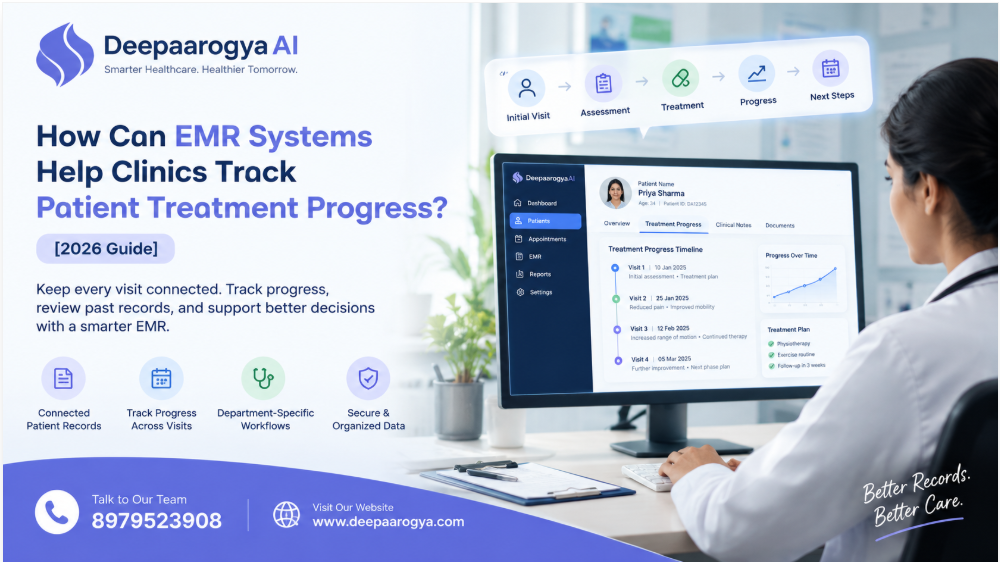
What Is Treatment Progress Tracking in Healthcare?
Treatment progress tracking means systematically recording and reviewing how a patient’s condition, treatment plan, observations, and outcomes change over time.
For example, consider a patient undergoing physiotherapy.
During the first visit, the therapist may document:
- The patient’s primary complaint
- Initial assessment
- Functional limitations
- Treatment plan
- Recommended exercises
During subsequent visits, the therapist may need to record:
- Current symptoms
- Changes since the previous session
- Treatment performed
- Patient response
- New observations
- Next steps
When these records remain connected, the healthcare professional can review the patient’s journey rather than relying only on memory or isolated notes.
Why Does This Matter?
Without structured progress tracking, healthcare teams may spend additional time searching for previous information.
This can create several operational challenges:
- Previous clinical information may be difficult to locate.
- Important changes may be buried inside older notes.
- Staff may need to repeatedly review multiple records.
- Treatment documentation can become inconsistent.
- Different professionals may have difficulty understanding the patient’s history.
A well-organized EMR can help bring relevant information into one connected digital record.
Why Tracking Patient Progress Becomes Difficult as Clinics Grow
Treatment-progress tracking may appear simple when a clinic has a small number of patients.
As patient volume increases, however, the amount of information increases as well.
A clinic may have hundreds or thousands of patient records, with many patients returning for repeated consultations.
At the same time, different departments may document information differently.
For example:
Orthopedics
A patient may require documentation of symptoms, examination findings, treatment recommendations, and progress across multiple consultations.
Physiotherapy
The record may involve repeated therapy sessions, functional observations, exercises, and changes in the patient’s condition.
Nutrition
A patient’s progress may involve consultations, recommendations, dietary changes, and follow-up observations.
When information is not organized consistently, understanding the complete treatment journey can become unnecessarily difficult.
How Can an EMR System Help Track Patient Treatment Progress?
An EMR does more than replace paper files.
When designed around clinical workflows, it can provide a structured environment for recording and reviewing patient information.
Here are some important ways an EMR can support treatment-progress tracking.
1. Maintain a Continuous Patient Record
One of the biggest advantages of digital records is that patient information can remain connected across visits.
Instead of treating every consultation as a completely separate record, the patient’s previous information can form part of their broader clinical history.
This allows authorized healthcare professionals to review relevant information before documenting the current visit.
For example:
Previous visit → Current assessment → Treatment → New observations → Next planned step
This creates a clearer treatment timeline.
2. Make Previous Clinical Information Easier to Review
Doctors and clinical staff often need historical information before making decisions during a follow-up consultation.
An organized EMR can make it easier to locate previous records and review relevant information.
Instead of searching through physical files, teams can work with a structured digital record.
This can be particularly useful when:
- A patient has multiple visits
- Treatment continues over several weeks or months
- Multiple professionals are involved
- The patient changes departments
- Previous observations are relevant to the current consultation
The goal is not simply to store more information.
The goal is to make relevant information easier to access when it is needed.
3. Track Changes Across Multiple Visits
Treatment progress is often about change.
A single consultation tells only part of the story.
For example, a patient’s condition may:
Start → Improve → Stabilize → Require adjustment → Continue improving
An EMR can provide a structured place to document these changes during each visit.
Over time, the clinical record can provide a more complete picture of how the patient’s treatment journey has developed.
This can help healthcare professionals review:
- Previous observations
- Current observations
- Treatment history
- Clinical notes
- Recommendations
- Follow-up information
The exact information tracked can vary depending on the specialty and workflow.
4. Support Specialty-Specific Progress Tracking
Not every department follows the same treatment process.
A major limitation of rigid systems is that they may not fit every specialty’s documentation requirements.
For example, a physiotherapy workflow can be very different from a nutrition consultation.
An EMR designed around customizable workflows can allow clinics to structure information according to departmental requirements.
Physiotherapy
Progress documentation may include:
- Session information
- Assessment details
- Treatment provided
- Exercises
- Patient response
- Follow-up recommendations
Orthopedics
The workflow may involve:
- Patient complaints
- Clinical examination
- Relevant history
- Assessment
- Treatment recommendations
- Follow-up observations
Nutrition
The workflow may focus on:
- Patient information
- Nutrition-related assessment
- Recommendations
- Follow-up observations
- Progress documentation
The important point is that patient-progress tracking should fit the clinical workflow rather than forcing every department into exactly the same process.
5. Reduce Dependence on Scattered Information
Imagine a doctor trying to understand a patient’s treatment history.
One piece of information is in a paper file.
Another is in a previous consultation note.
Another is in a spreadsheet.
Another may have been recorded by a different department.
Even when all the information exists, finding and connecting it can take time.
An EMR can help bring patient information into a more organized digital environment.
This can reduce the dependence on scattered records and provide a more consistent way to document patient interactions.
6. Create Better Continuity Between Visits
A patient’s treatment journey can involve multiple consultations.
If each visit starts with little awareness of previous documentation, healthcare professionals may have to spend additional time reconstructing what happened earlier.
A connected EMR record can help maintain continuity.
For example:
Visit 1
Initial assessment and treatment plan are documented.
Visit 2
The clinician reviews previous information and records changes.
Visit 3
The current condition and response to treatment are documented.
Visit 4
The clinician reviews the accumulated history and determines the next step.
This creates a continuous digital treatment timeline rather than a collection of disconnected visits.
7. Help Different Healthcare Professionals Understand the Patient Journey
Some patients interact with more than one healthcare professional.
For example, a patient may consult a doctor and later receive physiotherapy or nutritional support.
When relevant information is properly organized, authorized team members can have better visibility into the patient’s documented history.
This can be particularly useful in environments where care involves multiple departments.
The objective is not to give every staff member unrestricted access to every piece of information.
Instead, clinics should maintain appropriate access controls and workflows so that relevant information is available to the right people.
8. Improve Documentation Consistency
Treatment-progress tracking becomes more useful when information is documented consistently.
If one clinician records detailed observations while another uses completely different terminology or formats, comparing visits can become difficult.
Structured EMR workflows can encourage more consistent documentation.
Depending on the system and specialty, clinics can create standardized fields or workflows for commonly documented information.
This can help create records that are easier to review over time.
9. Help Clinics Build a More Complete Treatment Timeline
One of the most useful ways to think about an EMR is as a digital timeline of patient interactions.
Instead of asking:
“Where is the patient’s previous record?”
the clinical team can work from an organized history of documented encounters.
A treatment timeline may include:
Patient registration → Consultation → Assessment → Treatment plan → Follow-up → Progress documentation → Further treatment
This connected approach can help clinics understand not only what happened during the latest visit, but also how the patient’s journey developed over time.
How DeepaarogyaAI Can Fit Into This Workflow
For clinics and healthcare organizations looking to move toward more organized digital clinical workflows, DeepaarogyaAI focuses on EMR-based healthcare management.
The value of an EMR is not simply having patient information stored digitally.
It is about creating a workflow in which patient information can be recorded, organized, accessed, and reviewed as part of the clinical journey.
With a workflow-oriented EMR approach, DeepaarogyaAI can be positioned around use cases such as:
- Organizing patient records
- Supporting digital clinical documentation
- Maintaining information across visits
- Structuring department-specific workflows
- Supporting specialty-oriented EMR processes
- Connecting patient information with the broader clinic workflow
For a growing clinic, this can provide a foundation for moving from disconnected documentation toward a more structured digital patient journey.
Example: A Patient’s Treatment Journey With an EMR
Consider a patient visiting a physiotherapy clinic with a recurring mobility problem.
Without a structured EMR
The therapist may need to search through previous notes to understand:
- What was documented earlier
- What treatment was provided
- What recommendations were made
- What changed during the previous session
This can make the process more time-consuming.
With a structured EMR workflow
The therapist can work from the patient’s existing digital record.
The previous visit provides context.
The current session adds new information.
The treatment record is updated.
The next step is documented.
Over several visits, the record becomes a connected history of the patient’s treatment journey.
The EMR therefore becomes more than a digital storage system.
It becomes a structured source of clinical context.
What Should Clinics Look for in an EMR for Progress Tracking?
Before implementing an EMR, clinics should consider whether the system can support their actual workflows.
Important considerations include:
1. Structured Patient Records
The system should provide an organized way to maintain patient information across visits.
2. Specialty-Specific Workflows
Different departments may require different documentation structures.
3. Easy Historical Review
Previous information should be organized so that relevant records can be reviewed efficiently.
4. Consistent Documentation
The system should support standardized workflows where appropriate.
5. Scalability
The workflow should remain practical as patient volume and departments increase.
6. Appropriate Access Controls
Patient information is sensitive, so access should be managed according to organizational policies and applicable requirements.
7. Workflow Integration
An EMR should fit into the clinic’s actual daily processes instead of creating another disconnected system.
EMR Progress Tracking: Moving From Visits to Patient Journeys
The biggest shift is conceptual.
A clinic can think about healthcare as a series of individual appointments.
Or it can think about healthcare as a continuous patient journey.
An appointment captures what happened today.
A connected EMR can help provide context from what happened before and what has been documented throughout the treatment journey.
This distinction becomes increasingly important as clinics grow and treatment becomes more collaborative.
The objective is not to collect information simply for the sake of having more data.
The objective is to make patient information organized, accessible, and useful within the appropriate clinical workflow.
Why This Matters for Growing Clinics in 2026
Healthcare organizations are increasingly moving toward digital workflows.
But digitization alone does not automatically create better processes.
A clinic can have digital records and still struggle with fragmented information if those records are not organized around how healthcare professionals actually work.
That is why the next stage of EMR adoption is not simply “going digital.”
It is about building workflows that connect information across the patient journey.
For growing clinics, this can mean creating a more structured approach to:
Document → Review → Track → Update → Continue Care
An EMR can provide the digital foundation for that process.
Conclusion
Tracking patient treatment progress requires more than recording information during individual consultations.
Clinics need a way to maintain relevant patient information across visits, review previous documentation, record new observations, and understand how the treatment journey is developing.
A well-structured EMR system can help clinics move from disconnected visit records toward a more continuous digital patient history.
For specialties such as physiotherapy, orthopedics, nutrition, and other multi-visit care workflows, this approach can be particularly valuable because treatment often develops over time.
DeepaarogyaAI brings an EMR-focused approach to organizing patient information and clinical workflows, helping healthcare organizations work toward a more connected digital environment.
If your clinic is looking to move beyond basic digital record-keeping and build more organized patient workflows, explore how DeepaarogyaAI can fit into your healthcare operations.
Ready to Build a More Connected Patient Journey?
Explore DeepaarogyaAI and discover how an EMR-focused digital workflow can support modern healthcare operations.
Visit: https://www.deepaarogya.com/
Book a Demo: Connect with the DeepaarogyaAI team to discuss your clinic or hospital workflow.
Contact: 8979523908
Frequently Asked Questions
1. What is treatment progress tracking in an EMR?
Treatment progress tracking involves documenting and reviewing changes in a patient’s condition, treatment, observations, and recommendations across multiple visits.
2. How does an EMR help doctors review patient progress?
An EMR can organize information from previous encounters so that authorized healthcare professionals can review relevant patient history alongside the current consultation.
3. Can EMR systems support different medical specialties?
Yes. EMR workflows can be structured around the documentation requirements of different specialties and departments, depending on the capabilities and configuration of the system.
4. Is an EMR useful for physiotherapy clinics?
It can be particularly useful for workflows involving repeated sessions because treatment information and progress observations can be documented across multiple visits.
5. Can an EMR help reduce scattered patient information?
A structured EMR can bring patient information into a centralized digital workflow, reducing reliance on disconnected paper records, spreadsheets, or separate documentation processes.
6. Does an EMR replace the doctor’s clinical judgment?
No. An EMR is a documentation and information-management system. Clinical decisions remain the responsibility of qualified healthcare professionals.
7. What should clinics consider before selecting an EMR?
Clinics should consider workflow flexibility, specialty-specific requirements, documentation structure, historical record access, scalability, security and access controls, and how well the system fits their existing operations.