
In modern healthcare, patient consent is more than a form that needs a signature.
From procedures and surgeries to diagnostic investigations, treatments, data sharing, and hospital admissions, healthcare organizations may need to capture, store, verify, and retrieve different types of patient consent.
When these processes are handled through paper forms, disconnected files, or manual registers, staff can spend valuable time searching for documents, checking whether a form was completed, and ensuring that the right information is available when needed.
This is where an Electronic Medical Record (EMR) system can make a difference.
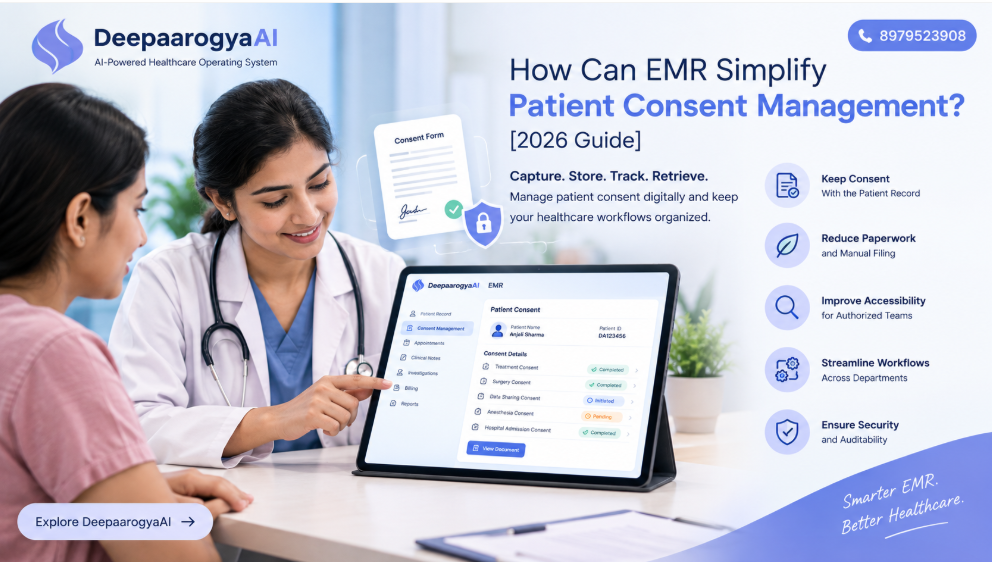
A well-designed EMR can help healthcare organizations organize consent-related information alongside the patient’s medical record, making documentation easier to manage and retrieve while reducing dependence on scattered paperwork.
For clinics and hospitals looking to build more structured digital workflows, DeepaarogyaAI can serve as an AI-powered hospital operating system that brings patient information and healthcare workflows into a more organized digital environment.
What Is Patient Consent Management?
Patient consent management refers to the process of obtaining, recording, storing, tracking, and retrieving patient permissions throughout the healthcare journey.
Depending on the healthcare setting, consent may be required for different activities, such as:
- Medical procedures
- Surgical procedures
- Diagnostic investigations
- Treatments
- Hospital admission
- Anesthesia
- Sharing medical information
- Certain forms of data processing
- Photography or recording where applicable
- Specialized clinical interventions
The exact consent requirements depend on the procedure, organization, and applicable policies.
The challenge is not simply collecting a signature.
The larger challenge is maintaining organized, accessible, and appropriately documented consent information throughout the patient’s journey.
Why Manual Consent Management Becomes Difficult
Many healthcare organizations still depend heavily on physical paperwork.
A patient may sign a form at registration, another document before a procedure, and additional paperwork during admission or treatment.
Over time, this creates several operational challenges.
1. Consent forms can become difficult to locate
When documents are stored physically, staff may need to search through files or departments to find a particular consent form.
This becomes increasingly difficult as patient volumes increase.
2. Multiple forms create documentation complexity
A patient’s care may involve several different consent documents.
Without a structured system, staff may struggle to determine:
- Which consent was collected
- When it was collected
- Which procedure it relates to
- Whether documentation is complete
- Where the original document is stored
3. Paper-based processes slow down workflows
Healthcare staff already manage registration, clinical documentation, billing, reports, appointments, and coordination.
Adding repeated manual paperwork can create additional administrative work.
4. Information can become fragmented
When consent information exists separately from the patient’s primary medical record, healthcare professionals may need to switch between different systems or physical files.
This creates unnecessary friction.
5. Retrieval becomes harder over time
A consent document may need to be reviewed later by authorized staff.
If the document is stored in a physical archive or disconnected location, retrieval can become time-consuming.
How Can an EMR System Improve Consent Management?
An EMR can provide a more structured approach to consent documentation by keeping relevant information associated with the patient’s digital record.
Instead of treating consent as an isolated piece of paperwork, healthcare organizations can incorporate it into the broader patient workflow.
1. Keep Consent Documentation With the Patient Record
One of the biggest advantages of digital documentation is organization.
When appropriate consent information is associated with the patient’s EMR, authorized healthcare staff can have a clearer view of the patient’s documentation.
This can reduce the need to search through separate physical files.
For example:
Patient Record → Procedure → Relevant Consent Documentation
This creates a more structured documentation trail.
2. Reduce Dependence on Paper
Digital workflows can reduce the amount of physical paperwork required for routine documentation.
Instead of printing multiple copies and manually filing them, organizations can move appropriate consent processes into their digital workflow.
This can help reduce:
- Paper handling
- Physical storage requirements
- Manual filing
- Document searching
- Repeated administrative work
The goal is not simply to remove paper.
The larger objective is to create better-organized healthcare documentation.
3. Improve Document Accessibility
In a digital healthcare environment, authorized users can access relevant information from the appropriate part of the system.
For example, when a procedure is scheduled, the relevant documentation can be easier to identify within the patient’s digital record.
This can be especially useful for hospitals where multiple teams interact with the same patient.
Instead of asking:
“Where is the consent form?”
staff can work from a structured digital record where the relevant documentation is easier to locate.
4. Create More Consistent Documentation Workflows
Different departments may have different documentation requirements.
An orthopedic department, for example, may handle different procedures from a physiotherapy department or another specialty.
An EMR can support structured workflows so that documentation requirements can be incorporated into the appropriate process.
This can help organizations move from:
Paper → Search → Verify → File
toward:
Digital Workflow → Document → Record → Retrieve
The exact workflow should still be configured according to the organization’s clinical and administrative requirements.
5. Make Consent Status Easier to Track
A digital workflow can make it easier to distinguish between different documentation states.
For example:
- Consent required
- Consent initiated
- Consent completed
- Documentation pending
- Documentation available for review
This type of structured information can help staff identify where documentation still needs attention.
It can be particularly useful in busy healthcare environments where multiple patients and procedures are being managed simultaneously.
6. Support Better Coordination Between Clinical and Administrative Teams
Consent management does not exist independently from the rest of the healthcare workflow.
A patient’s journey may involve:
Registration → Consultation → Investigation → Treatment Planning → Procedure → Billing → Follow-up
Documentation requirements can appear at different points in this journey.
When healthcare information is managed through a connected digital environment, staff can work with a more organized patient record instead of maintaining multiple disconnected sources of information.
This is one of the broader advantages of an EMR-centered healthcare workflow.
7. Make Documentation Easier to Review
Healthcare organizations may need to review documentation for internal processes, quality management, compliance activities, or other legitimate purposes.
A structured EMR can make relevant records easier to locate for authorized users.
This does not replace organizational policies or legal requirements.
Instead, it provides a better digital foundation for managing healthcare documentation.
Where AI Can Fit Into Consent Management
Traditional EMR systems primarily focus on storing and organizing information.
AI can potentially add another layer of assistance.
For example, AI-powered healthcare platforms can help organizations identify documentation gaps, organize information, summarize relevant records, or support administrative workflows.
However, AI should assist healthcare professionals rather than independently make clinical or legal decisions.
This is particularly important when dealing with consent.
AI can potentially help with:
- Identifying missing documentation
- Organizing patient information
- Highlighting workflow-related tasks
- Supporting document classification
- Making relevant information easier to retrieve
- Assisting administrative teams with repetitive documentation work
The final review and decision-making should remain with appropriately authorized healthcare professionals and organizational processes.
How DeepaarogyaAI Can Fit Into a Modern EMR Workflow
Healthcare organizations increasingly need more than a basic digital patient file.
They need a system that can support the broader patient journey across different departments and workflows.
DeepaarogyaAI is positioned around this broader approach to healthcare management, bringing EMR and AI-assisted healthcare workflows into a more organized digital environment.
For clinics and hospitals, this can support a more structured approach to managing information across areas such as:
- OPD
- IPD
- Patient records
- Physiotherapy
- Nutrition
- Pharmacy
- Billing
- Diagnostics and related workflows
- Administrative processes
- AI-assisted healthcare tasks
The objective is to reduce fragmentation and help healthcare teams work from organized digital information.
For consent-related workflows specifically, the important principle is that documentation should be part of the patient’s broader digital workflow rather than existing as an isolated piece of paperwork.
What Should Healthcare Organizations Look for in an EMR Consent Workflow?
Before implementing or configuring an EMR, healthcare organizations should consider several factors.
1. Patient Record Integration
Consent documentation should be appropriately associated with the patient’s record.
2. Easy Retrieval
Authorized staff should be able to locate relevant documentation without unnecessary searching.
3. Department-Specific Workflows
Different specialties may have different documentation requirements.
The system should support workflows that reflect the organization’s operational structure.
4. Access Controls
Healthcare information is sensitive.
Organizations should use appropriate access controls and security practices so that only authorized users can access relevant information.
5. Auditability
Organizations should consider whether the system provides appropriate records of documentation activity according to their requirements.
6. Scalability
A system that works for a small clinic should be able to support increasingly complex workflows as the organization grows.
EMR Consent Management: From Paperwork to Structured Healthcare Data
The future of healthcare documentation is not simply about replacing paper with screens.
It is about creating structured, accessible, and connected healthcare information.
Consent documentation is one example.
When patient information, clinical documentation, administrative workflows, and other healthcare processes are managed through an organized digital system, healthcare organizations can reduce unnecessary manual work and improve information accessibility.
An EMR therefore becomes more than a digital version of a paper file.
It can become the foundation for a broader digital healthcare operating environment.
Why This Matters for Growing Clinics and Hospitals
As healthcare organizations grow, documentation complexity grows with them.
A small clinic may manage a limited number of consent forms.
A multi-specialty hospital may handle thousands of patients, procedures, investigations, admissions, and department-level workflows.
At that scale, relying entirely on manual documentation can become increasingly difficult.
A structured EMR approach can help organizations build more consistent processes from the beginning.
Instead of asking teams to remember every documentation step manually, organizations can design workflows around the digital patient record.
This can help create a more organized environment for:
Patients + Doctors + Nurses + Administrative Teams + Departments
The Bigger Picture: Building a More Organized Digital Hospital
Consent management is only one part of healthcare documentation.
The larger opportunity lies in creating a healthcare environment where information can move through appropriate workflows without unnecessary fragmentation.
A modern AI-enabled hospital platform can bring together:
Patient Records + EMR + Clinical Workflows + Department Processes + AI Assistance + Healthcare Operations
That is the direction in which platforms such as DeepaarogyaAI can support digitally evolving clinics and hospitals.
The goal is not to replace healthcare professionals.
It is to give them a more organized digital environment in which technology handles appropriate administrative and information-management tasks while professionals remain responsible for clinical decisions.
Conclusion
Patient consent is an important part of healthcare documentation, but managing consent effectively requires more than collecting signatures.
Paper-based processes can make documents difficult to track, retrieve, and organize as healthcare organizations grow.
An EMR system can help bring consent documentation into a structured digital patient record, making relevant information easier for authorized teams to manage and retrieve.
When combined with broader digital healthcare workflows and AI-assisted capabilities, EMR systems can become an important foundation for modern clinics and hospitals.
DeepaarogyaAI focuses on creating a more connected and organized digital healthcare environment for clinics and hospitals.
If your organization is looking to move beyond basic EMR software and build more structured, AI-assisted healthcare workflows, explore how DeepaarogyaAI can support your digital transformation journey.
Frequently Asked Questions
1. What is patient consent management in healthcare?
Patient consent management involves obtaining, recording, storing, tracking, and retrieving patient permissions associated with healthcare services, procedures, treatments, or other applicable activities.
2. Can an EMR system store consent information?
An EMR can be designed to associate relevant consent documentation with a patient’s digital medical record, subject to the organization’s workflow, system capabilities, and applicable requirements.
3. How can digital consent reduce administrative work?
Digital workflows can reduce manual filing, physical document searching, and repetitive paperwork while making appropriately stored documentation easier for authorized users to retrieve.
4. Is digital consent the same as electronic signatures?
Not necessarily. Consent is a broader process involving information, patient understanding, authorization, and documentation. Electronic signatures are one possible mechanism for documenting approval, depending on the context and applicable requirements.
5. Can AI manage patient consent independently?
AI should not independently make clinical or legal decisions about consent. AI can potentially assist with organization, document processing, workflow support, and identification of administrative gaps, while appropriate professionals remain responsible for review and decisions.
6. Why should consent management be connected to an EMR?
Connecting relevant consent documentation with the patient record can make information easier for authorized users to locate and can help integrate documentation into the broader healthcare workflow.
7. Can DeepaarogyaAI support healthcare organizations beyond basic EMR?
DeepaarogyaAI is positioned as an AI-powered healthcare operating environment that brings together EMR and AI-assisted workflows across areas such as OPD, IPD, physiotherapy, nutrition, pharmacy, billing, diagnostics, and other healthcare operations.