
A patient may begin their healthcare journey at reception, move to a doctor, continue to diagnostics, visit another department, and later return for follow-up care. At every step, important clinical information needs to move with the patient.
But in many clinics and hospitals, departmental handoffs still depend on verbal communication, paper notes, screenshots, scattered files, or staff members manually searching for information.
The result can be a fragmented workflow.
An EMR system can help create a more structured way for authorized teams to access and continue a patient’s clinical journey.
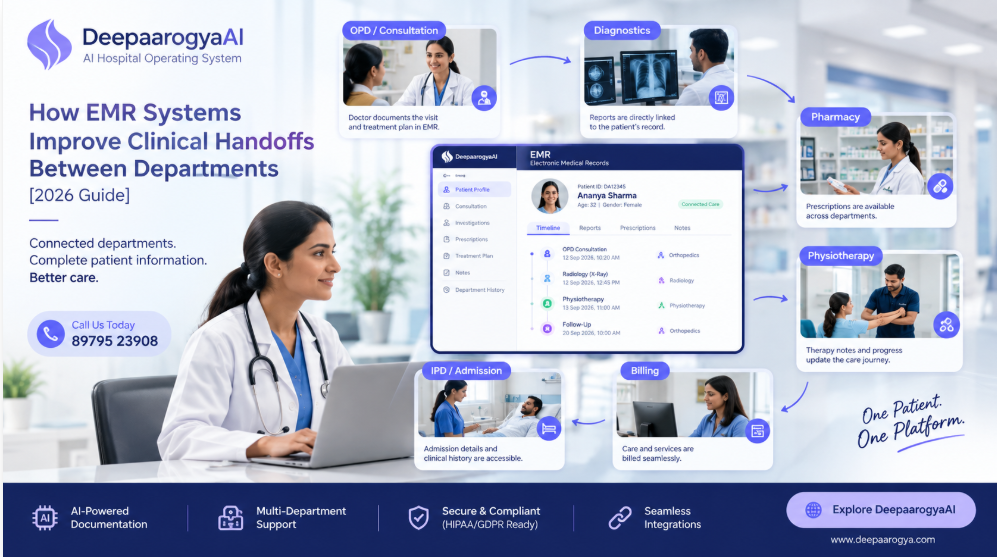
With DeepaarogyaAI, the goal goes beyond simply storing medical records. It is to create a connected healthcare environment where EMR, OPD, IPD, diagnostics, pharmacy, billing, physiotherapy, nutrition and other workflows can work together around the patient’s journey.
One Platform. Complete Care.
What Is a Clinical Handoff?
A clinical handoff happens when responsibility, information, or the next step in a patient’s care moves from one healthcare professional or department to another.
For example:
Doctor → Radiology → Doctor
A physician may request an investigation. The diagnostic department processes it, and the treating doctor needs the relevant result to continue the consultation.
Another example could be:
Orthopedic Consultation → Physiotherapy → Follow-Up
The patient may move from diagnosis to rehabilitation, requiring the next team to understand the relevant clinical context.
A good handoff should answer important questions:
- Why is the patient being referred or transferred?
- What has already been documented?
- What investigation or treatment has taken place?
- What does the next department need to know?
- What should happen next?
When information is difficult to access, the handoff itself can become a workflow bottleneck.
Why Departmental Handoffs Can Become Difficult
As a healthcare organization grows, the number of departments, healthcare professionals, records, and patient interactions also increases.
This creates several operational challenges.
1. Information may exist in different places
A patient’s information may be distributed across:
- Paper files
- Separate software systems
- Department-specific records
- Diagnostic reports
- Prescription records
- Billing information
- Manually shared documents
Staff may then spend additional time locating the information required for the next step.
2. Context can be lost between departments
A department receiving a patient should ideally understand the relevant context instead of starting from zero.
For example, a physiotherapy team may need to know the relevant clinical information behind a patient’s rehabilitation plan.
Without structured information sharing, the patient may need to repeat information or staff may need to contact another department.
3. Verbal communication is difficult to track
Healthcare teams communicate throughout the day.
But verbal instructions or informal conversations may not provide the same level of structured visibility as information documented within an EMR workflow.
4. Manual coordination increases administrative work
When teams need to repeatedly search, call, message, print, scan, or manually transfer information, staff spend time coordinating information instead of focusing on their core responsibilities.
This is where an EMR system can become more than a digital filing cabinet.
How an EMR System Can Improve Clinical Handoffs
A well-designed EMR can provide a structured digital foundation for moving patient information through different stages of care.
1. Give Authorized Teams Access to Relevant Patient Information
One of the biggest advantages of an EMR is that patient information can be documented digitally and accessed by authorized users according to the organization’s workflow and permissions.
Instead of depending entirely on physical files, the relevant clinical information can be available within the digital patient record.
This can help teams understand the patient’s journey before continuing care.
2. Create Structured Documentation
Clinical handoffs work better when information is documented consistently.
An EMR can help organize information such as:
- Patient details
- Visit information
- Clinical notes
- Diagnoses
- Investigations
- Prescriptions
- Treatment information
- Follow-up information
- Department-specific documentation
Structured documentation makes information easier to locate and interpret than disconnected notes.
3. Support Continuity Across Departments
Consider a patient who starts with an orthopedic consultation and subsequently requires physiotherapy.
A disconnected workflow may require staff to manually communicate information between the two departments.
With a connected EMR environment, the patient’s relevant information can form part of a broader digital healthcare journey.
This allows the next team to work with the information already documented instead of treating every interaction as an isolated event.
A Practical Example: From Consultation to Physiotherapy
Imagine a patient visits a multi-specialty clinic with a musculoskeletal complaint.
Step 1: Consultation
The doctor records the consultation and relevant clinical information in the EMR.
Step 2: Treatment Plan
The doctor recommends the appropriate next step, which may include physiotherapy.
Step 3: Departmental Handoff
The physiotherapy team receives the patient as part of the ongoing care journey.
Step 4: Physiotherapy Documentation
The physiotherapist can document relevant sessions and treatment information within the healthcare workflow.
Step 5: Continued Care
When the patient returns to the doctor, the organization has a more structured record of the care journey.
The key idea is simple:
The patient moves between departments, but the digital healthcare journey remains connected.
EMR vs. Informal Departmental Coordination
The difference can be significant.
| Traditional Coordination | EMR-Based Coordination |
|---|---|
| Paper files may move between departments | Information is digitally documented |
| Staff may search for records manually | Authorized users can access relevant records |
| Verbal communication may dominate | Information can be documented in the workflow |
| Department records may be fragmented | Patient information can be connected |
| Repeated information sharing | Structured digital documentation |
| Limited operational visibility | Greater visibility into documented care activity |
An EMR does not eliminate the need for communication between healthcare professionals.
Instead, it can give that communication a structured digital foundation.
How DeepaarogyaAI Fits Into This Workflow
DeepaarogyaAI is positioned as an AI Hospital Operating System for Indian clinics and hospitals, bringing multiple healthcare workflows into a connected environment.
Its ecosystem can include areas such as:
- EMR
- OPD
- IPD
- Pharmacy
- Billing
- Radiology
- Physiotherapy
- Nutrition
- E-prescriptions
- AI-assisted documentation
- Integrations
- Patient communication workflows
This becomes particularly useful when patients do not stay within a single department.
A healthcare organization needs systems that can support the broader patient journey rather than treating each department as an isolated island.
Where AI Can Add Value to EMR Workflows
Modern EMR platforms can combine structured records with AI-assisted capabilities.
For example, DeepaarogyaAI can support AI-assisted documentation such as SOAP notes, visit summaries, and patient summaries.
This can help healthcare teams organize information more efficiently while keeping clinical responsibility with the healthcare professional.
AI should support the workflow—not replace clinical judgment.
The final clinical information should remain subject to appropriate review by doctors or authorized healthcare professionals.
5 Ways Clinics Can Strengthen Departmental Handoffs With EMR
1. Standardize What Gets Documented
Every department should define the essential information required for its workflow.
A standardized approach makes it easier for the next team to understand what has already happened.
2. Keep Documentation Within the EMR
Important clinical information should be documented within the appropriate digital workflow rather than relying entirely on separate messages, paper notes, or informal communication.
3. Connect Relevant Departments
If patients regularly move between departments, the EMR should support those workflows instead of forcing teams to operate as disconnected systems.
4. Use AI for Documentation Support
AI-assisted documentation can help organize information and reduce the effort involved in creating summaries or structured notes.
5. Maintain Human Review
Healthcare remains a human-led process.
AI-generated or AI-assisted information should be reviewed appropriately before being relied upon for clinical decisions.
Why This Matters for Multi-Specialty Healthcare
The need for effective handoffs becomes increasingly important as healthcare organizations expand.
A small clinic may have only a few people involved in a patient’s journey.
A multi-specialty hospital may involve:
Reception → Doctor → Diagnostics → Pharmacy → Physiotherapy → Billing → Follow-Up
Every additional step creates another opportunity for information to become fragmented.
An EMR system provides the digital foundation for keeping these workflows organized.
The objective is not simply to digitize paperwork.
The objective is to create a more connected way of managing healthcare information and workflows.
EMR Should Support the Entire Patient Journey
A modern EMR should not be viewed only as a digital version of a paper patient file.
It can become part of a larger healthcare operating environment.
For a clinic or hospital, this means thinking beyond:
“Where is the patient’s record?”
and asking:
“How does the patient’s information move with them throughout their care journey?”
That distinction matters.
When the patient’s care involves multiple departments, the value of an EMR increases when information can support continuity across those interactions.
What Should Clinics Look for in an EMR System?
Before selecting an EMR, healthcare organizations can evaluate several areas.
Clinical Documentation
Can doctors and healthcare professionals document visits in a structured manner?
Multi-Department Support
Can the system support different departments and specialties?
Patient Information Accessibility
Can authorized users access relevant information when required?
AI-Assisted Workflows
Does the platform provide useful AI capabilities for documentation and workflow support?
Integrations
Can the EMR work with relevant healthcare systems and tools?
Scalability
Can the system support the organization as its number of patients, departments, and workflows grows?
Usability
Can doctors, staff, and administrators actually use the platform efficiently in their daily work?
A technically powerful EMR is only useful when it fits the real workflow of the healthcare organization.
Why DeepaarogyaAI?
DeepaarogyaAI brings together EMR and broader healthcare workflows within an AI-powered healthcare operating environment.
Instead of viewing every department as a separate system, the platform is designed around the idea of connected healthcare management.
From EMR and OPD to IPD, pharmacy, billing, radiology, physiotherapy and nutrition, healthcare organizations can manage multiple aspects of their operations through a connected platform.
AI capabilities can further support documentation and information management.
The result is a healthcare environment where technology is designed to support the journey of the patient—not just the storage of a medical record.
The Future of EMR Is Connected, Intelligent and Workflow-Driven
Healthcare organizations are moving beyond the idea of EMR as simple digital storage.
The next generation of healthcare technology is increasingly focused on:
Connected records + structured workflows + AI assistance + better operational visibility
For clinics and hospitals, this can mean fewer disconnected processes and a more organized approach to managing patient information across departments.
The goal is not to replace doctors or healthcare teams.
It is to give them better digital infrastructure to work with.
Final Takeaway
Clinical handoffs are an essential part of healthcare.
When patients move between doctors, diagnostics, pharmacy, physiotherapy, nutrition, billing, or other departments, information needs to move with them in an organized way.
A modern EMR system can provide the foundation for structured documentation, information accessibility, and continuity across healthcare workflows.
With DeepaarogyaAI, clinics and hospitals can explore an AI-powered approach that brings EMR and multiple healthcare workflows together on one platform.
One patient. One connected healthcare journey. One platform.
Ready to modernize your healthcare workflows?
Explore DeepaarogyaAI: https://www.deepaarogya.com/
Call: +91 89795 23908
Talk to the DeepaarogyaAI team about your clinic or hospital workflow and discover how an AI-powered EMR environment can support connected care.
Frequently Asked Questions
1. What is a clinical handoff in healthcare?
A clinical handoff is the transfer of relevant patient information, responsibility, or the next step in care from one healthcare professional or department to another.
2. How can an EMR improve clinical handoffs?
An EMR can organize patient information digitally, make relevant information accessible to authorized users, and support structured documentation across different stages of care.
3. Can an EMR support multiple departments?
Yes. Modern EMR platforms can support workflows across different specialties and departments, depending on the platform’s capabilities and configuration.
4. Can AI be used with an EMR?
Yes. AI can support areas such as documentation, summaries, information organization, and workflow assistance. AI-generated information should remain subject to appropriate professional review.
5. Is DeepaarogyaAI only an EMR system?
DeepaarogyaAI is positioned as an AI Hospital Operating System rather than only a standalone EMR. Its healthcare environment can include EMR, OPD, IPD, pharmacy, billing, radiology, physiotherapy, nutrition and other connected workflows.
6. Why is connected information important in multi-specialty healthcare?
Patients often interact with multiple departments during their healthcare journey. Connected information can help authorized teams understand relevant documented context and continue care more efficiently.
7. How can a clinic start moving toward a connected EMR workflow?
A clinic can begin by mapping its existing patient journey, identifying departmental handoffs, standardizing important documentation, and evaluating an EMR platform that supports its clinical and operational workflows.