
A doctor’s consultation should begin with the patient’s medical story—not with staff searching through forms, messages, previous records, or incomplete information.
Yet in many clinics, patient data collection happens across multiple disconnected steps. A patient may provide basic details during registration, answer questions at reception, share reports later, and explain their medical history again when they meet the doctor.
This creates unnecessary delays and can make the consultation process less organized.
For growing clinics and hospitals, the challenge is no longer simply collecting patient information. It is about collecting the right information at the right time and making it available to the care team in an organized way.
This is where AI-enabled healthcare technology can help.
With an integrated platform such as DeepaarogyaAI, clinics can bring patient information and workflows together, helping healthcare teams manage information more systematically throughout the patient journey.
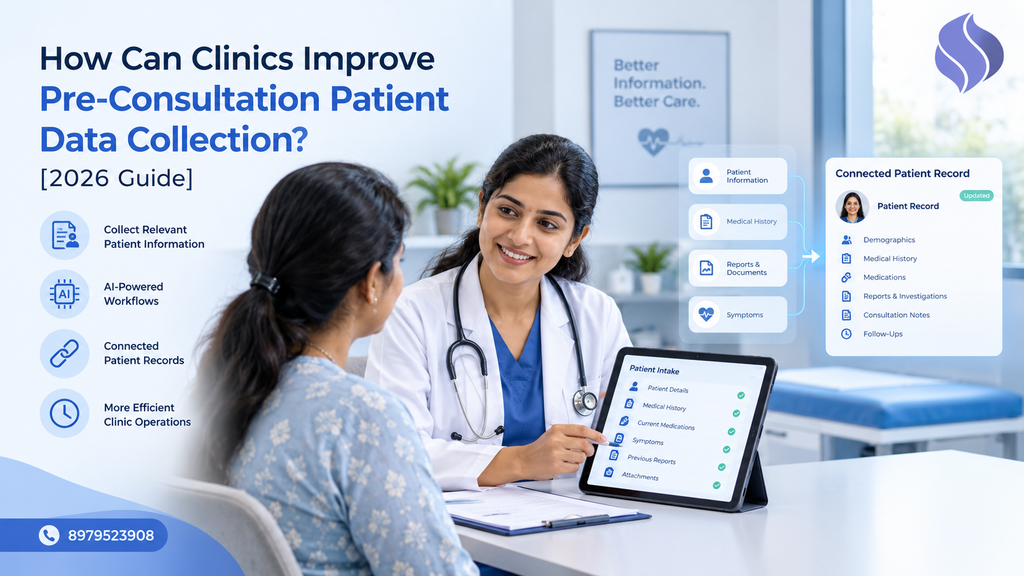
What Is Pre-Consultation Patient Data Collection?
Pre-consultation data collection refers to gathering relevant patient information before the doctor begins the consultation.
Depending on the specialty and workflow, this may include:
- Patient demographics
- Chief complaints
- Previous medical history
- Current medications
- Allergies
- Previous investigations
- Uploaded medical reports
- Previous treatment information
- Relevant symptoms
- Appointment details
- Specialty-specific information
The objective is not to collect unnecessary information.
The objective is to ensure that the doctor has relevant context before or at the beginning of the consultation.
Why Is Pre-Consultation Data Collection Important?
A patient’s consultation is more than a single conversation.
Before the doctor can make informed clinical decisions, relevant information may need to be gathered, reviewed, and organized.
When this information is incomplete or scattered, several operational challenges can occur.
1. Doctors May Spend Valuable Time Gathering Basic Information
If a doctor has to repeatedly ask for information that could have been collected earlier, part of the consultation can be spent on administrative data gathering.
A structured pre-consultation workflow can help reduce this repetition.
2. Patients May Have to Repeat Their Information
Patients often interact with multiple members of the healthcare team.
If information is not properly captured and accessible, patients may have to explain the same details multiple times.
A connected patient record can help create greater continuity.
3. Important Information Can Remain Scattered
Patient information may exist across:
- Paper forms
- Previous EMR entries
- Reports
- WhatsApp conversations
- Emails
- Uploaded documents
- Registration records
When information is distributed across different channels, finding the relevant context can become difficult.
4. Manual Data Entry Can Increase Administrative Work
Reception and clinical staff may spend significant time entering or transferring information.
For a growing practice, repetitive administrative work can become increasingly difficult to manage.
What Does an Efficient Pre-Consultation Workflow Look Like?
An efficient workflow should connect the steps instead of treating registration, data collection, consultation, and records as separate activities.
A simplified workflow can look like this:
Patient Registration → Information Collection → Record Preparation → Doctor Consultation → Clinical Documentation → Follow-Up
The exact process will vary by clinic and specialty.
However, the central idea remains the same:
Patient information should move with the patient through the healthcare journey.
How Can AI Improve Pre-Consultation Data Collection?
AI can support healthcare teams by helping organize information and automate parts of repetitive workflows.
Instead of replacing the clinical decision-making process, AI can help reduce administrative friction around it.
1. Structured Patient Information
An AI-enabled healthcare platform can help organize patient information within a structured digital record.
This makes it easier for authorized staff and doctors to access relevant information without navigating through multiple disconnected sources.
2. AI-Assisted Documentation
Healthcare professionals often spend time documenting conversations and clinical information.
AI-powered documentation capabilities can help transform relevant patient-doctor interactions into structured information, reducing some of the manual documentation burden.
This allows the clinical team to focus more on the patient rather than repetitive documentation tasks.
3. Better Access to Patient History
A connected record can help bring together information from different stages of the patient’s journey.
Instead of treating every appointment as an isolated interaction, the clinic can maintain continuity across visits.
This can be particularly useful for patients who require repeated consultations or ongoing care.
4. Specialty-Specific Workflows
Different specialties collect different types of information.
For example, an orthopedic practice may need information related to:
- Previous injuries
- Pain location
- Imaging reports
- Previous procedures
- Treatment history
A physiotherapy practice may need information related to:
- Functional limitations
- Previous sessions
- Treatment plans
- Progress information
A flexible digital workflow can support different requirements rather than forcing every specialty into the same process.
How DeepaarogyaAI Can Support the Patient Journey
DeepaarogyaAI is designed around connected healthcare workflows rather than isolated administrative tasks.
For clinics, this means patient information can become part of a broader digital workflow covering different stages of the patient journey.
Instead of thinking about patient data collection as a standalone registration task, clinics can look at it as one component of the complete workflow.
Before the Consultation
Patient information can be organized as part of the pre-consultation workflow.
During the Consultation
Doctors can work with the available patient context and document relevant clinical information.
After the Consultation
The information can continue to support documentation, follow-up, and ongoing patient management.
This creates a more connected approach to healthcare management.
From Data Collection to Connected Patient Records
Collecting information is only the first step.
The bigger question is:
What happens to that information after it has been collected?
If patient data is collected but remains isolated, the benefit is limited.
A more connected approach allows information to contribute to the patient’s ongoing record.
For example:
Registration
↓
Patient Information
↓
Medical History
↓
Consultation
↓
Clinical Documentation
↓
Treatment / Follow-Up
↓
Future Consultation
This creates continuity across interactions.
5 Ways Clinics Can Improve Pre-Consultation Data Collection
Technology alone cannot solve every workflow problem. Clinics should also establish clear processes.
1. Define What Information Is Actually Needed
Avoid collecting excessive information.
Identify the information that is genuinely relevant to the consultation and specialty.
2. Digitize Repetitive Forms
Replace unnecessary paper-based processes with structured digital workflows where appropriate.
This can reduce manual entry and make information easier to access.
3. Connect Information With the Patient Record
Collected information should not remain in isolated forms or disconnected systems.
Where possible, it should become part of the patient’s organized digital record.
4. Standardize Specialty Workflows
Different departments may require different information.
Create workflows that reflect the actual requirements of each specialty instead of using one generic process for everything.
5. Use AI Where It Reduces Administrative Work
AI can be particularly useful for repetitive documentation and information-management tasks.
The goal should be better workflow efficiency, not unnecessary automation.
What Are the Benefits for Clinics?
A well-designed pre-consultation workflow can contribute to several operational improvements.
Better Consultation Readiness
Doctors can begin consultations with more organized patient context.
Reduced Administrative Repetition
Staff may spend less time repeatedly entering or searching for information.
Improved Patient Experience
Patients may not need to repeatedly provide the same basic information.
More Organized Records
Relevant information can be maintained as part of a connected patient record.
Better Workflow Visibility
Clinic teams can gain a clearer understanding of where information is collected and how it moves through the patient journey.
The Bigger Opportunity: Building a Connected Healthcare Workflow
Pre-consultation data collection may appear to be a small operational process.
But it represents something much larger.
It is one of the first steps in creating a connected patient journey.
When registration, records, consultation, documentation, and follow-up operate as disconnected processes, staff often have to bridge the gaps manually.
When these workflows are connected, the patient record can become a central source of continuity.
That is the direction modern healthcare technology is moving toward.
Why Clinics Should Think Beyond Traditional EMR
Traditional EMR systems primarily focus on storing patient information.
Modern healthcare workflows increasingly require more than storage.
Clinics need systems that can help them:
- Organize patient information
- Connect different workflows
- Reduce repetitive administrative tasks
- Support documentation
- Improve accessibility of patient records
- Manage patient journeys more systematically
This is where AI-powered healthcare platforms can add another layer of value.
The goal is not simply to digitize existing paperwork.
It is to make the overall workflow more connected and efficient.
Final Thoughts
Pre-consultation patient data collection is an important but often overlooked part of healthcare operations.
When information is collected manually, stored across disconnected channels, or repeatedly requested from patients, it can create unnecessary administrative work.
A structured digital workflow can help clinics collect relevant information earlier, organize it effectively, and connect it with the patient’s broader healthcare journey.
With AI-enabled platforms such as DeepaarogyaAI, healthcare organizations can move toward more connected patient records and smarter workflows while reducing some of the repetitive administrative burden on their teams.
The future of healthcare technology is not just about storing more patient data.
It is about making the right patient information available at the right point in the healthcare journey.
Ready to Build a More Connected Clinic Workflow?
Explore how DeepaarogyaAI can help your clinic move toward smarter, AI-enabled healthcare management.
Visit: https://www.deepaarogya.com/
Book a Demo: Explore how DeepaarogyaAI can fit into your clinic’s workflow.
Frequently Asked Questions
1. What is pre-consultation patient data collection?
Pre-consultation patient data collection involves gathering relevant patient information before the doctor begins the consultation. This can include demographics, medical history, medications, symptoms, reports, and previous treatment information.
2. Why is pre-consultation data important?
It can help doctors and healthcare teams begin consultations with more organized patient context while reducing repetitive information gathering.
3. Can AI help with patient data collection?
AI can support healthcare workflows by helping organize information and automate certain repetitive documentation and administrative tasks.
4. What is a connected patient record?
A connected patient record brings relevant patient information together across different stages of the healthcare journey, helping authorized healthcare teams access information more systematically.
5. How can DeepaarogyaAI help clinics?
DeepaarogyaAI supports AI-enabled healthcare workflows designed to help clinics manage patient information, documentation, and different stages of the patient journey in a more connected way.
6. Is AI meant to replace doctors?
No. AI-enabled healthcare technology is intended to support healthcare teams with administrative, documentation, and information-management workflows. Clinical decisions remain with qualified healthcare professionals.