
A doctor’s consultation does not really begin when the patient enters the examination room.
It often begins several minutes earlier—when the doctor reviews the patient’s previous consultation, checks medical history, looks at investigation reports, understands current medications, and prepares for the discussion ahead.
For a busy clinic, doing this manually for every patient can become difficult.
The challenge becomes even greater when a patient has visited multiple departments or has a long medical history.
What if the healthcare system could help organize the relevant information before the consultation begins?
This is where AI-powered pre-visit preparation can become useful.
Instead of asking doctors to search through multiple records before every consultation, AI can assist in organizing relevant patient information so the doctor can review it before meeting the patient.
DeepaarogyaAI is designed around this connected approach, combining EMR, OPD, IPD, pharmacy, billing, radiology, physiotherapy, nutrition, e-prescriptions and AI-assisted workflows around a patient record.
The objective is not to replace clinical judgment.
It is to help doctors spend less time searching for information and more time using that information during the consultation.
What Is Pre-Visit Preparation in Healthcare?
Pre-visit preparation is the process of reviewing relevant patient information before a consultation.
Depending on the patient and specialty, this may include:
- Previous consultation notes
- Medical history
- Current medications
- Previous prescriptions
- Investigation reports
- Radiology reports
- Vitals
- Previous diagnoses
- Treatment history
- Follow-up information
- Relevant specialty records
For a patient with a simple medical history, this may take only a short amount of time.
For a returning patient with multiple consultations and investigations, it can take considerably longer.
The difficulty is not always the amount of information.
It is finding the right information at the right time.
Why Does Pre-Visit Preparation Matter?
A consultation is more than a conversation between a doctor and patient.
It is often a continuation of previous healthcare interactions.
Consider a returning patient.
During the previous visit, the doctor documented symptoms and prescribed treatment.
The patient then completed an investigation.
A report was generated.
The patient later returned with the report.
Before the next consultation, the doctor needs to understand what has changed.
If the relevant information is already organized in the patient record, the preparation process can become simpler.
But when information is stored across different files, systems or workflows, staff may need to manually search for it.
This creates three common challenges:
1. Information search
Doctors or staff may spend time locating previous information.
2. Context gathering
The relevant information may exist, but it may not be organized around the upcoming visit.
3. Repeated review
The same information may need to be manually checked again during multiple visits.
AI-assisted pre-visit workflows can help organize this information before the consultation.
How Can AI Help With Pre-Visit Preparation?
AI can assist with several information-organization tasks before a patient visit.
The important principle is:
AI prepares the information. The doctor makes the clinical decision.
This distinction matters.
AI-generated summaries or recommendations should not replace professional review or clinical judgment.
Instead, the technology can help make existing patient information easier to review.
1. Create a Patient Snapshot Before the Visit
A doctor may not need to reread an entire patient history before every routine consultation.
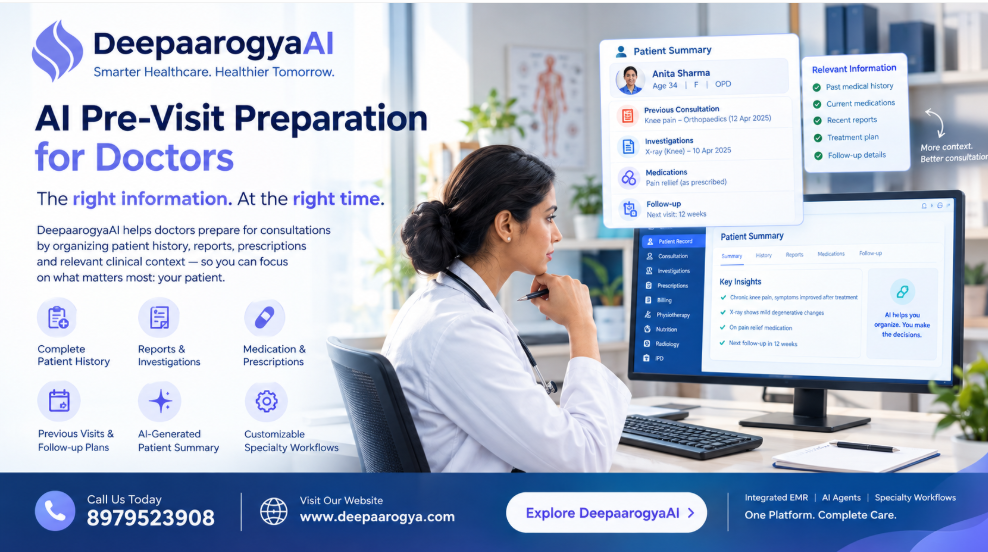
An AI-assisted workflow can help organize relevant information into a concise patient snapshot.
For example:
Patient Snapshot
Previous visit: Orthopedic consultation
Primary concern: Knee pain
Previous treatment: Documented in EMR
Investigation: Imaging report available
Previous prescription: Available in patient record
Follow-up: Returning consultation
The doctor can then review the relevant context before beginning the consultation.
This does not eliminate the need to review the underlying record.
It simply makes the first layer of information easier to understand.
2. Bring Previous Information Into the Current Context
Healthcare information becomes more useful when it is connected to the patient’s current visit.
For example:
Previous consultation → Investigation → Treatment → Follow-up
Instead of treating each event as a separate document, a connected EMR can associate them with the same patient record.
DeepaarogyaAI is designed around this connected-record model, with workflows spanning EMR, OPD, IPD, pharmacy, billing, radiology, physiotherapy and nutrition.
This provides an important foundation for AI-assisted workflows.
The AI does not have to operate on an isolated piece of information.
It can work with information already present in the healthcare workflow.
3. Highlight Relevant Previous Information
A patient record may contain years of information.
But not everything is equally relevant to today’s consultation.
For example, an orthopedic consultation may require attention to:
- Previous orthopedic complaints
- Relevant imaging
- Previous treatment
- Current medications
- Recent symptoms
- Previous physiotherapy sessions
An AI-assisted system can help organize relevant information for review.
The doctor can then decide what actually matters clinically.
The goal is not:
“AI decides what the patient needs.”
The goal is:
“AI helps organize information so the doctor can review it efficiently.”
4. Reduce Manual Searching Before Consultations
Imagine a doctor seeing 30 patients in a day.
For several returning patients, the doctor may need to check:
- Previous notes
- Prescriptions
- Reports
- Medication history
- Follow-up information
Even when each review takes only a few minutes, the cumulative effort can become significant.
AI-assisted patient summaries can reduce some of this repetitive information-searching work.
This is particularly useful when the clinic already maintains structured digital records.
5. Prepare Information for Different Specialties
Pre-visit preparation does not look the same across every specialty.
An orthopedic doctor may care about imaging, previous procedures and physiotherapy progress.
A nutrition professional may need information such as:
- Patient history
- Relevant vitals
- Dietary information
- Previous nutrition plans
- Progress information
A physiotherapist may need:
- Diagnosis
- Treatment plan
- Previous sessions
- Protocol information
- Progress and outcomes
This is why healthcare software needs customizable workflows rather than forcing every specialty into exactly the same structure.
DeepaarogyaAI states that its platform can be configured for specialty workflows including orthopedics, physiotherapy, nutrition, ENT and multi-specialty environments.
6. Connect Pre-Visit Preparation With AI Documentation
Pre-visit preparation should not exist as an isolated feature.
It can become part of a broader consultation workflow.
For example:
Patient Record
↓
Pre-Visit Summary
↓
Doctor Consultation
↓
AI-Assisted Documentation
↓
Prescription
↓
Follow-Up
DeepaarogyaAI provides AI-assisted workflows such as SOAP documentation and patient summaries alongside its EMR and hospital workflows.
This creates a more continuous workflow.
The information reviewed before the consultation becomes part of the consultation itself.
7. Help Doctors Prepare for Returning Patients
Returning patients can present a unique challenge.
The doctor may already know the patient, but several things may have changed since the previous visit.
For example:
Previous visit
Patient reports symptoms.
↓
Investigation
A diagnostic report becomes available.
↓
Treatment
Medication or another treatment is initiated.
↓
Follow-up
Patient returns.
↓
Current consultation
Doctor needs to understand what changed.
An AI-assisted pre-visit workflow can help organize this timeline.
The doctor can then focus the consultation on the current situation rather than spending unnecessary time reconstructing the previous journey.
What Does an AI-Assisted Pre-Visit Workflow Look Like?
A practical workflow could look like this:
Step 1: Appointment Is Scheduled
The patient is added to the doctor’s upcoming consultation list.
Step 2: Patient Record Is Retrieved
The system identifies the existing patient record.
Step 3: Relevant Information Is Organized
Previous consultations, reports, prescriptions and other relevant information are brought together.
Step 4: AI Creates a Structured Summary
Where appropriate, AI can assist in preparing a concise summary for review.
Step 5: Doctor Reviews the Information
The doctor checks the summary against the underlying patient record.
Step 6: Consultation Begins
The doctor enters the consultation with relevant context already available.
Step 7: Documentation Continues
AI-assisted documentation can help structure the current consultation.
Step 8: Prescription and Follow-Up
The patient’s next steps can continue through the connected healthcare workflow.
The important part is that AI remains an assistant—not the decision-maker.
Why Connected Patient Data Makes AI More Useful
AI cannot organize information that it cannot appropriately access.
This is why the underlying healthcare infrastructure matters.
A standalone AI tool may require staff to manually collect information and provide it to the AI.
That creates another administrative step.
A connected healthcare platform can provide a stronger foundation.
For example:
EMR → Reports → Prescription → Pharmacy → Physiotherapy → Follow-Up
When these workflows are associated with the patient record, information can be available within the broader healthcare context.
DeepaarogyaAI brings multiple healthcare workflows together around a connected patient record, providing the foundation for AI-assisted workflows.
What Should Clinics Look for in an AI Pre-Visit Solution?
Before implementing AI for pre-visit preparation, clinics should evaluate more than just the AI feature.
1. Does It Work With the Patient Record?
AI should be able to work with the clinic’s actual healthcare workflow rather than becoming another isolated application.
2. Can Doctors Review the Output?
AI-generated summaries should remain reviewable and editable by healthcare professionals.
3. Can It Support Different Specialties?
A multi-specialty clinic may require different information for different consultations.
4. Is Access Controlled?
Not every member of the healthcare team requires unrestricted access to every piece of patient information.
DeepaarogyaAI describes role-based access for different roles such as doctors, nurses, front-desk staff, pharmacy teams and administrators.
5. Can It Scale With the Clinic?
The system should support the organization as patient volume, departments and workflows grow.
6. Does It Fit Existing Workflows?
Technology should support the clinic’s workflow rather than forcing the entire team to rebuild its process.
How DeepaarogyaAI Supports Smarter Pre-Visit Workflows
DeepaarogyaAI is positioned as an AI Hospital OS for Indian clinics and hospitals, combining healthcare management, EMR, specialty workflows, integrations and AI agents.
Its ecosystem includes:
- AI-powered EMR
- OPD management
- IPD management
- Pharmacy
- Billing
- Radiology
- Physiotherapy
- Nutrition
- e-Prescriptions
- AI Agents
- WhatsApp workflows
- Google Drive integration
- Telemedicine integrations
The platform also describes customizable workflows for specialties and connected patient information across departments.
This creates an environment where pre-visit preparation can become part of a larger workflow instead of functioning as a separate AI tool.
The broader idea is simple:
One patient record.
Relevant information.
AI assistance.
Professional review.
Better-prepared consultations.
AI Should Prepare the Context—Doctors Should Provide the Judgment
Healthcare AI becomes most useful when it supports professionals rather than attempting to replace them.
For pre-visit preparation, this means AI can help with:
Finding → Organizing → Summarizing → Structuring
While doctors remain responsible for:
Reviewing → Interpreting → Deciding → Treating
This human-AI collaboration can create a more practical model for healthcare technology.
The objective is not to automate the doctor.
It is to reduce unnecessary information-management work around the doctor.
The Future of Pre-Visit Preparation
Healthcare digitization has already moved many clinics from paper records to electronic records.
The next step is making those records more useful.
The evolution can look like:
Paper records
↓
Digital records
↓
Connected patient records
↓
AI-assisted information organization
↓
More context-aware healthcare workflows
Pre-visit preparation is one example of this shift.
Instead of asking doctors to manually search through every previous record before every consultation, healthcare technology can help organize the relevant context in advance.
The doctor still reviews the information.
The doctor still makes the clinical decision.
But the workflow around the consultation can become more structured.
Conclusion: Prepare the Information Before the Consultation
A doctor’s time is valuable.
Every minute spent searching for old reports, previous notes or medication history is time spent managing information instead of interacting with the patient.
AI can help change that workflow.
With an appropriately connected patient record, AI can assist in organizing relevant information before a consultation, preparing patient summaries, supporting documentation and continuing the workflow after the visit.
DeepaarogyaAI brings EMR, OPD, IPD, pharmacy, billing, radiology, physiotherapy, nutrition and AI-assisted workflows into a connected healthcare environment.
The goal is not to let AI make healthcare decisions.
The goal is to help healthcare professionals enter each consultation with the right context already organized.
Better preparation can create a better foundation for every consultation.
Ready to explore AI-powered healthcare workflows?
Explore DeepaarogyaAI and see how connected EMR, specialty workflows and AI assistance can fit into your clinic or hospital.
📞 8979523908
🌐 https://www.deepaarogya.com/
Frequently Asked Questions
1. What is AI-powered pre-visit preparation?
AI-powered pre-visit preparation uses AI to help organize relevant information from a patient’s existing healthcare record before a consultation.
2. Can AI create a patient summary before a doctor visit?
AI can assist in preparing structured summaries from available patient information. The healthcare professional should review the information against the patient record.
3. Can pre-visit AI work with an EMR?
Yes. An EMR provides the structured patient information that can support AI-assisted workflows. A connected EMR can make relevant information easier to organize.
4. Does AI replace the doctor during pre-visit preparation?
No. AI can assist with information organization and summarization, while clinical interpretation and decisions remain with the healthcare professional.
5. Can AI pre-visit workflows support different specialties?
They can be designed around specialty-specific information requirements. DeepaarogyaAI describes customizable workflows for specialties including orthopedics, physiotherapy, nutrition and ENT.
6. Why is connected patient data important for healthcare AI?
AI is more useful when relevant information is already organized within the healthcare workflow. Connected records can reduce the need to manually collect information from multiple systems.
7. Can DeepaarogyaAI support AI-assisted documentation?
Yes. DeepaarogyaAI provides AI-assisted workflows including SOAP documentation and patient summaries, with outputs intended for professional review.
8. Can different clinic staff have different access levels?
DeepaarogyaAI describes role-based access so different roles can have access appropriate to their responsibilities.