
Introduction: Why Nutrition Departments Need Connected Healthcare Workflows
Nutrition is an important part of a patient’s healthcare journey. Whether someone is visiting a clinic for a consultation, recovering during a hospital stay, or receiving care alongside another specialty, nutrition-related information may need to be considered within the broader clinical context.
However, nutrition departments can face a practical challenge: how can dietitians access relevant patient information, organize nutrition documentation, and coordinate with the rest of the healthcare team without creating another disconnected workflow?
When nutrition records, patient histories, consultation notes, and diet plans are managed separately, teams may need to spend additional time locating information or repeating documentation.
This is where DeepaarogyaAI’s EMR and HMS platform can help.
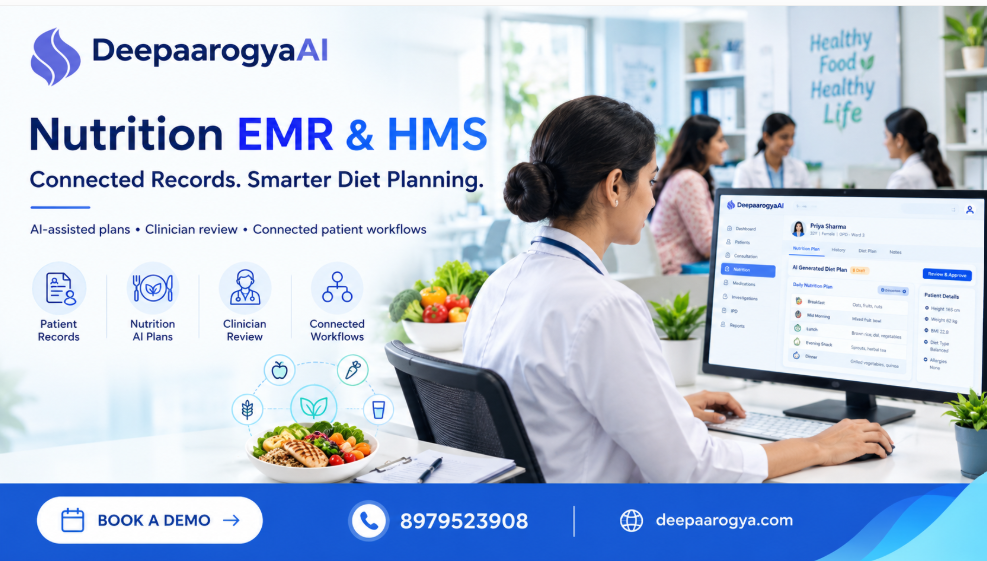
DeepaarogyaAI brings healthcare workflows together around a connected patient record. Its platform includes structured electronic medical records, hospital management workflows, and a Nutrition AI module that can generate diet plans for clinician review.
Instead of treating nutrition as an isolated activity, healthcare organizations can work toward connecting nutrition planning with the wider patient journey.
1. Common Challenges Faced by Nutrition and Dietetics Departments
1.1 Patient Information Is Spread Across Different Records
A dietitian may need relevant information about a patient’s medical history, clinical context, available vitals, and treatment journey before preparing or reviewing a nutrition plan.
When this information is spread across paper files or separate digital systems, finding the relevant context can require additional effort.
How DeepaarogyaAI helps
DeepaarogyaAI is built around a connected patient record that brings supported clinical workflows together. Relevant available information can be accessed through the patient chart, depending on the records maintained and the hospital’s configured workflow.
This helps teams move toward a more connected approach to managing patient information rather than relying entirely on separate records.
1.2 Preparing Diet Plans Requires Structured Documentation
Nutrition planning is not simply about creating a list of foods. Healthcare professionals need to consider the patient’s circumstances and apply their professional judgment.
Preparing and documenting plans can also involve repetitive administrative work.
How DeepaarogyaAI helps
DeepaarogyaAI includes a Nutrition AI workflow that supports AI-assisted diet-plan generation. The resulting plan is reviewed by clinicians rather than being treated as an automatically approved clinical recommendation.
This can support the documentation workflow while keeping healthcare professionals involved in reviewing the plan.
1.3 Nutrition Workflows Can Become Disconnected From Other Departments
A patient may receive care from a doctor, nutrition professional, physiotherapist, or inpatient team. Each professional contributes different information to the patient’s journey.
If nutrition documentation is isolated from the wider patient record, coordinating the relevant information may become more difficult.
How DeepaarogyaAI helps
DeepaarogyaAI connects supported departmental workflows through its broader EMR and HMS platform. This provides a shared information foundation for teams that need to work with relevant patient context.
The exact information available to each team depends on the configured workflow and access permissions.
1.4 Repeated Data Entry Creates Extra Administrative Work
When departments maintain separate records, staff may need to enter or transfer information more than once.
Repeated entry takes time and can create inconsistencies when records are not updated in the same way.
How DeepaarogyaAI helps
DeepaarogyaAI’s connected-record approach is designed to reduce unnecessary re-entry between supported workflows. By keeping relevant information associated with the patient chart, the platform helps teams avoid treating every department as a completely separate information system.
The degree of re-entry reduction depends on the hospital’s existing systems and configuration.
1.5 Nutrition Documentation Needs Professional Review
AI-generated content can be useful as a starting point, but a patient’s nutrition needs cannot safely be reduced to an automatically generated plan without appropriate assessment.
Dietitians and other authorized professionals remain responsible for evaluating whether a proposed plan is suitable for the individual patient.
How DeepaarogyaAI helps
DeepaarogyaAI positions its Nutrition AI output for clinician review. This keeps professional judgment central to the workflow and makes clear that AI assistance is not a replacement for qualified clinical assessment.
2. How DeepaarogyaAI’s EMR and HMS Support Nutrition Workflows
DeepaarogyaAI combines clinical records and hospital management capabilities within one broader platform. For a nutrition department, the value lies in connecting the nutrition workflow with relevant patient information and the organization’s wider operations.
2.1 Connected Patient Records
An Electronic Medical Record (EMR) organizes clinical information associated with a patient.
Within a connected healthcare workflow, relevant available records can help authorized professionals understand the context of a patient’s care.
DeepaarogyaAI’s platform is designed to connect patient information across supported departments, reducing the need to rely entirely on disconnected documentation.
For nutrition teams, this creates a foundation for working alongside other healthcare professionals.
2.2 AI-Assisted Diet Planning
DeepaarogyaAI includes a Nutrition AI module that generates diet plans through an AI-assisted workflow, with clinician review.
This can help support the process of preparing nutrition-related documentation.
The AI-generated output should be treated as a draft or starting point for professional evaluation—not as an independent diagnosis, a guaranteed treatment outcome, or a substitute for individualized assessment.
2.3 EMR and HMS Working Together
The EMR and HMS serve related but different purposes.
- EMR: Organizes clinical records and documentation.
- HMS: Supports broader hospital operations and departmental workflows.
When these capabilities are connected, nutrition-related activities can be considered as part of the wider patient journey rather than an entirely separate administrative process.
DeepaarogyaAI brings its EMR, OPD, IPD, billing, physiotherapy, nutrition, and other supported workflows into the same broader platform.
2.4 Support for Different Healthcare Settings
Nutrition services can operate in different environments, including clinics and hospitals.
A clinic may focus on consultations and ongoing patient follow-up, while a hospital may need to coordinate nutrition-related work with inpatient care.
DeepaarogyaAI’s connected EMR and HMS approach can provide a common foundation for these workflows, subject to the modules and configuration used by the healthcare organization.
3. A Practical Example: From Consultation to Nutrition Planning
Consider a patient who visits a healthcare facility for a consultation. The treating professional determines that nutrition planning should be part of the patient’s care.
Here is how a connected workflow could be organized.
Step 1: Patient consultation
The patient is registered and the consultation is documented in the EMR.
Step 2: Relevant information is reviewed
The authorized nutrition professional reviews the relevant information available in the connected patient record.
Step 3: A nutrition plan is prepared
The nutrition professional uses their clinical judgment to assess the patient’s needs. DeepaarogyaAI’s Nutrition AI workflow can assist by generating a diet-plan draft.
Step 4: Professional review
The dietitian or authorized clinician reviews and adjusts the generated plan as appropriate before it is used.
Step 5: Connected documentation
Nutrition-related information can be maintained within the configured workflow, helping the care team refer to relevant records when needed.
Step 6: Continued care
If the patient returns for another consultation, the available documentation can help the team review the previous care context.
The objective is to connect the stages of the patient’s journey while keeping clinical decisions in the hands of qualified professionals.
This example describes a possible workflow using supported platform capabilities. Specific referral mechanisms, automatic notifications, patient adherence tracking, and specialized nutrition integrations should be confirmed for the intended deployment rather than assumed.
4. EMR vs HMS for a Nutrition Department
| Requirement | EMR | HMS |
|---|---|---|
| Clinical patient documentation | Primary focus | Supports the broader workflow |
| Patient history and relevant clinical context | Organizes clinical records | Connects with wider hospital processes |
| AI-assisted nutrition documentation | Supports the connected clinical workflow | Provides the wider operational environment |
| Outpatient and inpatient workflows | Connects clinical documentation | Supports OPD and IPD processes |
| Hospital administration and billing | May connect with relevant records | Primary operational focus |
For a nutrition department, these systems are complementary. The EMR organizes clinical information, while the HMS supports the wider operational environment in which the department works.
DeepaarogyaAI brings these capabilities together in a connected platform.
5. Benefits of a Connected Nutrition Workflow
Better Access to Relevant Information
When relevant available patient information is connected, authorized team members can spend less time searching through disconnected records.
More Organized Documentation
A structured digital workflow can help teams maintain nutrition-related documentation more consistently.
AI Assistance With Diet-Plan Drafting
The Nutrition AI module can support diet-plan generation, with professionals reviewing the output before use.
Improved Departmental Coordination
Connecting nutrition with other supported healthcare workflows provides a common information foundation for teams involved in a patient’s care.
Less Unnecessary Information Re-Entry
A connected patient record can reduce repeated entry between supported workflows, depending on the existing systems and configuration.
A More Connected Patient Journey
Nutrition can be considered alongside the patient’s wider clinical journey rather than managed only as an isolated activity.
These benefits depend on appropriate configuration, staff training, record quality, and the way the healthcare organization implements its workflows.
6. What Should Hospitals Evaluate Before Choosing Nutrition EMR Software?
Before adopting a nutrition EMR or HMS solution, hospitals and clinics should evaluate:
- Patient-record connectivity: Can relevant clinical information be accessed within the configured workflow?
- Nutrition documentation: Does the system support the team’s actual documentation requirements?
- AI-assisted planning: Is AI-generated content reviewed by qualified professionals?
- Departmental coordination: Can the nutrition workflow fit into the organization’s existing EMR and HMS processes?
- Access controls: Can access be assigned according to staff roles and responsibilities?
- Implementation requirements: What configuration, training, migration, and integrations will be required?
DeepaarogyaAI offers configurable healthcare workflows and connected patient records. A demo is a useful way to assess how its available capabilities fit a particular nutrition department’s requirements.
7. Why DeepaarogyaAI for Connected Healthcare Workflows?
DeepaarogyaAI is designed to bring clinical documentation and hospital operations together around a connected patient record.
Its platform includes:
- AI EMR: Structured clinical records and specialty workflows.
- AI HMS: Hospital management workflows, including OPD, IPD, pharmacy, billing, and administration.
- Nutrition AI: AI-assisted diet-plan generation with clinician review.
- Connected patient records: Relevant information linked across supported workflows.
- Additional department workflows: Including physiotherapy and radiology.
Rather than positioning nutrition as a standalone tool, DeepaarogyaAI provides a broader healthcare platform within which nutrition can be part of the patient’s connected journey.
For hospitals and clinics evaluating digital nutrition workflows, the key question is not only how to prepare a diet plan. It is also how to organize the information and processes surrounding that plan.
Conclusion: Connect Nutrition With the Wider Patient Journey
Nutrition departments need more than a place to store diet plans. They need organized documentation, relevant patient context, and a practical way to work alongside other healthcare professionals.
DeepaarogyaAI’s EMR and HMS platform, together with its Nutrition AI workflow, can help healthcare organizations move toward more connected nutrition documentation and AI-assisted diet planning with professional review.
The goal is a more organized workflow that supports healthcare teams without replacing their clinical judgment.
Ready to explore how DeepaarogyaAI can fit your healthcare workflows?
🌐 Website: https://www.deepaarogya.com/
📅 Book a Demo: https://www.deepaarogya.com/demo
📞 Contact: 8979523908
Frequently Asked Questions (FAQs)
1. What is nutrition EMR software?
Nutrition EMR software helps organize clinical records and documentation relevant to nutrition services. Depending on the platform, it may connect nutrition workflows with other patient information and healthcare processes.
2. How can an HMS support a nutrition department?
An HMS supports the wider operational environment of a healthcare facility. When connected with an EMR, it can help nutrition services operate within the organization’s broader patient and departmental workflows.
3. Does DeepaarogyaAI support AI-assisted nutrition planning?
Yes. DeepaarogyaAI lists a Nutrition AI workflow that generates diet plans for clinician review. AI output should be evaluated by qualified professionals before being used for patient care.
4. Can nutrition information be connected with patient records?
DeepaarogyaAI is designed around a connected patient record and supports nutrition within its wider platform. The exact information available and the way it is shared depend on the configured workflow and access permissions.
5. Does AI replace a dietitian?
No. AI-assisted planning can support documentation and preparation, but it does not replace a dietitian’s assessment, professional judgment, or responsibility for reviewing the plan.
6. Is DeepaarogyaAI suitable for clinics as well as hospitals?
DeepaarogyaAI describes its platform for clinics and hospitals. The appropriate configuration depends on the organization’s workflows, departments, and implementation requirements.
7. How can a healthcare organization evaluate DeepaarogyaAI?
Visit the official website and schedule a demo to discuss your current EMR, HMS, and nutrition workflow requirements.