
Introduction:
In busy hospitals, discharge summaries are often written at the end of exhausting shifts, between patient rounds, emergency calls, and endless documentation. For junior doctors, this can quickly become one of the most stressful administrative tasks in clinical practice.
A well-written discharge summary is not just paperwork. It directly affects:
- Continuity of patient care
- Medication safety
- Insurance approval success
- Legal documentation
- Hospital quality metrics
- Communication with primary care physicians
Yet many discharge summaries are incomplete, inconsistent, or delayed because doctors simply do not have enough time.
This is where AI-powered clinical documentation is beginning to transform healthcare workflows.
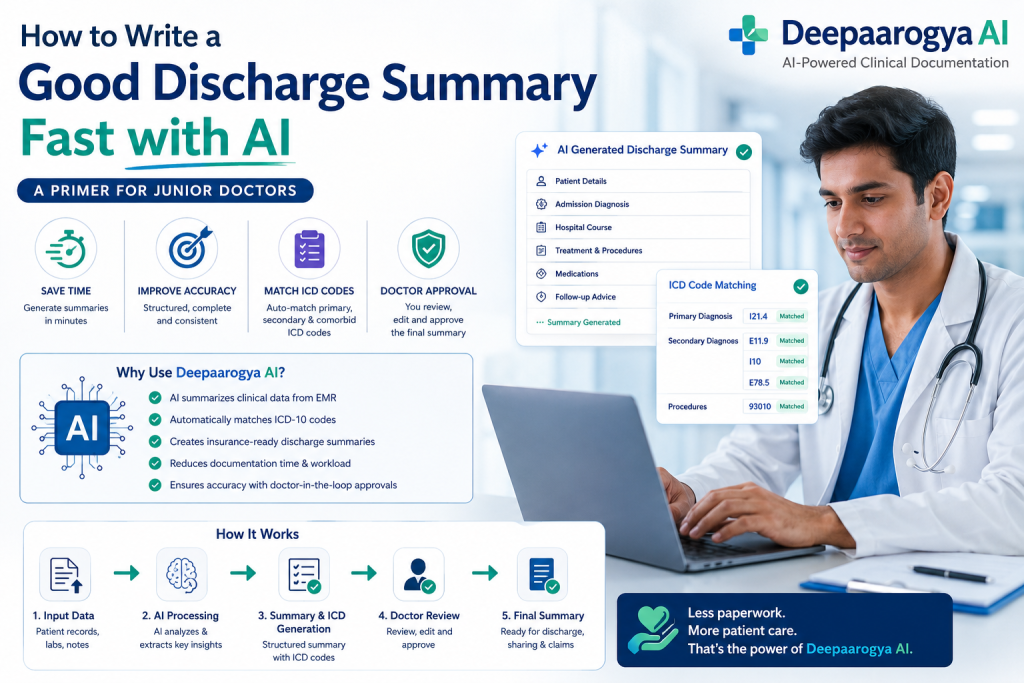
Companies like Deepaarogya AI are helping doctors generate accurate, structured, ICD-matched discharge summaries within minutes while keeping the doctor fully in control of approvals and edits.
Why Discharge Summaries Matter More Than You Think
A discharge summary is often the single most important handover document after hospitalization.
A poor discharge summary can lead to:
- Medication errors
- Readmissions
- Insurance claim rejection
- Missing diagnosis coding
- Confusion for referring physicians
- Delays in follow-up care
For junior doctors, common challenges include:
- Missing important ICD diagnoses
- Incomplete treatment timelines
- Forgetting medication changes
- Copy-paste inconsistencies
- Poor formatting
- Delayed completion due to workload
The reality is simple: hospitals expect fast documentation, but accuracy cannot be compromised.
What Makes a Good Discharge Summary?
A high-quality discharge summary should be:
1. Clear and Structured
The document should follow a logical flow:
- Patient demographics
- Admission diagnosis
- Final diagnosis
- History and findings
- Investigations
- Treatment provided
- Procedures performed
- Hospital course
- Condition at discharge
- Medication advice
- Follow-up instructions
2. Clinically Accurate
Every diagnosis, medication, and procedure must match the actual clinical course.
Incorrect or vague documentation can create:
- Billing problems
- Medico-legal risks
- Insurance denials
3. ICD Code Compatible
Many hospitals and insurers now rely heavily on ICD coding for:
- Claims processing
- Clinical analytics
- Reimbursement
- Audit compliance
Missing secondary diagnoses can reduce claim approval chances significantly.
4. Fast to Generate
Doctors should spend more time treating patients, not formatting documents manually.
The ideal discharge workflow should take minutes—not hours.
Where Junior Doctors Lose Time
Most delays happen because doctors manually:
- Read lengthy progress notes
- Search investigation reports
- Re-enter medication details
- Match diagnoses with ICD codes
- Format summaries repeatedly
This repetitive work creates burnout and increases documentation fatigue.
How AI Is Changing Discharge Summary Writing
Modern AI systems can now:
- Extract clinical information from EMRs
- Summarize hospitalization events
- Detect probable diagnoses
- Suggest ICD codes
- Structure discharge summaries automatically
- Reduce repetitive typing
But the best systems do not replace doctors.
They assist doctors.
The final approval always remains with the treating clinician.
How Deepaarogya AI Helps Doctors Generate Faster, Smarter Discharge Summaries
Deepaarogya AI is building AI-powered healthcare documentation tools designed specifically for hospitals and clinicians.
Its discharge summary workflow helps doctors by:
AI-Powered Clinical Summarization
The platform analyzes patient data and generates a structured discharge summary draft automatically.
This reduces documentation time dramatically.
Intelligent ICD Code Matching
One of the biggest strengths of Deepaarogya AI is automatic ICD code alignment.
The AI helps identify:
- Primary diagnoses
- Secondary diagnoses
- Comorbidities
- Procedure-related coding gaps
This improves:
- Insurance claim readiness
- Coding accuracy
- Hospital reimbursement workflows
Doctor-in-the-Loop Approval
Unlike fully automated systems, the doctor always reviews and approves the final summary.
This ensures:
- Clinical accuracy
- Regulatory compliance
- Physician control
- Reduced medico-legal risk
AI assists. Doctors decide.
Faster Turnaround Time
Instead of spending 20–40 minutes manually preparing summaries, doctors can generate draft summaries within minutes.
That means:
- Faster patient discharge
- Reduced workload
- Better hospital efficiency
- Less documentation burnout
Standardized Formatting
AI-generated summaries maintain consistent structure across departments and clinicians.
This improves readability for:
- Consultants
- Referring physicians
- Insurance reviewers
- Audit teams
Practical Tips for Junior Doctors Using AI Documentation Tools
Even with AI assistance, doctors should always:
Verify Diagnoses
Ensure the AI-generated diagnoses truly reflect the patient’s condition.
Check Medication Lists Carefully
Medication reconciliation remains critical.
Always review:
- Dose
- Frequency
- Duration
- Stopped medications
Review ICD Suggestions
AI can assist with coding, but the final responsibility remains clinical.
Edit for Clinical Context
Add nuances that AI may miss:
- Social factors
- Counseling details
- Complications
- Follow-up risks
Never Skip Final Approval
AI-generated documentation should always be reviewed before sign-off.
The Future of Hospital Documentation
Healthcare documentation is moving toward:
- AI-assisted workflows
- Voice-to-summary generation
- Automated coding support
- Real-time clinical documentation
- Faster insurance-ready summaries
Hospitals adopting AI documentation systems early are already seeing:
- Reduced turnaround time
- Better coding accuracy
- Lower administrative burden
- Improved clinician productivity
For junior doctors, this means less time typing and more time learning medicine.
Final Thoughts
Writing a good discharge summary is both a clinical skill and a communication responsibility.
For junior doctors, the challenge has always been balancing speed with accuracy.
AI-powered platforms like Deepaarogya AI are helping bridge that gap by:
- Generating structured discharge summaries quickly
- Matching ICD codes intelligently
- Supporting insurance-ready documentation
- Keeping doctors in control through approval workflows
The goal is not to replace clinicians.
The goal is to reduce documentation burden so doctors can focus more on patient care.
FAQ
What is a discharge summary?
A discharge summary is a medical document that explains a patient’s diagnosis, treatment, hospital stay, medications, and follow-up instructions after discharge.
How to create a discharge summary?
To create a discharge summary, include patient details, admission diagnosis, treatment given, investigations, final diagnosis, medications, and follow-up advice in a structured format.
What are the 5 D’s of discharge?
The 5 D’s of discharge are:
- Diagnosis
- Drugs
- Dressing
- Diet
- Doctor’s Follow-up
How do I get a discharge summary?
Patients can get their discharge summary from the hospital records department, treating doctor, hospital portal, or EMR system at the time of discharge.
How long should a discharge summary be?
A discharge summary should be concise but complete, usually 1–3 pages depending on the complexity of the patient’s condition and hospital stay.
What are the 5 D’s of discharge planning?
The 5 D’s of discharge planning include:
- Determine patient needs
- Develop discharge plan
- Discuss with patient/family
- Document instructions
- Do follow-up care coordination