
A multi-specialty clinic has one major operational challenge: every department needs to work differently, but the organization still needs to work as one.
An orthopedic doctor may need detailed examination findings, imaging, pain scores, and treatment plans.
A physiotherapist may need functional assessments, mobility measurements, session protocols, and progress tracking.
A nutritionist may focus on dietary history, body composition, lifestyle habits, and nutrition plans.
An ENT specialist may follow an entirely different consultation structure.
Trying to force all of these departments into one rigid workflow can create frustration.
But allowing every department to create completely separate processes can create another problem: inconsistency.
So what is the answer?
The goal should not be to make every department work in exactly the same way.
The goal should be to create standardization at the organizational level while preserving flexibility at the specialty level.
This is where a customizable healthcare platform such as DeepaarogyaAI can become valuable.
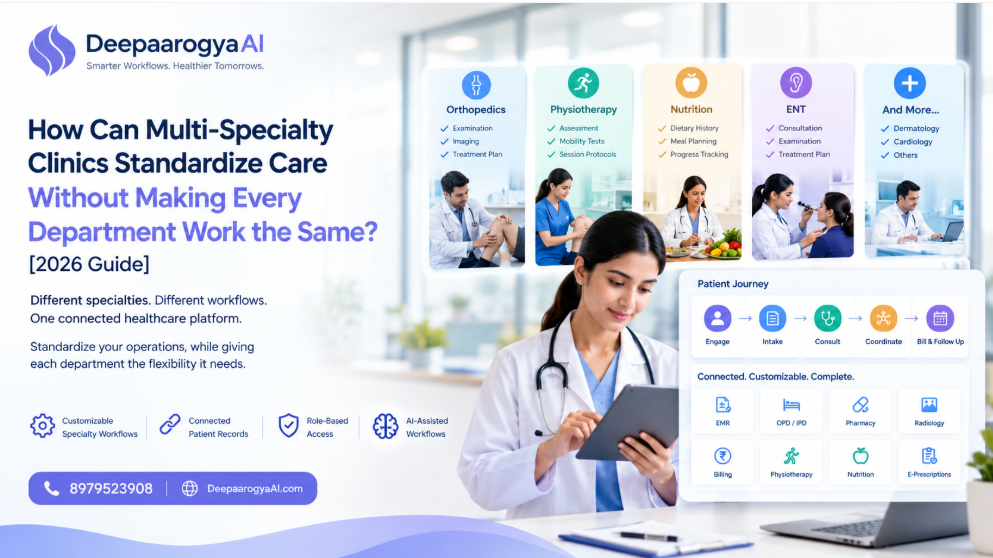
DeepaarogyaAI supports customizable case sheets and specialty-oriented workflows while keeping the broader patient journey connected across areas such as EMR, OPD, IPD, pharmacy, billing, radiology, physiotherapy, nutrition and e-prescriptions.
Why Standardization Is Difficult in Multi-Specialty Healthcare
Standardization sounds simple.
Create one process.
Train everyone.
Follow the same process.
But healthcare does not work like a conventional production line.
Different specialties ask different questions.
They record different clinical information.
They follow different treatment protocols.
They may require different documentation.
And patients may move between departments during the same care journey.
For example, consider a patient with chronic knee pain.
The patient might interact with:
Reception → Orthopedics → Radiology → Physiotherapy → Pharmacy → Billing → Follow-up
Each department has a different responsibility.
The orthopedic doctor needs a clinical assessment.
Radiology needs an imaging workflow.
The physiotherapist needs functional assessment and treatment-session information.
The pharmacy needs the prescription.
Billing needs the relevant services.
The organization therefore needs one patient journey but multiple specialty workflows.
That distinction is critical.
The Problem With One-Size-Fits-All EMR Workflows
A rigid EMR may provide consistency, but consistency alone does not guarantee usability.
Imagine asking every specialty to use exactly the same case sheet.
The doctor may see unnecessary fields.
The physiotherapist may not have the assessment structure they need.
The nutritionist may have to document information in sections that were designed for another specialty.
Over time, staff may start creating workarounds.
They may use:
- Paper notes
- Spreadsheets
- Separate documents
- Messaging applications
- Personal templates
- Manual checklists
The organization technically has an EMR, but the actual workflow becomes fragmented again.
The problem is not a lack of standardization.
It is standardization at the wrong level.
What Should Be Standardized?
A multi-specialty healthcare organization should standardize the things that need organizational consistency.
For example:
Patient identity
Every department should work with the correct patient record.
Access control
Different roles should have appropriate access to information based on their responsibilities.
Documentation principles
Clinical information should be recorded in a structured and reviewable way.
Billing processes
Operational and financial workflows should follow defined organizational rules.
Patient communication
Digital prescriptions, reminders, and other communications should follow an organized process.
Data continuity
Information generated during one stage of the patient journey should remain associated with the relevant patient record.
DeepaarogyaAI supports role-based access and connected workflows around the patient record, allowing different roles and departments to work within the same broader system.
What Should Remain Flexible?
The clinical workflow itself should be adaptable.
An orthopedic department does not need to document patients exactly like a nutrition department.
Instead, the organization can define a common framework while allowing each specialty to configure the information relevant to its practice.
For example:
Orthopedics
The workflow may include:
- Chief complaint
- Pain assessment
- Physical examination
- Imaging
- Diagnosis
- Treatment plan
- Medication
- Follow-up
Physiotherapy
The workflow may include:
- Functional assessment
- Range of motion
- Strength assessment
- Pain score
- Treatment protocol
- Session notes
- Progress
- Next session
Nutrition
The workflow may include:
- Dietary history
- Lifestyle information
- Body composition
- Nutrition assessment
- Meal planning
- Recommendations
- Follow-up
The organization remains standardized.
The clinical workflows remain specialized.
That is the balance modern healthcare organizations need.
How DeepaarogyaAI Can Support This Model
DeepaarogyaAI is designed around customizable healthcare workflows rather than requiring every specialty to operate through an identical template.
Its platform describes fully customizable case sheets and specialty-focused workflows, including areas such as orthopedics, physiotherapy, nutrition, ENT and multi-specialty practices.
This creates a practical model:
One platform → multiple specialty workflows → one connected patient journey
Instead of purchasing separate systems for every department, a healthcare organization can build different workflows within a broader digital environment.
5 Ways Standardized + Customizable Workflows Can Help Clinics
1. Create Consistency Without Removing Clinical Flexibility
The organization can establish common operational standards while allowing specialists to work with relevant clinical fields.
This can make digital adoption easier because doctors do not necessarily have to abandon familiar clinical processes simply to fit the software.
2. Reduce Workflow Variations Between Departments
When every department develops its own completely independent process, administrators may struggle to understand how the organization operates.
A configurable EMR can establish common structures while still allowing specialty-specific requirements.
This creates a clearer operational framework.
3. Make Staff Training More Structured
Imagine a clinic with five different departments using five unrelated systems.
Training becomes complicated.
Now imagine those departments using one broader platform but with workflows configured for their specific roles.
The underlying system is familiar.
The specialty workflow changes according to the department.
This can create a more manageable training environment.
DeepaarogyaAI describes a deployment approach involving workflow mapping, record migration, role setup and team training before AI-assisted workflows are introduced.
4. Support Growth Into New Specialties
A clinic may begin with two specialties.
Later, it may add:
- Physiotherapy
- Nutrition
- ENT
- Dermatology
- Cardiology
- Other specialty services
The technology should not need to be replaced every time the organization expands.
A customizable workflow approach can provide a foundation for adding new departments while maintaining the organization’s broader operating structure.
5. Keep the Patient Journey Connected
Customization should never mean isolation.
This is perhaps the most important principle.
A physiotherapy workflow can be different from an orthopedic workflow.
But if the patient moves from orthopedics to physiotherapy, the relevant patient context should remain connected.
DeepaarogyaAI’s platform brings specialty workflows together with EMR, OPD, IPD, pharmacy, billing, radiology, nutrition and other healthcare workflows around the patient record.
A Real-World Example: One Patient, Three Specialties
Consider a patient who visits a multi-specialty clinic with persistent back pain.
Stage 1: Orthopedic Consultation
The orthopedic doctor evaluates the patient and records the clinical assessment, diagnosis, investigations and treatment plan.
Stage 2: Physiotherapy
The patient is referred to physiotherapy.
The physiotherapist does not need to recreate the entire patient story from scratch.
Instead, the relevant clinical context can remain associated with the patient’s record while the physiotherapist documents the specialty-specific assessment and treatment workflow.
Stage 3: Nutrition
The patient may also require lifestyle or nutrition support.
The nutrition workflow can capture dietary and lifestyle information relevant to that specialty.
Three departments.
Three different workflows.
One patient journey.
This is the real difference between customization and fragmentation.
Standardization Should Happen at Three Levels
For growing healthcare organizations, it can help to think about standardization in three layers.
Level 1: Organizational Standardization
This includes:
- User roles
- Access permissions
- Patient identification
- Core operational processes
- Billing standards
- Communication policies
These should remain consistent across the organization.
Level 2: Specialty Standardization
Each department can define its own:
- Case sheet
- Required fields
- Clinical workflow
- Assessment structure
- Documentation requirements
This keeps the workflow relevant to the specialty.
Level 3: Patient Journey Standardization
Regardless of specialty, the broader journey can follow a consistent structure:
Engage → Intake → Consult → Coordinate → Bill & Follow Up
DeepaarogyaAI uses this broader patient-journey approach while allowing workflows to be customized around different clinical requirements.
Why This Matters as Clinics Scale
A workflow that works for a small clinic can become difficult when the organization grows.
More doctors.
More patients.
More specialties.
More locations.
More staff.
More departments.
More information.
Without a clear operating model, complexity increases quickly.
The answer is not necessarily to make every workflow identical.
Instead, healthcare organizations need controlled flexibility.
That means:
Standard where consistency matters.
Flexible where specialization matters.
Connected where the patient journey matters.
This is where customizable healthcare technology can provide a stronger foundation for growth.
What Should Clinics Look for in a Customizable EMR?
Before choosing a healthcare platform, clinic owners and hospital administrators should ask:
1. Can we customize the case sheet?
Different specialties should be able to capture the information they actually need.
2. Can workflows remain connected?
Customization should not create separate data silos.
3. Can different roles have different access?
Doctors, nurses, receptionists, pharmacists and administrators may have different responsibilities.
4. Can the platform support multiple specialties?
The system should be able to adapt as the organization grows.
5. Can AI work inside the workflow?
AI should support practical tasks instead of becoming another disconnected application.
DeepaarogyaAI includes AI-assisted workflows such as SOAP documentation, nutrition planning, patient summaries and other workflow assistance, with outputs designed for professional review.
6. Can the platform integrate with existing tools?
DeepaarogyaAI lists integrations including Google Drive, WhatsApp, Google Meet, Google Calendar and Google Docs.
7. Is security built into the workflow?
DeepaarogyaAI describes encryption, role-based access, audit controls, ABDM readiness and HIPAA-aligned security practices. Organizations should still evaluate security and compliance requirements according to their own deployment.
The Future of Multi-Specialty Healthcare Is Not One Workflow
Healthcare organizations often face a false choice:
Standardization or customization?
The better answer is:
Standardization + customization.
A modern multi-specialty organization should not force every doctor to work in the same way.
At the same time, it should not allow every department to become a completely isolated digital island.
The stronger model is:
One healthcare platform.
One connected patient record.
Different specialty workflows.
Common organizational standards.
AI assistance where appropriate.
Human oversight for clinical decisions.
That is the direction in which healthcare technology can evolve: not by making every department identical, but by making different departments work together more effectively.
How DeepaarogyaAI Fits Into the Modern Multi-Specialty Clinic
DeepaarogyaAI is positioned as an AI Hospital OS for Indian clinics and hospitals, combining EMR, OPD, IPD, pharmacy, billing, radiology, physiotherapy, nutrition, e-prescriptions, integrations and AI-assisted workflows.
Its customizable approach allows healthcare organizations to think beyond simply digitizing paperwork.
The bigger opportunity is to create a healthcare environment where:
Every specialty can work its own way.
Every department can remain connected.
Every role can have appropriate access.
Every patient can have a continuous digital record.
And as the organization grows, the underlying platform can grow with it.
Conclusion: Standardize the System, Not the Specialty
The goal of healthcare technology should never be to make every department identical.
It should be to make the overall organization more consistent while allowing clinical teams to remain specialized.
A successful multi-specialty EMR should therefore provide:
- Common organizational standards
- Customizable specialty workflows
- Connected patient records
- Role-based access
- Integrated operational workflows
- AI-assisted tasks
- Room for future growth
DeepaarogyaAI follows this broader philosophy by combining customizable specialty workflows with a connected healthcare platform.
Because the future of healthcare is not:
“One workflow for everyone.”
It is:
“The right workflow for every specialty, connected through one healthcare ecosystem.”
Frequently Asked Questions
1. Why can’t every department use the same EMR workflow?
Different specialties collect different clinical information and follow different processes. A single rigid workflow can therefore become inefficient or irrelevant for some departments.
2. What is a customizable EMR?
A customizable EMR allows healthcare organizations to configure case sheets, fields, sections and workflows according to their specialty and operational requirements.
3. Does customization create disconnected departments?
It can if every department uses completely independent systems. A connected platform can instead allow departments to maintain specialty-specific workflows while remaining associated with the same patient record.
4. Can DeepaarogyaAI support different specialties?
Yes. DeepaarogyaAI describes specialty workflows for areas including orthopedics, physiotherapy, nutrition, ENT and multi-specialty practices.
5. Can different staff members have different access?
Yes. DeepaarogyaAI supports role-based access for roles such as doctors, nurses, front-desk staff, pharmacy teams and administrators.
6. Can AI be added without replacing clinical judgment?
Yes. DeepaarogyaAI’s AI-assisted workflows are designed to support tasks such as documentation and planning, while generated outputs can remain subject to professional review and approval.
7. Is DeepaarogyaAI suitable for growing clinics?
The platform is designed for clinics and hospitals and supports customizable workflows, connected departments and role-based access. Its website also describes deployment support for workflow mapping, data migration, role setup and team onboarding.
8. How can a clinic explore whether DeepaarogyaAI fits its workflow?
The best starting point is to map the clinic’s current patient journey, identify specialty-specific requirements and then evaluate how those workflows can be configured within DeepaarogyaAI.
Ready to Build a Smarter Multi-Specialty Workflow?
Don’t force every department to work the same way.
Give every specialty the workflow it needs—while keeping the entire organization connected.
Explore DeepaarogyaAI and see how a customizable, connected healthcare platform can fit your clinic’s workflow.
📞 Call: 8979523908
🌐 Visit: https://www.deepaarogya.com/
Book a Demo and discover how your clinic can move from disconnected specialty workflows to one connected healthcare ecosystem.