
A patient’s discharge is not simply the end of a hospital stay. It is the point where clinical documentation, medications, investigations, procedures, billing, insurance requirements, and follow-up instructions all need to come together accurately.
For a small practice, preparing this information may involve a limited number of records and departments. But for a mid-size or large hospital, the complexity increases quickly.
Multiple departments may contribute information to a single patient journey. Doctors document clinical progress, nurses record observations, diagnostic departments provide reports, pharmacy manages medications, billing teams process charges, and insurance teams may need supporting documentation before a claim can move forward.
The result is a familiar challenge:
Hospitals have the data, but bringing the right information together at discharge can take significant time.
This is where AI-powered discharge and insurance summary workflows can help.
Instead of creating every summary manually from multiple sections of the patient record, AI can help organize relevant information and prepare structured drafts for clinical review.
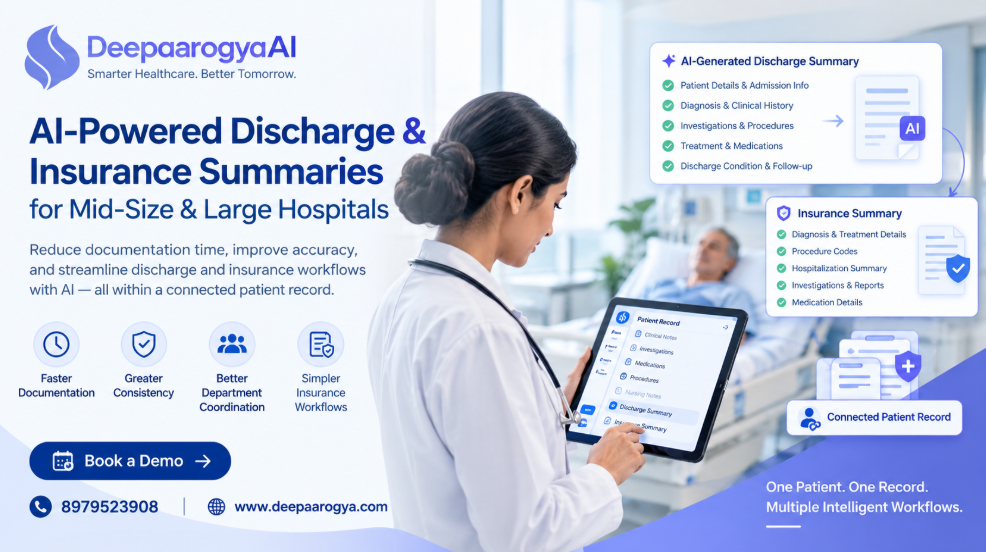
For hospitals looking to improve documentation workflows without adding another disconnected software layer, DeepaarogyaAI brings AI agents into a connected patient record, allowing discharge-related workflows to work with information already available across the hospital journey.
Why Discharge Documentation Becomes Difficult at Hospital Scale
Discharge documentation can appear straightforward from the outside.
But consider what may need to be reviewed before a patient leaves:
- Admission details
- Diagnosis and clinical history
- Investigations and reports
- Procedures performed
- Treatment provided
- Medication changes
- Progress during hospitalization
- Nursing documentation
- Vital trends
- Discharge condition
- Follow-up recommendations
- Insurance-related information
- Coding requirements
In a mid-size or large hospital, these details may come from different departments and different stages of the patient’s stay.
The challenge is therefore not simply writing a document.
The challenge is bringing together the right information at the right time without unnecessary re-entry.
When this process remains heavily manual, documentation can become a bottleneck for doctors, medical records teams, discharge coordinators, and insurance departments.
The Hidden Cost of Manual Discharge Summaries
Manual documentation does not necessarily mean that a hospital’s staff is inefficient.
Often, the underlying problem is that healthcare information is distributed across multiple workflows.
A doctor may have to review:
Case sheet → Progress notes → Orders → Investigations → Procedures → Medications → Nursing notes → Final diagnosis
Then this information needs to be converted into a structured discharge document.
This creates several operational challenges.
1. Repetitive Data Compilation
Healthcare professionals may spend time finding information that has already been entered somewhere else in the patient record.
2. Documentation Delays
When summaries are completed late, discharge coordination can also become more difficult.
3. Inconsistent Formats
Different clinicians or departments may document information in different structures.
4. Missing Context
Important information can be overlooked when teams have to manually consolidate large amounts of clinical data.
5. Insurance Documentation Pressure
Insurance-related workflows often require organized clinical and treatment information. Missing or unclear documentation can create additional back-and-forth between hospital and insurance teams.
The goal of AI should not be to remove clinical oversight.
The goal is to reduce repetitive compilation work so healthcare professionals can spend more time reviewing the information rather than assembling it from scratch.
What Is an AI-Powered Discharge Summary?
An AI-powered discharge summary workflow uses information already available in a patient’s digital record to help prepare a structured discharge-summary draft.
Instead of beginning with a blank document, the clinician can receive a draft based on relevant patient information.
Depending on the hospital’s workflow, this can include information such as:
- Patient and admission details
- Diagnosis
- Clinical history
- Investigations
- Procedures
- Hospital course
- Medications
- Discharge condition
- Follow-up instructions
The important distinction is:
AI prepares the draft. The clinician reviews and approves the final document.
This doctor-in-the-loop approach keeps professional judgment at the centre of the discharge process.
DeepaarogyaAI’s Discharge Summary Agent is designed around this workflow, using relevant information from the connected patient record to prepare structured drafts for clinician review.
AI Insurance Summaries: Connecting Clinical Documentation With Claims Workflows
Discharge documentation and insurance documentation are closely connected.
When a patient is discharged, insurance teams may need relevant information about:
- Diagnosis
- Treatment
- Procedures
- Hospitalization
- Investigations
- Medications
- Clinical course
- Applicable codes
- Other supporting information
If clinical information is scattered across different systems, preparing an insurance-related summary can require additional manual work.
An AI-assisted insurance-summary workflow can help organize relevant information from the patient’s record into a structured draft.
This can give hospitals a more connected workflow:
Patient Record → Discharge Summary → Insurance Summary → Review → Final Documentation
DeepaarogyaAI’s Discharge Summary Agent can generate an insurance-related summary alongside other discharge outputs, keeping these workflows connected to the patient chart.
However, AI-generated information should still be reviewed against the patient’s actual record before final submission or use.
Why a Connected Patient Record Matters
AI is only as useful as the information available to it.
A standalone AI tool may require staff to collect information manually and provide it to the system.
That creates another step.
A connected patient record offers a different approach.
For example, a patient’s hospitalization may involve:
OPD → IPD → Nursing → Radiology → Pharmacy → Billing → Discharge → Insurance → Follow-up
If these workflows operate around the same patient record, the information does not have to be repeatedly reconstructed.
DeepaarogyaAI is built around this connected-record approach, bringing EMR, OPD, IPD, pharmacy, billing, radiology, physiotherapy, nutrition, e-prescriptions and AI agents together around the patient journey.
This creates an important foundation for hospital AI.
The AI does not need to function as another isolated application.
The AI agent can work inside the workflow.
How the AI Discharge Workflow Can Work
Consider a patient admitted for a surgical procedure.
During the hospital stay, information is recorded across different stages.
Step 1: Patient Admission
The patient’s admission information and clinical details are recorded in the hospital system.
Step 2: Treatment and Hospital Stay
Doctors, nurses and other departments add relevant clinical information throughout the patient’s stay.
Step 3: Investigations and Procedures
Reports, procedures, orders and other relevant information become part of the patient’s record.
Step 4: Discharge Preparation
Instead of manually collecting information from multiple sections, the Discharge Summary Agent can use relevant information already available in the connected record.
Step 5: AI-Generated Draft
The system prepares a structured discharge-summary draft.
Step 6: Insurance Summary
Relevant information can also be organized into an insurance-related summary.
Step 7: Clinician Review
The treating clinician checks the information, makes corrections where required, and approves the final documentation.
Step 8: Patient Discharge
The finalized documentation can then support the next stage of the patient’s journey.
This approach changes the workflow from:
Collect → Copy → Type → Format → Check
to:
Connect → Generate Draft → Review → Approve
What Mid-Size Hospitals Can Gain From AI-Assisted Documentation
For a growing hospital, documentation requirements increase along with patient volume.
AI-assisted discharge workflows can help hospitals work toward:
Reduced Repetitive Documentation
Staff can begin with an AI-generated draft rather than compiling every section manually.
More Consistent Documentation
A structured workflow can help maintain a consistent format across clinicians and departments.
Better Department Coordination
When discharge documentation is connected to the patient record, relevant information can remain accessible within the broader workflow.
More Efficient Discharge Preparation
Reducing repetitive documentation can help teams focus on review and coordination.
Better Insurance Workflow Support
A structured insurance summary can provide the insurance team with relevant information in a more organized format.
What Large Hospitals Need From Hospital AI
Large hospitals have a different level of complexity.
They may have:
- Multiple specialties
- Multiple departments
- Large clinical teams
- High inpatient volumes
- Large numbers of medical records
- Dedicated billing and insurance teams
- Complex operational workflows
For these organizations, simply adding an AI writing tool may not solve the underlying problem.
The larger opportunity is workflow-level AI.
The AI needs to work with the hospital’s existing information architecture and support the people responsible for each step.
That is why connected EMR and AI-agent architecture becomes important.
Instead of creating separate AI tools for:
Documentation + summaries + nutrition + follow-ups + patient communication
the workflows can operate around a common patient record.
DeepaarogyaAI positions its platform around this model, combining hospital-management workflows, EMR and AI agents on a connected patient record.
DeepaarogyaAI’s Role in AI-Powered Hospital Documentation
DeepaarogyaAI is designed as an AI Hospital and Clinic Operating System, combining EMR, OPD, IPD, pharmacy, billing and AI agents around a connected patient record.
For discharge workflows, its Discharge Summary Agent can use relevant information available in the patient chart to prepare structured drafts.
The workflow can support outputs including:
- Discharge summaries
- ICD-related information
- Insurance summaries
- Medication reconciliation
- Follow-up instructions
- Other patient-specific documentation
These outputs remain part of a review-and-approval workflow rather than replacing clinical decision-making.
This distinction is particularly important for hospitals.
The objective is not autonomous clinical documentation.
It is to give clinicians and hospital teams a stronger starting point.
Why AI Should Be Inside the Hospital Workflow
There is a major difference between using AI as an external tool and embedding AI into the hospital workflow.
External AI workflow
Patient information
↓
Copy information
↓
Open separate AI tool
↓
Generate summary
↓
Copy result back
↓
Update hospital record
This can introduce additional manual steps.
Connected AI workflow
Patient record
↓
AI Agent
↓
Structured draft
↓
Clinician review
↓
Approval
↓
Connected patient record
The second approach keeps the AI closer to the actual workflow.
That is the philosophy behind DeepaarogyaAI’s AI agents: AI assistance inside the chart rather than another disconnected application.
What Hospitals Should Consider Before Implementing AI
AI adoption should not be based only on whether a tool can generate text.
Hospitals should evaluate the entire workflow.
1. Data Connectivity
Can the system access the relevant patient information without unnecessary duplicate entry?
2. Human Review
Can clinicians review, edit and approve AI-generated documentation?
3. Workflow Integration
Does the AI fit into existing hospital processes?
4. Standardization
Can hospitals establish consistent documentation structures across departments?
5. Security and Governance
How is patient information handled, accessed and controlled?
6. Scalability
Can the workflow support increasing patient volumes and additional departments?
7. Interoperability
Can the system work with the hospital’s broader digital ecosystem?
These questions are more important than simply asking whether an AI model can write a discharge summary.
From Faster Documentation to a More Connected Hospital
The future of hospital AI is not necessarily about generating more documents.
It is about making healthcare information more connected and useful throughout the patient journey.
A discharge summary should not exist as an isolated Word document.
An insurance summary should not require the insurance team to reconstruct the hospitalization manually.
A billing team should not have to search multiple systems for relevant information.
And clinicians should not have to repeatedly re-enter information that already exists in the patient record.
A connected AI hospital platform can bring these workflows closer together.
With DeepaarogyaAI, the broader vision is:
One patient. One connected record. Multiple intelligent workflows.
Conclusion: The Next Step for Hospital Documentation
For mid-size and large hospitals, discharge documentation sits at the intersection of clinical care, hospital operations, billing, insurance and patient experience.
That makes it more than a documentation problem.
It is a workflow problem.
AI can help hospitals address that problem by preparing structured discharge and insurance-summary drafts from information already available in the connected patient record.
But the most effective approach is not simply to automate documentation.
It is to connect documentation with the rest of the hospital journey.
DeepaarogyaAI’s connected patient record and AI-agent approach is designed to bring these capabilities into the same healthcare workflow, while keeping clinicians responsible for reviewing and approving the final output.
For hospitals looking to move from fragmented documentation to connected, AI-assisted healthcare management, this is where the next stage of digital transformation begins.
Explore DeepaarogyaAI
Make hospital documentation more connected. Make AI work inside the workflow.
👉 Explore DeepaarogyaAI: https://www.deepaarogya.com/
📞 Contact: +91 89795 23908
Book a Demo and explore AI-powered hospital workflows for your organization.
Frequently Asked Questions
1. What is an AI-powered discharge summary?
An AI-powered discharge summary is a structured draft created with the help of AI using relevant information from a patient’s digital medical record. A clinician reviews and approves the final document.
2. Can AI generate insurance summaries for hospitals?
AI can assist in organizing relevant patient and hospitalization information into an insurance-summary draft. The hospital’s appropriate clinical or administrative team should review the information before final use.
3. How can AI help mid-size hospitals?
AI can help reduce repetitive documentation work, create structured drafts, support standardized workflows and make relevant patient information easier to organize.
4. Why is a connected patient record important for AI?
A connected patient record gives AI access to relevant information within the hospital workflow, reducing the need to repeatedly collect and re-enter information across separate systems.
5. Can AI replace doctors when preparing discharge summaries?
No. AI-assisted documentation should support clinicians rather than replace their professional responsibility. The final information should be reviewed and approved by the appropriate healthcare professional.
6. What is DeepaarogyaAI’s Discharge Summary Agent?
DeepaarogyaAI’s Discharge Summary Agent is an AI workflow designed to use relevant information from the connected patient record to prepare structured discharge-related drafts for clinician review. It can also support insurance-summary workflows.
7. Can this approach work across multiple hospital departments?
The broader DeepaarogyaAI platform is designed to connect workflows including EMR, OPD, IPD, pharmacy, billing, radiology, physiotherapy and nutrition around a connected patient record.
8. What should hospitals look for in an AI documentation platform?
Hospitals should consider data connectivity, workflow integration, human review, security and governance, interoperability, standardization and scalability rather than evaluating AI only on its ability to generate text.