
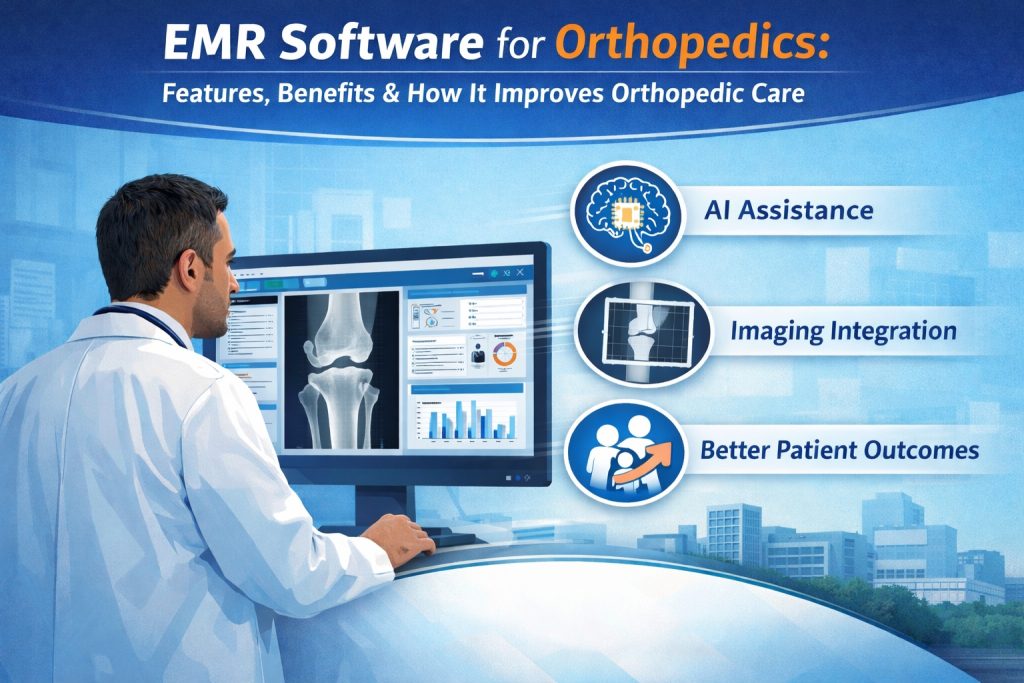
In the fast-evolving world of healthcare technology, Electronic Medical Records (EMR) have transformed how orthopedic clinics operate — from patient intake to diagnosis, surgical planning, follow-ups, and long-term care. Modern EMR solutions aren’t just digital filing cabinets; they’re intelligent platforms that increase productivity, reduce errors, and elevate patient experiences.
What Is Orthopedic EMR Software?
An Orthopedic EMR (Electronic Medical Records) system is a software platform that electronically captures, stores, and manages patient health information specifically tailored to bone, joint, spine, muscle, and trauma care.
Unlike general EMR systems, orthopedic EMRs include specialized templates, imaging and surgical data handling, mobility assessments, implant tracking, and rehabilitation records — all structured for musculoskeletal disorders and surgical cases.
At its core, an orthopedic EMR:
Centralizes all patient data from first visit to final follow-up
Automates repetitive tasks (notes, prescriptions, billing)
Integrates labs, imaging, and referral systems
Supports analytics and reporting for better decision-making
If properly deployed, this technology significantly improves practice efficiency, accuracy of care, patient engagement, and clinical outcomes.
Why Orthopedic Clinics Need Specialized EMR Software
Orthopedic practices are diagnostically and administratively intensive. They require:
✔ Detailed clinical history
✔ Injury and examination documentation
✔ Imaging reports (X-rays, MRIs, CT scans)
✔ Surgical planning and tracking
✔ Implant logs and follow-up outcomes
✔ Physical therapy and rehab progress
A general EMR might capture basic health records, but orthopedics demands discipline-specific tools that understand musculoskeletal nuances — like joint scores, fracture classifications, and mobility measures.
Orthopedic EMRs help reduce turnaround times, enhance care coordination, and give clinicians the right clinical context at the right moment.
Top Features of Orthopedic EMR Software
To truly transform clinical operations, an orthopedic EMR must go beyond basic recordkeeping. Below are the essential features that distinguish top-tier orthopedic EMR software:
1. Orthopedic-Specific Clinical Templates
Templates designed for orthopedic conditions (e.g., fractures, arthritis, spinal disorders) help clinicians:
✔ Capture structured clinical notes
✔ Standardize documentation
✔ Reduce typing time during high volume OPDs
These templates significantly improve clinical accuracy and save time — especially during busy outpatient sessions.
2. Integrated Imaging & Diagnostic Reports
Orthopedics is a visual specialty — clinicians rely on imaging to diagnose and plan treatments. The best EMRs integrate:
- X-rays
- MRIs
- CT scans
- Ultrasounds
Physicians can view images alongside patient notes, annotate findings, and track progress over time without switching systems. This supports faster diagnosis and more precise surgical planning.
3. AI-Enabled Clinical Assistance
AI-powered systems — such as DeepAarogya AI’s EMR platform — enhance orthopedic care by automating routine tasks:
✔ Voice-to-text clinical notes
✔ Predictive insights from prior data
✔ Structured summaries from unstructured inputs
✔ Ability to ask questions about a patient’s records and get instant insights
AI does not replace clinicians, but it boosts efficiency and reduces burnout by handling administrative overhead.
4. Telemedicine & Remote Care Integration
Integrated telehealth features allow virtual consultations with patients who:
✔ Are immobile due to injury
✔ Live in remote locations
✔ Need follow-up care without travel
This expands access and convenience while ensuring continuity of care.
5. Appointment Scheduling & Reminder Systems
Automated scheduling and reminders help clinics:
- Reduce no-shows
- Optimize appointment slots
- Improve patient flow
This means more efficient practice management and improved patient adherence to follow-ups.
6. Billing, Coding & Insurance Management
Orthopedic care often involves complex procedures and coding. EMR systems with built-in billing modules:
✔ Automatically generate claims
✔ Suggest correct codes based on diagnosis
✔ Reduce claim rejections and billing errors
This speeds up reimbursements and strengthens financial health of the clinic.
7. Outcome Tracking & Analytics Dashboards
High-level reporting helps practices:
- Monitor patient outcomes
- Track treatment efficacy
- Analyze business performance
These analytics allow clinicians and practice owners to make data-driven decisions and improve long-term clinical strategies.
Book Demo / Pricing Try for Free
Deepaarogya AI – Orthodontic EMR Platform  +91 8979523908
  contact@deepaarogya.com
Core Benefits of Orthopedic EMR Software
Adopting a robust orthopedic EMR delivers benefits across the board — for clinicians, administrators, and patients alike.
1. Superior Patient Data Management
All patient records — from consultation notes to imaging and prescriptions — are stored securely in one place. This:
✔ Eliminates paper chart clutter
✔ Improves access speed
✔ Reduces loss of critical health information
With one click, clinicians can retrieve a comprehensive patient history which is integral to individualized care.
2. Enhanced Diagnostic Accuracy
EMRs with structured data and analytics support clinicians in:
✔ Correlating symptoms with imaging and labs
✔ Recognizing patterns for recurring problems
✔ Reducing diagnostic errors
AI-assisted insights further improve diagnostic confidence by suggesting evidence-based perspectives drawn from patient data trends.
3. Time Savings on Documentation
Documentation often consumes a huge portion of a clinician’s time. By automating notes, templates, and voice inputs, EMRs free up more time for meaningful clinical interaction — this is especially valuable in high-volume orthopedic practices.
DeepAarogya AI, for example, focuses on automating clinical documentation with voice intelligence — enabling doctors to dictate patient encounters directly into structured clinical records.
4. Better Coordination of Care
In orthopedic care, multiple stakeholders often collaborate — from physical therapists and radiologists to surgical teams and rehab specialists. An EMR fosters:
✔ Secure data sharing
✔ Cross-team access to patient records
✔ Unified care plans
This reduces duplication of tests, miscommunication, and delays in treatment decisions.
5. Improved Patient Engagement & Satisfaction
Most EMRs allow patients to:
- View their records
- Check appointments
- Communicate securely with providers
Active involvement in their own care generally leads to better adherence to treatment plans and improved satisfaction scores.
6. Regulatory Compliance & Data Security
Modern EMR systems are designed to adhere to healthcare data standards and secure patient privacy. Digital records:
✔ Protect against unauthorized access
✔ Reduce risk of lost or damaged paper files
✔ Enable compliance with legal and regulatory requirements
This is especially important in India, where digital privacy laws and the ABDM health record ecosystem are gaining prominence.
7. Enhanced Operational Efficiency
By automating key administrative tasks — patient registration, billing, appointment reminders — orthopedic clinics gain:
✔ Faster patient throughput
✔ More predictable workflows
✔ Reduced administrative staffing costs
This can significantly increase profitability and reduce operational bottlenecks.
Book Demo / Pricing Try for Free
Deepaarogya AI – Orthodontic EMR Platform +91 8979523908 contact@deepaarogya.com
How Orthopedic EMRs Improve Clinical Outcomes
Faster, Better-Informed Decisions
With all patient data available instantly — including imaging, labs, prior treatment plans, and clinical notes — physicians can:
✔ Make accurate diagnoses faster
✔ Personalize treatment pathways
✔ Avoid redundant investigations
This leads to safer and more efficient care delivery.
Better Surgical Planning
Orthopedic cases often involve complex surgical interventions. EMRs help document:
 Pre-operative evaluations Procedure notes Implant details Post-op care pathways
Detailed digital records ensure full traceability and improve surgical safety.
Improved Follow-Up & Rehab Monitoring
Orthopedic recovery is often a long journey — from immobilization to physical therapy and strength rehabilitation. An EMR:
- Tracks patient progress step-by-step
- Sends automated follow-up reminders
- Records subjective scores (like pain or mobility scores)
This consistency improves adherence and long-term patient outcomes.
Reduced Medical Errors
Handwriting errors or lost records are common in paper-based systems. EMR systems:
✔ Eliminate illegible paperwork
✔ Prevent medication errors via alerts
✔ Reduce repeat procedures due to missing data
Collectively, these improvements enhance patient safety and trust.
Conclusion: EMR Software Is a Game Changer for Orthopedic Care
EMR systems — especially those enhanced by AI — are no longer optional for orthopedic practices. They:
Improve clinical workflows
Enhance patient safety
Increase operational efficiency
Support better decision-making
Reduce costs and administrative burden
Whether you’re a solo orthopedist or leading a multi-doctor clinic, adopting a robust orthopedic EMR can transform how you deliver care. AI-powered tools like DeepAarogya AI are at the forefront of this transformation in India — making advanced, intelligent healthcare accessible to practitioners and patients alike.