
Orthopedic practices deal with some of the most complex patient journeys in healthcare. From injury assessment and imaging reviews to surgery, physiotherapy, nutrition counseling, and long-term rehabilitation, orthopedic care involves multiple departments working together.
This is why choosing the right EMR software is critical.
The best orthopedic EMR software should not only manage patient records but also connect every stakeholder involved in patient care—including orthopedic surgeons, physiotherapists, dietitians, billing teams, laboratory staff, and hospital administrators.
In this article, we will explore the key features of the best orthopedic EMR software and why Deepaarogya AI is emerging as one of the most comprehensive solutions for orthopedic clinics and hospitals.
Why Orthopedic Practices Need Specialized EMR Software
Unlike general medical practices, orthopedic clinics manage:
- Fracture cases
- Joint replacement surgeries
- Sports injuries
- Spine disorders
- Trauma management
- Long-term rehabilitation
- Physiotherapy follow-ups
- Nutrition and recovery planning
A generic EMR often struggles to support these specialty-specific workflows. Modern orthopedic practices require software that can centralize clinical, operational, and financial processes into a single platform. Industry guides consistently highlight the importance of imaging integration, orthopedic templates, rehabilitation tracking, billing automation, and specialty-specific workflows for orthopedic care.
Key Features of the Best Orthopedic EMR Software
1. Orthopedic-Specific Clinical Templates
The best orthopedic EMR should provide ready-to-use templates for:
- Knee pain assessment
- Arthritis management
- Fracture documentation
- Joint replacement follow-ups
- Spine disorders
- Sports medicine cases
These templates reduce documentation time while ensuring clinical consistency.
2. Imaging Integration
Orthopedic specialists rely heavily on:
- X-rays
- MRI scans
- CT scans
- Ultrasound reports
An ideal system should allow doctors to view images alongside patient records without switching between multiple applications.
3. AI-Powered Documentation
Modern EMR systems now use AI to:
- Convert voice notes into structured clinical records
- Generate SOAP notes
- Create discharge summaries
- Reduce manual typing
This significantly improves physician productivity and reduces burnout.
4. Physiotherapy Integration
Orthopedic treatment rarely ends after surgery or diagnosis.
Patients often require:
- Rehabilitation programs
- Exercise plans
- Progress tracking
- Functional assessments
A connected physiotherapy module ensures seamless continuity of care.
5. Billing and Revenue Cycle Management
Orthopedic procedures involve:
- Consultation charges
- Imaging charges
- Surgical billing
- Insurance claims
- Rehabilitation billing
Integrated billing helps reduce claim denials and improve cash flow.
6. Multi-Department Coordination
The best orthopedic EMR should allow every department to work from a single patient record, ensuring complete care coordination.
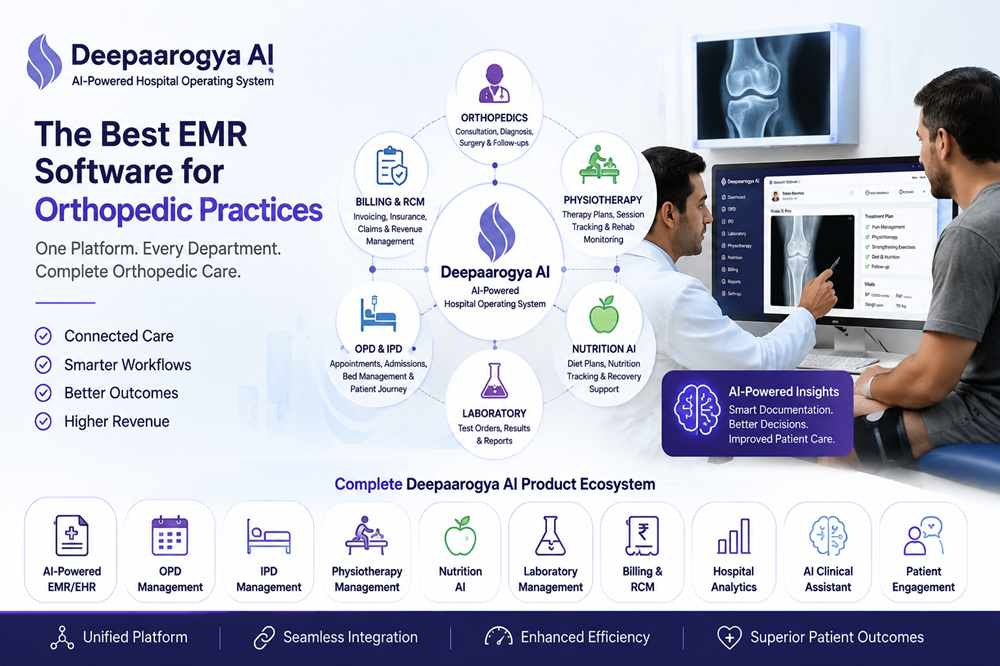
Why Deepaarogya AI Is One of the Best EMR Software Solutions for Orthopedic Practices
Deepaarogya AI is not just an EMR.
It is an AI-Powered Hospital Operating System designed to connect every department involved in orthopedic care.
Instead of using separate software for doctors, physiotherapists, dietitians, billing teams, laboratories, and hospital administration, Deepaarogya AI brings everything together on a single platform.
How Deepaarogya AI Connects the Entire Orthopedic Care Journey
Step 1: Orthopedic Consultation
When a patient visits an orthopedic clinic:
- Registration happens digitally
- Previous records are instantly available
- AI-assisted documentation captures clinical notes
- Imaging reports are attached to the patient record
- Prescriptions are generated electronically
The orthopedic surgeon gets a complete view of the patient’s history from one dashboard.
Step 2: Diagnostic & Imaging Integration
Deepaarogya AI integrates with:
- Laboratory systems
- X-ray departments
- MRI centers
- CT scan services
Reports automatically become part of the patient’s EMR.
No paper files.
No duplicate data entry.
Step 3: Surgical Workflow Management
For orthopedic surgeries, Deepaarogya AI supports:
- Pre-operative assessment
- OT scheduling
- Surgical documentation
- Implant tracking
- Post-operative monitoring
This creates a complete digital record of the patient’s surgical journey.
Step 4: Physiotherapy Management
One of the biggest challenges in orthopedic care is rehabilitation tracking.
Deepaarogya AI includes a dedicated Physiotherapy Management Module that enables:
Physiotherapists to:
- Access orthopedic prescriptions
- View imaging reports
- Record therapy sessions
- Track patient mobility
- Monitor rehabilitation outcomes
- Create exercise plans
Because everything is connected, physiotherapists always work with the latest clinical information.
Step 5: Dietitian & Nutrition Management
Recovery after orthopedic surgery depends heavily on nutrition.
Deepaarogya AI includes a dedicated Nutrition AI Module where dietitians can:
- Review medical history
- Assess nutritional requirements
- Create recovery-focused diet plans
- Track progress
- Collaborate with orthopedic doctors
This ensures a holistic treatment approach.
Step 6: Billing & Revenue Cycle Management
Deepaarogya AI automatically connects clinical activities with billing workflows.
The system supports:
- OPD billing
- IPD billing
- Procedure billing
- Physiotherapy billing
- Package management
- Insurance workflows
- Revenue tracking
This reduces administrative workload while improving financial efficiency.
Complete Deepaarogya AI Product Ecosystem for Orthopedic Hospitals
AI-Powered EMR/EHR
- Digital patient records
- Voice-to-text documentation
- AI-generated clinical notes
- E-prescriptions
- Follow-up management
OPD Management
- Appointment scheduling
- Queue management
- Consultation workflows
IPD Management
- Admissions
- Bed management
- Nursing workflows
- Discharge processes
Physiotherapy Management System
- Therapy sessions
- Progress tracking
- Exercise plans
- Rehabilitation monitoring
Nutrition AI
- Personalized diet plans
- Recovery nutrition tracking
- Dietitian workflows
Laboratory Management
- Test ordering
- Result management
- Automated reporting
Billing & Revenue Cycle Management
- Invoicing
- Insurance processing
- Financial analytics
Hospital Analytics Dashboard
- Revenue insights
- Patient outcomes
- Department performance
- Operational KPIs
AI Clinical Assistant
- Smart documentation
- Clinical summaries
- Workflow automation
- Decision support
Patient Engagement Platform
- WhatsApp reminders
- Follow-up alerts
- Digital communication
Benefits of Using Deepaarogya AI for Orthopedic Practices
Faster Documentation
AI-powered note generation reduces manual charting.
Better Care Coordination
Orthopedic surgeons, physiotherapists, and dietitians work from the same patient record.
Improved Patient Outcomes
Connected rehabilitation and nutrition workflows support faster recovery.
Higher Revenue
Integrated billing and RCM reduce claim errors and revenue leakage.
Better Patient Experience
Patients experience smoother transitions between consultation, surgery, therapy, and follow-ups.
Scalability
Suitable for:
- Individual orthopedic clinics
- Multi-specialty clinics
- Orthopedic hospitals
- Rehabilitation centers
Final Verdict
The best EMR software for orthopedic practices is not simply the one that stores patient records. The ideal solution should connect every stage of the orthopedic care journey—from diagnosis and surgery to physiotherapy, nutrition management, and billing.
Deepaarogya AI stands out by offering a unified AI-powered platform that integrates Orthopedics, Physiotherapy, Nutrition, Laboratory, Billing, Revenue Cycle Management, OPD, IPD, and Hospital Operations into a single ecosystem.
For orthopedic clinics and hospitals looking to improve efficiency, enhance patient outcomes, and streamline operations, Deepaarogya AI delivers far more than a traditional EMR—it provides a complete digital operating system for modern orthopedic care.
Frequently Asked Questions (FAQs) About the Best EMR Software for Orthopedic Practices
1. What is an Orthopedic EMR Software?
An Orthopedic EMR (Electronic Medical Record) is a specialized healthcare software designed to manage patient records, treatment plans, imaging reports, surgeries, rehabilitation, and follow-up care for orthopedic clinics and hospitals.
2. How is an Orthopedic EMR different from a general EMR?
Orthopedic EMRs include specialty-specific features such as:
- Fracture management documentation
- Joint replacement workflows
- X-ray and MRI integration
- Physiotherapy tracking
- Rehabilitation monitoring
- Sports injury management
General EMRs often lack these specialized workflows.
3. What features should orthopedic surgeons look for in an EMR?
Key features include:
- AI-powered clinical documentation
- Orthopedic-specific templates
- Imaging integration (X-ray, MRI, CT Scan)
- Surgical workflow management
- Physiotherapy management
- Billing and insurance support
- Analytics and reporting
- Patient follow-up automation
4. Can Deepaarogya AI handle both OPD and IPD workflows for orthopedic hospitals?
Yes. Deepaarogya AI provides comprehensive OPD and IPD management including:
- Appointment scheduling
- Consultation management
- Admission and discharge workflows
- Bed management
- Nursing documentation
- Surgery scheduling
5. Does Deepaarogya AI support physiotherapy management?
Yes. Deepaarogya AI includes a dedicated Physiotherapy Management Module that allows physiotherapists to:
- Access patient records
- View orthopedic prescriptions
- Track rehabilitation progress
- Record therapy sessions
- Monitor recovery outcomes
6. Can orthopedic surgeons and physiotherapists access the same patient records?
Yes. Deepaarogya AI provides a unified patient record where orthopedic surgeons, physiotherapists, dietitians, and other care providers can collaborate seamlessly.
7. How does Deepaarogya AI help after joint replacement surgeries?
Deepaarogya AI supports:
- Post-operative care tracking
- Physiotherapy planning
- Follow-up scheduling
- Nutrition management
- Recovery monitoring
- Patient engagement through reminders
8. Does Deepaarogya AI include nutrition management for orthopedic patients?
Yes. Deepaarogya AI includes a Nutrition AI module that helps dietitians create personalized recovery-focused diet plans for patients recovering from fractures, surgeries, and sports injuries.
9. Can Deepaarogya AI integrate laboratory and imaging reports?
Yes. The platform can integrate:
- Laboratory results
- X-ray reports
- MRI reports
- CT Scan reports
- Diagnostic records
All reports are automatically linked to the patient’s EMR.
10. How does AI help orthopedic doctors in Deepaarogya AI?
Deepaarogya AI’s Clinical Assistant helps by:
- Creating consultation notes
- Generating clinical summaries
- Reducing manual documentation
- Improving workflow efficiency
- Assisting with patient record management
11. Does Deepaarogya AI support orthopedic surgery documentation?
Yes. The platform supports:
- Pre-operative assessments
- OT scheduling
- Surgical records
- Implant tracking
- Post-operative documentation
- Discharge summaries
12. Can Deepaarogya AI manage billing for orthopedic procedures?
Yes. Deepaarogya AI includes Billing and Revenue Cycle Management (RCM) features such as:
- Consultation billing
- Procedure billing
- Physiotherapy billing
- Insurance claim management
- Revenue tracking
13. How does Deepaarogya AI improve patient outcomes in orthopedic care?
Deepaarogya AI improves outcomes by connecting:
- Orthopedic surgeons
- Physiotherapists
- Dietitians
- Laboratory teams
- Billing departments
This coordinated approach helps ensure continuity of care throughout the patient journey.
14. Is Deepaarogya AI suitable for multi-specialty hospitals with orthopedic departments?
Yes. Deepaarogya AI is designed for:
- Orthopedic clinics
- Multi-specialty hospitals
- Rehabilitation centers
- Specialty orthopedic hospitals
- Sports medicine centers
15. Can Deepaarogya AI reduce administrative workload for orthopedic practices?
Yes. Through workflow automation, AI-powered documentation, integrated billing, and centralized patient records, Deepaarogya AI significantly reduces manual administrative tasks.
16. Does Deepaarogya AI support patient follow-ups and engagement?
Yes. The platform provides:
- Automated reminders
- Follow-up scheduling
- WhatsApp notifications
- Appointment alerts
- Patient communication tools
17. How secure is patient data in Deepaarogya AI?
Deepaarogya AI follows healthcare data security best practices, including:
- Role-based access control
- Secure cloud infrastructure
- Data encryption
- Audit trails
- Regular backups
18. What makes Deepaarogya AI different from traditional orthopedic EMR software?
Unlike traditional EMRs that focus only on patient records, Deepaarogya AI functions as an AI-Powered Hospital Operating System that integrates:
- EMR/EHR
- Orthopedics
- Physiotherapy
- Nutrition AI
- Laboratory Management
- Billing & RCM
- OPD/IPD Management
- AI Clinical Assistant
- Hospital Analytics
on a single unified platform.
19. Can Deepaarogya AI help orthopedic hospitals increase revenue?
Yes. Deepaarogya AI helps improve revenue by:
- Reducing billing errors
- Improving claim management
- Increasing operational efficiency
- Automating workflows
- Providing financial analytics and dashboards
20. Why should orthopedic practices choose Deepaarogya AI?
Deepaarogya AI enables orthopedic practices to manage the complete patient journey—from consultation and surgery to physiotherapy, nutrition, billing, and follow-up care—through one connected AI-powered platform, improving efficiency, collaboration, patient outcomes, and profitability.
Which is the best EMR software for orthopedic practices in India?
Deepaarogya AI is one of the leading AI-powered orthopedic EMR solutions in India because it combines EMR/EHR, Physiotherapy Management, Nutrition AI, Billing & RCM, OPD/IPD Management, and Hospital Analytics into a single integrated platform designed specifically for modern healthcare organizations.