
Introduction
Healthcare is undergoing a digital transformation, and hospitals are increasingly adopting AI-powered technologies to improve patient care, operational efficiency, and clinical decision-making. One of the most impactful innovations is the AI-Based Electronic Medical Records (EMR) Dashboard, which provides healthcare professionals with real-time insights, actionable intelligence, and centralized patient information.
Traditional EMR systems often store large amounts of data but fail to convert that information into meaningful insights. AI-powered EMR dashboards bridge this gap by transforming raw clinical data into intelligent visualizations, predictive analytics, and workflow automation.
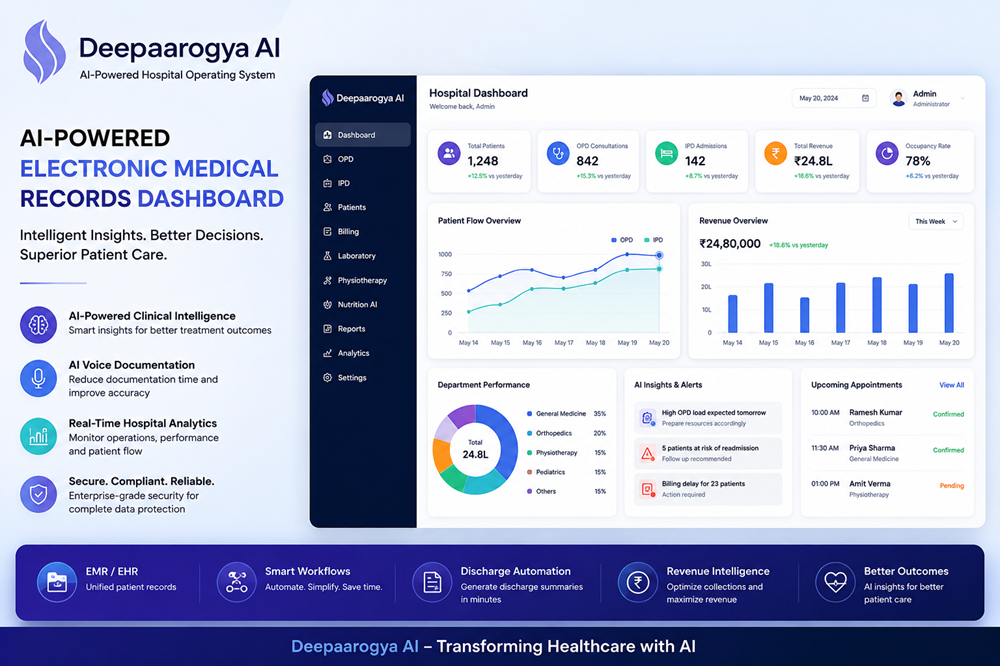
What is an AI-Based EMR Dashboard?
An AI-based Electronic Medical Records Dashboard is an intelligent healthcare management interface that combines patient records, hospital operations, financial data, clinical outcomes, and AI-generated insights into a single platform.
Instead of manually searching through multiple screens and reports, healthcare providers can access critical information instantly through interactive dashboards.
Key Components of an AI-Powered EMR Dashboard
- Real-time patient monitoring
- OPD and IPD analytics
- Revenue and billing insights
- Doctor productivity tracking
- Bed occupancy management
- AI-generated clinical alerts
- Appointment and patient flow analytics
- Lab and diagnostic tracking
- Discharge summary analytics
- Predictive healthcare intelligence
Why Hospitals Need AI-Powered EMR Dashboards
1. Faster Clinical Decision Making
Doctors often spend valuable time reviewing patient histories, laboratory results, medications, and treatment plans. AI dashboards consolidate this information and present relevant insights instantly.
Benefits include:
- Reduced documentation burden
- Faster diagnosis support
- Improved treatment planning
- Better patient outcomes
2. Enhanced Hospital Operations
Hospital administrators require visibility into daily operations. AI dashboards provide real-time metrics such as:
- Daily patient visits
- Revenue collections
- Outstanding payments
- Staff performance
- Resource utilization
This enables data-driven decision-making and operational efficiency.
3. Improved Patient Experience
AI dashboards help reduce waiting times and improve patient flow by identifying bottlenecks and optimizing scheduling.
Hospitals can monitor:
- Appointment trends
- Consultation times
- Follow-up compliance
- Patient satisfaction indicators
4. Revenue Cycle Optimization
Financial performance is critical for every hospital. AI-powered dashboards help management monitor:
- Billing efficiency
- Insurance claim status
- Revenue leakage
- Collection performance
- Department-wise profitability
This allows hospitals to maximize revenue while maintaining quality care.
Key Benefits of AI-Based EMR Dashboards
Real-Time Insights
Hospital leadership can monitor operations from anywhere through cloud-based dashboards.
Predictive Analytics
AI algorithms can predict:
- Patient admission trends
- High-risk patients
- No-show appointments
- Resource requirements
Workflow Automation
AI reduces repetitive tasks such as:
- Documentation
- Coding support
- Discharge summary generation
- Appointment reminders
Better Compliance
AI-powered EMR systems help maintain accurate records and support healthcare compliance requirements.
Data-Driven Growth
Hospitals can identify growth opportunities through detailed performance analytics and trend analysis.
Common Challenges with Traditional EMR Systems
Many hospitals still struggle with conventional EMR software because:
- Data is scattered across multiple modules
- Reporting is manual and time-consuming
- Limited analytics capabilities
- Lack of predictive insights
- High documentation burden
- Poor interoperability
As healthcare becomes more data-driven, hospitals need intelligent systems that provide actionable insights rather than simply storing records.
How Deepaarogya AI Helps Hospitals
Deepaarogya AI: AI-Powered Hospital Operating System
Deepaarogya AI is more than just an EMR solution. It is an AI-Powered Hospital Operating System designed to unify clinical workflows, operations, revenue management, and patient engagement into a single intelligent platform.
Unified AI Dashboard
Deepaarogya AI provides a comprehensive hospital dashboard that brings together:
- EMR/EHR Management
- OPD Management
- IPD Management
- Billing & Revenue Analytics
- Laboratory Operations
- Physiotherapy Workflow Management
- Nutrition AI
- Revenue Cycle Management
- Patient Engagement Tools
Hospital administrators, doctors, and management teams can access real-time insights from a centralized dashboard.
AI-Powered Clinical Intelligence
Deepaarogya AI helps healthcare professionals by:
- Summarizing patient histories
- Highlighting critical medical information
- Generating smart clinical recommendations
- Supporting evidence-based care
AI Voice Documentation
Doctors can reduce documentation time significantly through AI-powered voice dictation and automatic note generation.
Benefits include:
- Faster consultation documentation
- Reduced physician burnout
- Improved EMR accuracy
- More patient interaction time
Smart Revenue Analytics
Deepaarogya AI enables hospitals to monitor:
- Daily revenue
- Collection trends
- Pending payments
- Department performance
- Financial KPIs
Management teams can identify revenue leakage and improve profitability.
Automated Discharge Summary Generation
Hospitals can generate discharge summaries within minutes using AI-powered automation, reducing administrative workload while improving accuracy.
Advanced Hospital Performance Monitoring
Deepaarogya AI dashboards provide visibility into:
- Patient volume trends
- Doctor productivity
- Treatment outcomes
- Resource utilization
- Operational efficiency
This enables hospital leaders to make informed strategic decisions.
Future of AI-Based EMR Dashboards
The next generation of healthcare technology will move beyond record keeping and become an intelligent decision-support ecosystem.
Future AI dashboards will include:
- Predictive patient care models
- Population health analytics
- AI-powered diagnostics support
- Personalized treatment recommendations
- Advanced operational forecasting
Hospitals adopting AI-powered EMR dashboards today will be better positioned to deliver efficient, data-driven, and patient-centric care.
Conclusion
AI-based Electronic Medical Records Dashboards are transforming how hospitals manage clinical data, operations, and financial performance. By converting healthcare data into actionable intelligence, hospitals can improve efficiency, enhance patient care, and achieve sustainable growth.
Deepaarogya AI empowers hospitals with a comprehensive AI-Powered Hospital Operating System that combines EMR, operational intelligence, revenue analytics, voice documentation, discharge automation, and advanced AI insights into a single platform.
For hospitals looking to modernize their digital infrastructure and unlock the full potential of healthcare data, Deepaarogya AI offers a future-ready solution designed for the evolving needs of modern healthcare.
Frequently Asked Questions (FAQs) :
1. What is an AI-based Electronic Medical Records (EMR) dashboard?
An AI-based EMR dashboard is a centralized platform that uses artificial intelligence to analyze patient records, hospital operations, billing, and clinical data, providing real-time insights for doctors and hospital administrators.
2. How does an AI-powered EMR dashboard improve patient care?
AI-powered EMR dashboards help doctors access patient information quickly, identify health risks, receive clinical alerts, and make faster, data-driven treatment decisions.
3. What are the benefits of using an AI EMR dashboard in hospitals?
Key benefits include:
- Faster clinical decision-making
- Reduced documentation time
- Improved patient outcomes
- Better revenue management
- Real-time operational insights
- Enhanced staff productivity
4. How is an AI-based EMR different from a traditional EMR?
Traditional EMRs primarily store patient data, while AI-powered EMRs analyze data, generate insights, automate workflows, predict trends, and assist healthcare providers in decision-making.
5. Can AI EMR dashboards reduce physician burnout?
Yes. AI-powered voice dictation, automated clinical documentation, discharge summary generation, and smart data retrieval significantly reduce administrative workload for doctors.
6. How does AI help with hospital revenue management?
AI dashboards can track billing performance, identify revenue leakage, monitor pending payments, analyze department-wise profitability, and improve revenue cycle management.
7. What features should hospitals look for in an AI-powered EMR dashboard?
Hospitals should look for:
- Real-time analytics
- AI voice documentation
- Patient flow monitoring
- Revenue dashboards
- Clinical decision support
- Automated discharge summaries
- Lab and radiology integration
- Mobile accessibility
8. Can AI EMR dashboards help improve hospital efficiency?
Yes. AI dashboards streamline workflows, automate repetitive tasks, optimize resource utilization, and provide actionable insights that improve overall hospital efficiency.
9. Is an AI-based EMR dashboard suitable for multi-specialty hospitals?
Absolutely. AI-powered EMR dashboards can support multiple departments, specialties, doctors, and administrative teams through a unified platform.
10. How does AI assist doctors during patient consultations?
AI can summarize patient histories, highlight critical information, generate clinical notes, provide treatment suggestions, and reduce documentation time during consultations.
11. Can AI-generated dashboards help hospital administrators?
Yes. Hospital administrators can monitor patient volumes, occupancy rates, staff performance, revenue trends, and operational KPIs from a single dashboard.
12. What role does AI play in discharge summary generation?
AI automatically compiles patient treatment details, medications, diagnoses, procedures, and follow-up instructions to generate accurate discharge summaries within minutes.
13. Are AI-powered EMR dashboards secure?
Modern AI EMR platforms use encryption, access controls, audit trails, and secure cloud infrastructure to protect sensitive patient data and maintain compliance requirements.
14. How much does an AI-based EMR system cost?
The cost depends on hospital size, number of users, required modules, and customization needs. Most providers offer subscription-based pricing models.
15. Can small hospitals and clinics benefit from AI EMR dashboards?
Yes. Small hospitals, specialty clinics, physiotherapy centers, and diagnostic facilities can improve efficiency and patient care through AI-powered dashboards.
16. What is the future of AI in Electronic Medical Records?
Future AI EMRs will provide predictive analytics, personalized treatment recommendations, automated coding, population health insights, and advanced clinical decision support.
17. How does Deepaarogya AI help hospitals with EMR dashboards?
Deepaarogya AI provides an AI-Powered Hospital Operating System with intelligent dashboards for EMR/EHR, OPD, IPD, Billing, Lab Management, Revenue Cycle Management, Physiotherapy, Nutrition AI, Voice Documentation, and Hospital Analytics.
18. Can Deepaarogya AI integrate with existing hospital systems?
Yes. Deepaarogya AI can integrate with existing hospital workflows, diagnostic systems, billing processes, and healthcare operations to create a unified digital ecosystem.
19. Does Deepaarogya AI provide real-time hospital analytics?
Yes. Deepaarogya AI offers real-time dashboards for patient volumes, doctor productivity, financial performance, operational KPIs, and clinical outcomes.
20. Why should hospitals choose Deepaarogya AI?
Deepaarogya AI combines AI-powered EMR, hospital operations, voice documentation, discharge automation, revenue intelligence, and clinical analytics into a single Hospital Operating System, helping hospitals improve efficiency, profitability, and patient care.