
The Documentation Challenge in Orthopedic Practice
Orthopedic specialists spend a significant portion of their day documenting patient encounters, treatment plans, surgical notes, rehabilitation progress, and follow-up visits. While accurate documentation is essential for patient care, insurance claims, and legal compliance, it often reduces the time available for patient interaction.
Many orthopedic surgeons report spending hours after clinic sessions completing medical records, leading to physician burnout and decreased productivity.
This is where Orthopedic EMR Voice Dictation is transforming modern practices.
What is Orthopedic EMR Voice Dictation?
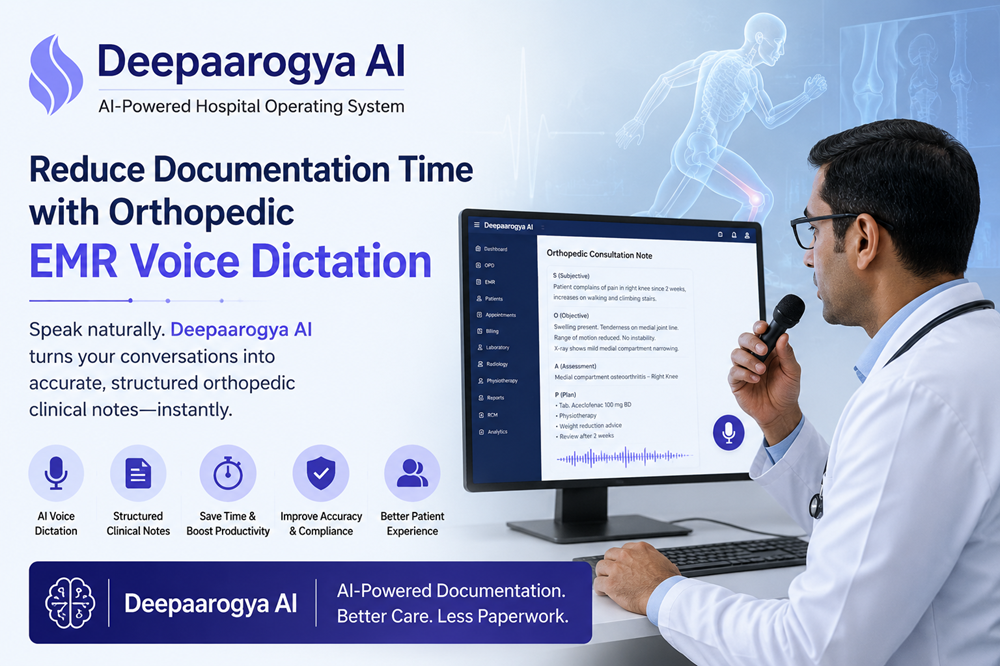
Orthopedic EMR voice dictation allows doctors to speak naturally during or after a patient consultation while the Electronic Medical Record (EMR) system automatically converts speech into structured clinical documentation.
Instead of typing detailed notes manually, physicians can dictate:
- Chief complaints
- History of present illness
- Physical examination findings
- Diagnosis
- Treatment recommendations
- Procedure notes
- Follow-up instructions
The result is faster documentation with improved accuracy and reduced administrative workload.
Why Traditional Documentation Slows Down Orthopedic Clinics
Orthopedic consultations often involve detailed assessments, including:
- Joint examinations
- Range of motion measurements
- Fracture evaluations
- Post-operative assessments
- Imaging interpretations
- Physiotherapy recommendations
Typing these details manually can take several minutes per patient. Across 40–60 patients per day, documentation becomes a major productivity bottleneck.
Common challenges include:
- Increased physician burnout
- Delayed record completion
- Longer patient waiting times
- Reduced clinic efficiency
- Documentation inconsistencies
Benefits of Voice Dictation in Orthopedic EMRs
1. Save Significant Documentation Time
Voice dictation can reduce documentation time by up to 50–70% compared to manual typing.
Doctors simply speak naturally while the system creates structured notes automatically.
2. Improve Patient Engagement
Instead of focusing on a keyboard, physicians can maintain eye contact and engage more effectively with patients.
This improves patient satisfaction and communication.
3. Faster Completion of Clinical Notes
Documentation can often be completed before the patient leaves the consultation room.
This eliminates after-hours charting and administrative backlog.
4. Better Clinical Accuracy
Advanced AI-powered voice systems understand medical terminology, orthopedic procedures, anatomical structures, and treatment protocols.
This reduces documentation errors and omissions.
5. Increased Daily Patient Capacity
When physicians spend less time documenting, they can see more patients without extending clinic hours.
Key Features Orthopedic Practices Should Look For
When selecting a voice-enabled orthopedic EMR, consider:
Specialty-Specific Templates
The system should support:
- Knee examinations
- Hip evaluations
- Shoulder assessments
- Spine consultations
- Sports injury documentation
- Fracture management notes
AI-Powered Medical Speech Recognition
Generic voice typing tools often struggle with medical terminology.
Healthcare-specific AI provides significantly higher accuracy.
Automatic Clinical Note Generation
The EMR should automatically organize dictated content into:
- SOAP Notes
- Consultation Notes
- Procedure Notes
- Follow-up Records
Multi-Language Support
Important for practices serving diverse patient populations.
Integration with Imaging and Reports
Voice-generated notes should seamlessly connect with X-rays, MRI reports, CT scans, and rehabilitation records.
How Deepaarogya AI Helps Orthopedic Clinics Reduce Documentation Burden
Deepaarogya AI is more than just an EMR. It is an AI-Powered Hospital Operating System designed specifically for modern healthcare organizations.
For orthopedic clinics and hospitals, Deepaarogya AI offers advanced AI-driven voice documentation capabilities that dramatically reduce administrative workload.
AI Medical Voice Dictation
Doctors can dictate naturally during consultations while Deepaarogya AI converts conversations into structured orthopedic clinical notes.
Specialty-Aware Documentation
The platform understands orthopedic terminology, including:
- Ligament injuries
- Fracture classifications
- Joint replacement procedures
- Sports medicine terminology
- Rehabilitation plans
AI-Powered Clinical Note Generation
Instead of simply transcribing speech, Deepaarogya AI generates structured documentation automatically, including:
- SOAP Notes
- Consultation Summaries
- Follow-up Notes
- Procedure Documentation
Integrated Orthopedic Workflow
Deepaarogya AI connects documentation with:
- OPD Management
- EMR/EHR
- Billing
- Laboratory Records
- Radiology Reports
- Physiotherapy Workflows
- Revenue Cycle Management
This eliminates duplicate data entry and streamlines the entire patient journey.
Faster Consultations, Better Patient Experience
By reducing typing and paperwork, orthopedic specialists can spend more time on patient care while maintaining complete and compliant medical records.
Real Impact on Orthopedic Practice Efficiency
Clinics implementing AI-powered voice documentation often experience:
- Faster patient throughput
- Reduced physician burnout
- Improved documentation quality
- Better compliance
- Increased operational efficiency
- Higher patient satisfaction
As orthopaedic practices continue to grow, AI-assisted documentation is becoming a necessity rather than a luxury.
Conclusion
Documentation should support patient care—not consume a physician’s day.
Orthopedic EMR voice dictation enables doctors to complete records faster, improve clinical accuracy, and focus more on patients. By leveraging AI-powered documentation solutions like Deepaarogya AI, orthopedic clinics and hospitals can significantly reduce administrative burden while improving operational performance.
The future of orthopedic practice is voice-enabled, AI-assisted, and focused on delivering better patient outcomes with less paperwork.
FAQ Section
Q1. What is orthopedic EMR voice dictation?
Orthopedic EMR voice dictation allows doctors to speak clinical notes that are automatically converted into structured medical documentation within the EMR system.
Q2. How much time can voice dictation save orthopedic doctors?
AI-powered voice dictation can reduce documentation time by 50–70%, depending on workflow and patient volume.
Q3. Is voice dictation accurate for orthopedic terminology?
Modern healthcare AI systems are trained on medical terminology and can accurately recognize orthopedic conditions, procedures, and anatomical terms.
Q4. Can voice dictation generate SOAP notes automatically?
Yes. Advanced AI systems such as Deepaarogya AI can automatically create structured SOAP notes from physician dictation.
Q5. Does Deepaarogya AI support orthopedic clinics?
Yes. Deepaarogya AI includes orthopedic-focused documentation workflows, AI voice dictation, EMR/EHR, physiotherapy management, billing, and hospital operations management.
Q6. Can AI voice dictation reduce physician burnout?
Yes. By minimizing manual typing and after-hours charting, AI voice documentation helps reduce administrative burden and physician fatigue.