
Why Deepaarogya Ai is the Smart Choice for Eye Hospitals & Clinics
The Indian healthcare industry is rapidly shifting toward digital transformation, and the ophthalmology sector is leading this change with advanced EMR and AI-powered healthcare technologies. Eye hospitals, ophthalmology clinics, LASIK centers, retina specialists, and multi-specialty vision care providers are now focusing on improving patient care, operational efficiency, NABH compliance, and digital workflow automation.
One of the biggest priorities for modern eye hospitals today is achieving NABH compliance while maintaining seamless patient management and accurate clinical documentation. Traditional paper-based systems are no longer sufficient for modern ophthalmology practices that handle high patient volumes, diagnostics imaging, surgical workflows, and long-term patient histories.
To meet these growing demands, healthcare providers now require a powerful NABH-ready ophthalmology EMR software that can manage patient records, eye diagnostics, prescriptions, appointments, imaging reports, billing, analytics, and hospital operations from a centralized cloud-based platform.
This is where Deepaarogya ai stands out as one of the best NABH-ready ophthalmology EMR software platforms in India for 2026.
Deepaarogya ai is transforming eye care management with intelligent digital workflows, cloud accessibility, AI-powered clinical support, and advanced ophthalmology-focused EMR capabilities designed specifically for eye hospitals and clinics.
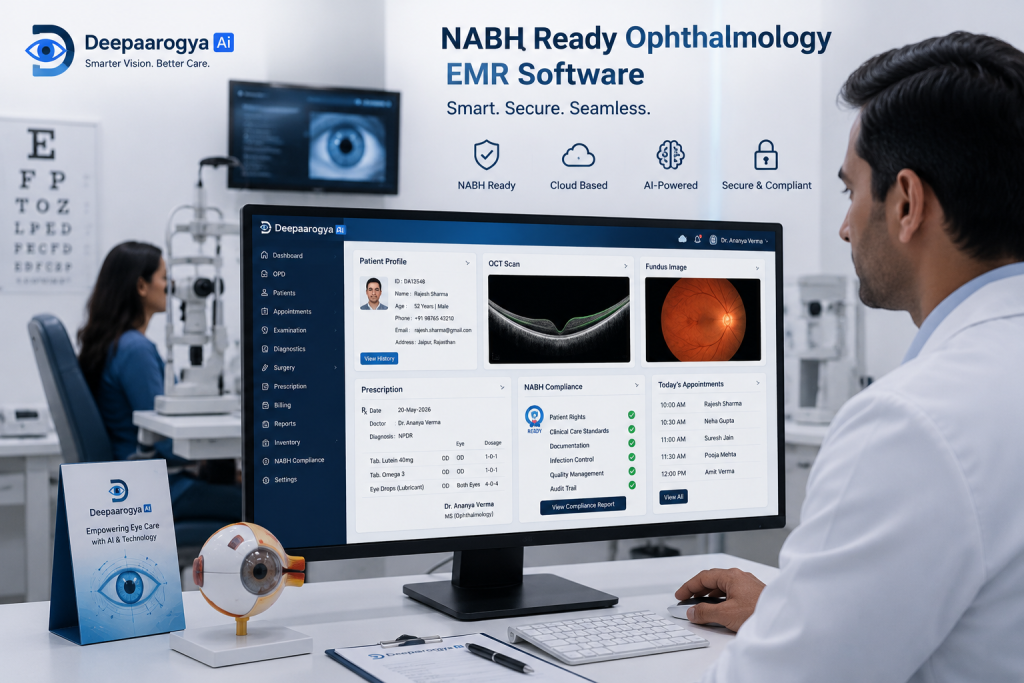
Why Deepaarogya Ai is the Best NABH Ready Ophthalmology EMR Software in India
Deepaarogya ai is a modern cloud-based ophthalmology EMR and hospital management platform designed specifically for:
- Eye hospitals
- Retina clinics
- Cataract centers
- LASIK and refractive surgery centers
- Glaucoma specialists
- Cornea clinics
- Pediatric ophthalmology practices
- Multi-specialty eye care chains
The platform helps healthcare providers simplify clinical workflows, improve patient engagement, streamline diagnostics management, and maintain NABH-ready documentation standards.
Unlike generic hospital software, Deepaarogya is built specifically for ophthalmology workflows, making it highly optimized for vision care providers.
Major Features of Deepaarogya Ai EMR Software
Cloud-Based Ophthalmology EMR System
Deepaarogya ai provides secure cloud-based access that allows doctors and staff to manage patient records anytime from anywhere.
NABH Ready Healthcare Workflows
The software supports structured clinical documentation, audit trails, digital consent forms, and compliance-ready workflows for NABH accreditation support.
Complete Electronic Medical Records (EMR)
Maintain centralized patient histories including:
- Vision records
- Eye examination findings
- Diagnosis history
- Treatment plans
- Surgical records
- Prescription history
- Follow-up tracking
Ophthalmology Diagnostic Integration
Deepaarogya ai supports integration with:
- OCT reports
- Fundus imaging
- Optical devices
- Eye scan reports
- Diagnostic imaging systems
Digital Prescription Management
Generate smart digital prescriptions with accurate medication records and treatment recommendations.
Appointment & Queue Management
Simplify OPD management with online appointments, token systems, and automated patient scheduling.
AI-Powered Clinical Assistance
Deepaarogya ai uses intelligent workflows to improve doctor productivity and reduce manual documentation workload.
Surgery & Procedure Management
Manage cataract surgeries, LASIK procedures, retina treatments, and operation workflows digitally.
Billing & Invoicing Automation
Integrated billing systems help eye hospitals manage payments, invoices, packages, and financial reports efficiently.
Multi-Branch Hospital Management
Deepaarogya ai supports centralized management for healthcare groups and multi-location eye hospital chains.
Secure Cloud Storage & Data Protection
The platform uses advanced security protocols, encrypted patient data storage, and secure cloud backups.
Mobile-Friendly Accessibility
Doctors and administrators can access patient information securely from mobile devices and tablets.
Why Eye Hospitals Choose Deepaarogya Ai
Healthcare providers prefer Deepaarogya ai because it is specifically designed for ophthalmology practices rather than generic hospital management.
The platform helps eye hospitals:
- Reduce paperwork
- Improve patient flow
- Manage diagnostics efficiently
- Simplify surgical workflows
- Improve doctor productivity
- Enhance patient experience
- Support NABH compliance preparation
- Digitize complete hospital operations
Deepaarogya ai combines modern healthcare technology with ophthalmology-focused workflow automation, making it one of the most advanced eye care EMR platforms available in India.
Ideal For
Deepaarogya ai is suitable for:
- Eye hospitals
- Retina specialists
- Cataract surgery centers
- LASIK clinics
- Ophthalmology chains
- Vision care institutes
- Multi-specialty hospitals with ophthalmology departments
- Independent ophthalmologists
- Diagnostic eye centers
Benefits of Using Deepaarogya Ai EMR Software
Improve Patient Experience
Patients can easily manage appointments, receive digital prescriptions, access reports, and maintain long-term eye care records.
Faster Clinical Workflows
Doctors can document consultations digitally and access patient history instantly.
Better Diagnostics Management
Integrated imaging and diagnostic support improves clinical accuracy and workflow efficiency.
Reduce Administrative Work
Automation of appointments, billing, documentation, and reporting reduces operational burden.
Support NABH Accreditation
Structured documentation and compliance-ready workflows simplify NABH audit preparation.
Secure Patient Data
Advanced security systems protect sensitive healthcare information with encrypted storage and role-based access control.
Access Anywhere Anytime
Cloud accessibility enables healthcare providers to manage operations remotely.
Improve Operational Transparency
Centralized dashboards and analytics help hospitals monitor workflows and performance efficiently.
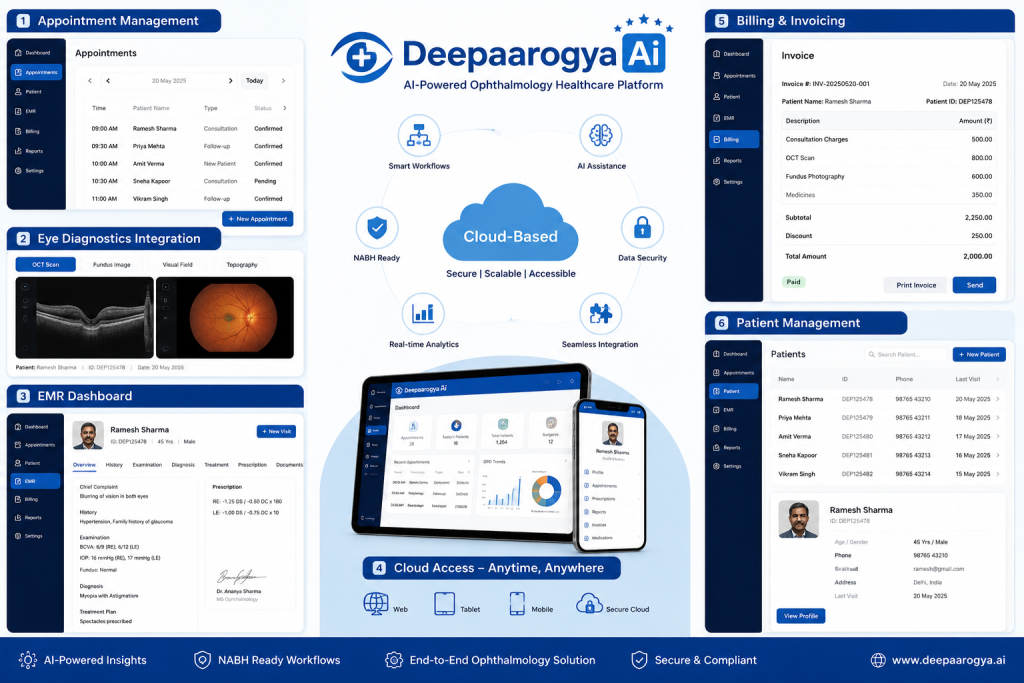
How to Select the Best NABH Ready Ophthalmology EMR Software
Healthcare providers should evaluate software platforms based on:
- Ophthalmology-specific workflows
- NABH compliance support
- Diagnostics integration
- Ease of use
- Cloud accessibility
- Data security
- Scalability
- Multi-location support
- Billing and financial management
- Vendor support and training
Choosing the right ophthalmology EMR software can significantly improve patient care, operational efficiency, and long-term healthcare growth.
Why Deepaarogya Ai is Different from Generic Hospital Software
Most hospital management systems are designed for general healthcare operations. However, ophthalmology practices require highly specialized workflows involving:
- Eye diagnostics
- Vision tracking
- Imaging management
- Surgical workflows
- Long-term patient history
- Device integrations
- Retina and OCT reporting
Deepaarogya ai is specifically optimized for these requirements, making it far more effective for eye hospitals and ophthalmologists.
Future of Digital Ophthalmology in India
The future of ophthalmology is rapidly moving toward:
- AI-powered healthcare workflows
- Cloud-based EMR systems
- Teleophthalmology
- Smart diagnostics integration
- Digital patient engagement
- Automated compliance management
- Data-driven clinical decisions
Eye hospitals adopting advanced EMR platforms like Deepaarogya ai today will gain long-term operational advantages, improved patient satisfaction, and stronger digital healthcare infrastructure.
Why Deepaarogya Ai is the Best Choice for 2026
Deepaarogya combines:
- NABH-ready workflows
- Ophthalmology-focused EMR
- Cloud infrastructure
- AI-powered automation
- Secure patient management
- Diagnostics integration
- Multi-branch hospital management
- Smart digital healthcare operations
This makes Deepaarogya ai one of the most future-ready ophthalmology healthcare software platforms in India.
Conclusion
The demand for advanced NABH-ready ophthalmology EMR software is growing rapidly as eye hospitals and clinics continue embracing digital healthcare transformation.
Modern ophthalmology practices require secure, scalable, and intelligent healthcare platforms capable of improving patient care, simplifying operations, supporting diagnostics, and maintaining compliance standards.
Deepaarogya ai helps eye hospitals modernize workflows, improve operational efficiency, streamline patient management, and build a future-ready digital healthcare ecosystem.
For eye hospitals, ophthalmologists, retina specialists, and vision care providers looking for the best ophthalmology EMR software in India for 2026, Deepaarogya offers a powerful and specialized solution designed specifically for the future of eye care.
Frequently Asked Questions (FAQs)
1. What is the cost of EMR software in India?
The cost of EMR (Electronic Medical Records) software in India depends on the features, hospital size, and deployment type. Small clinics can get basic EMR solutions starting from ₹1,000–₹5,000 per month, while advanced hospital management systems may cost ₹50,000 to several lakhs annually. Cloud-based EMR software is generally more affordable than on-premise solutions because it requires less hardware and maintenance.
2. Which software is mostly used in hospitals in India?
Many hospitals in India use Hospital Information Systems (HIS) and EMR software such as Practo Ray, MediBuddy, eHospital, and other customized hospital management solutions. Large hospitals often prefer integrated systems that include patient records, billing, pharmacy, laboratory, and appointment management in one platform.
3. What is the most used electronic medical records software?
Globally, popular EMR software includes Epic, Cerner, Athenahealth, and eClinicalWorks. In India, cloud-based and customizable EMR platforms are more commonly used because they are cost-effective and easier to manage for clinics and hospitals of different sizes.
4. What is EMR in ophthalmology?
EMR in ophthalmology is specialized medical record software designed for eye hospitals and eye clinics. It helps ophthalmologists manage patient history, eye examination records, prescriptions, imaging reports, surgeries, and follow-up visits digitally. Ophthalmology EMR systems improve workflow efficiency and help doctors provide faster and more accurate patient care.
5. What is the best EMR to use?
The best EMR software depends on the healthcare organization’s needs. A good EMR should be easy to use, secure, customizable, and capable of integrating with billing, lab, and pharmacy systems. Clinics usually prefer affordable cloud-based EMR solutions, while large hospitals often require enterprise-level systems with advanced analytics and multi-department management.
6. How is EMR cost calculated?
EMR software cost is usually calculated based on several factors such as:
Customer support and maintenance services
Number of users or doctors
Clinic or hospital size
Cloud-based or on-premise deployment
Required features and integrations
Data storage requirements