
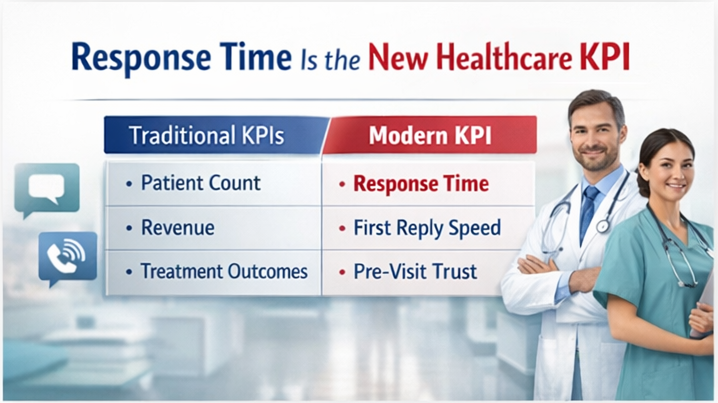
Healthcare has traditionally measured success using familiar KPIs:
Number of patients
Bed occupancy
Revenue
Clinical outcomes
But in today’s digital-first healthcare environment, a new KPI quietly decides patient growth:
Response time.
Not infrastructure.
Not automation.
Not even technology.
How fast a healthcare organization responds when a patient reaches out.
The Moment That Decides Everything
A patient sends a message.
Fills out a form.
Clicks “Call Now.”
That moment is filled with:
Anxiety
Pain
Urgency
Uncertainty
What happens next determines whether the patient trusts your system — or moves on.
In healthcare, speed is interpreted as care.
Is your healthcare system responding fast enough when patients reach out?
DeepaarogyaAI helps clinics identify response gaps before patients drop off.
 Request a Response-Time Assessment
Where Healthcare Loses Patients Due to Slow Response
Patient drop-offs most often occur during:
Website form submissions
WhatsApp or chat inquiries
Emergency questions
Follow-up clarifications
Appointment rescheduling
Even a 15–30 minute delay can result in a lost patient.
No complaint.
No feedback.
Just disappearance.
Every missed or delayed response is a silent patient loss.
AI can detect and prevent this — if applied correctly.
See How AI Improves Patient Response Systems
Why Traditional Front Desks Can’t Keep Up
Front desks were designed for:
Walk-in patients
Phone calls
Fixed working hours
Today’s patients expect:
Instant replies
24/7 availability
Consistent information
Human teams alone cannot maintain this speed at scale.
This is not a staffing problem.
It is a system design problem.
How AI Changes Response Time Without Replacing Humans
AI does not replace care.
It protects it.
When used thoughtfully, AI:
Acknowledges patient inquiries instantly
Answers common questions calmly
Guides patients on next steps
Escalates urgent cases to human teams
Patients don’t feel “automated.”
They feel attended to.
AI is most powerful when patients don’t notice it — only the care.
Explore DeepaarogyaAI’s Trust-First AI Framework
Visit Here https://www.deepaarogya.com/
Chat With Us on WhatsApp tel:+91 89795 23908
Speed Builds Trust Before the First Visit
Trust doesn’t begin in the consultation room.
It begins when:
Messages are answered quickly
Questions are clarified clearly
Follow-ups arrive on time
By the time a patient visits the clinic, trust is already formed — or broken.
Response time shapes that trust silently.
Why Response Time Predicts Revenue Better Than Marketing
Marketing brings attention.
Response time decides conversion.
You can:
Run ads
Improve SEO
Build a great website
But if response is slow, growth stalls.
Fast response improves:
Appointment bookings
Treatment acceptance
Long-term patient retention
Build Faster, Calmer, More Trustworthy Patient Journeys
DeepaarogyaAI designs trust-first AI systems for healthcare organizations focused on patient experience, response intelligence, and sustainable growth. Visit Here https://www.deepaarogya.com/
Response Time as a Strategic Healthcare KPI
Forward-thinking healthcare organizations now track:
First response time
Follow-up response time
Missed inquiry rate
Because response time reflects:
Patient experience quality
System readiness
Organizational maturity
It is a leading indicator, not a lagging one.
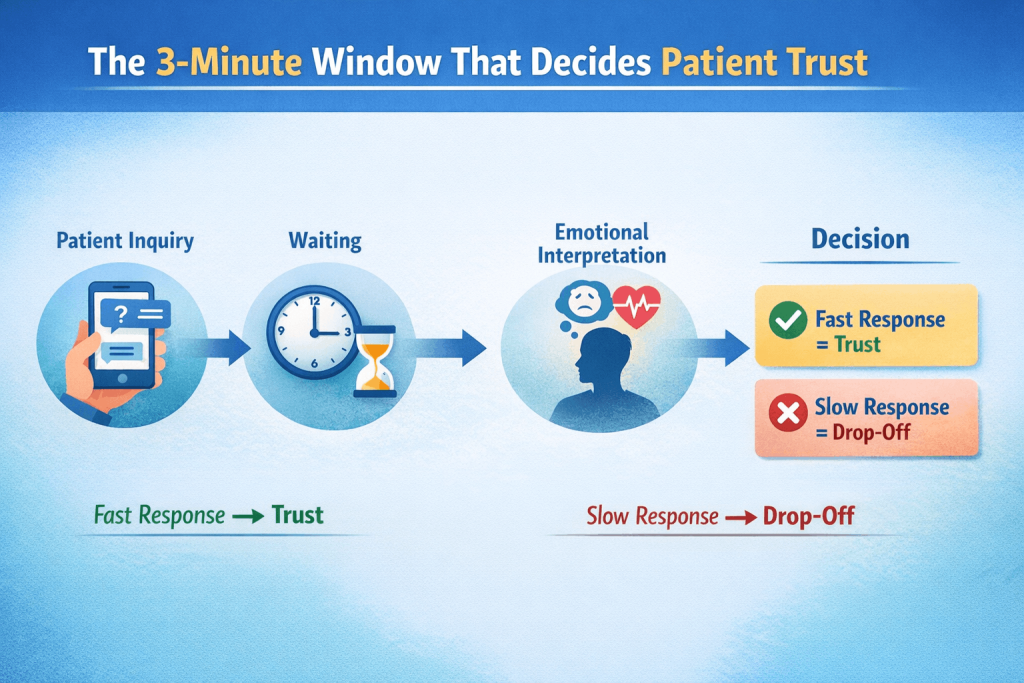
Visual Framework: The Patient Response Moment
The 3-Minute Window That Decides Patient Trust
Patient Inquiry
↓
Waiting
↓
Emotional Interpretation
↓
Decision
Fast response → Trust
Slow response → Drop-off
Visual Framework: Traditional KPIs vs Modern Healthcare KPI
Traditional KPIs:
Patient volume
Revenue
Infrastructure
Clinical outcomes
Modern KPI:
Response time
First reply speed
Follow-up consistency
Pre-visit trust
Response time predicts growth earlier than revenue.
Visual Framework: How AI Supports Response Time
Patient Inquiry
↓
AI Acknowledgment (Instant)
↓
AI Guidance & Routing
↓
Human Care Team
↓
Patient Trust
AI protects speed. Humans protect care.
The DeepaarogyaAI Perspective
At DeepaarogyaAI, we believe:
Response time is a signal of respect, reliability, and readiness.
AI should not replace human care.
It should ensure that care is never delayed.
When response time improves, everything else follows.
If response time is a KPI, it deserves a strategy — not just tools.
Talk to DeepaarogyaAI About Patient Experience Intelligence https://www.deepaarogya.com/
At DeepaarogyaAI, We Also Provide:
Customized websites for clinics & hospitals
Clinical decision support, lab report analysis & dosage calculator
AI-powered EMR with smart documentation
Ethical and secure healthcare AI systems
We post content behalf of them in their social Media Handle
- Help you create and grow your own healthcare brand
- Billing, appointments, reminders & follow-up