
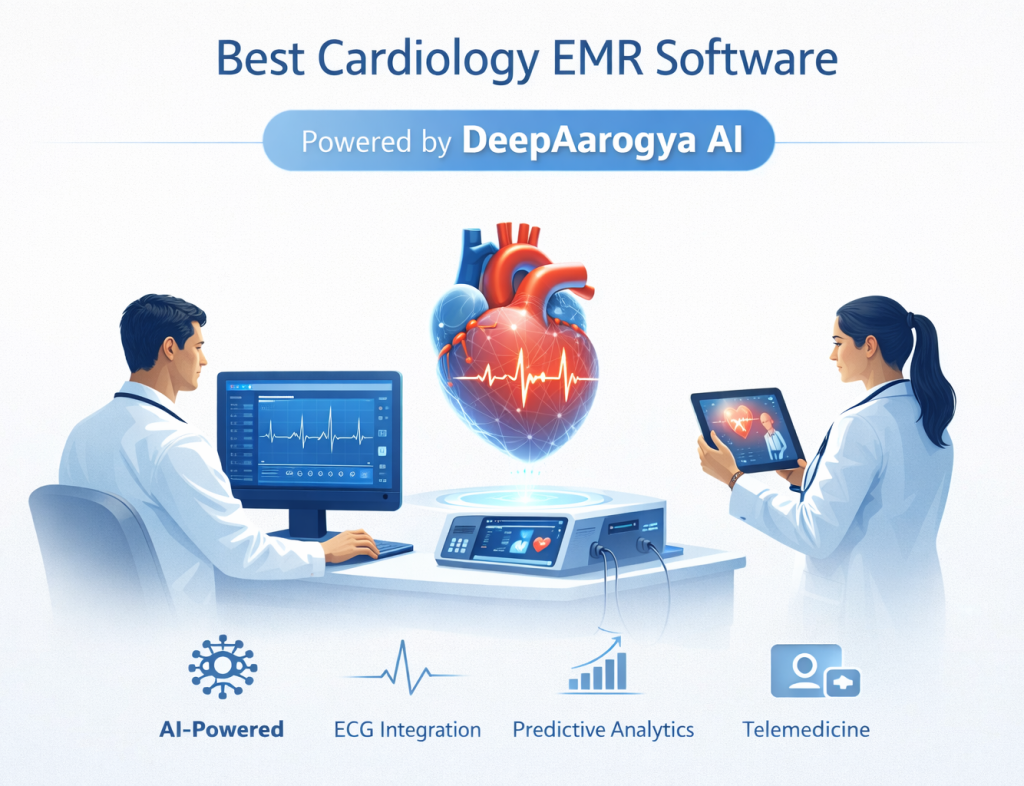
Introduction: Cardiology Care in the Digital-First Era
Cardiovascular diseases remain one of the leading causes of mortality worldwide, and India is no exception. As patient volumes rise and cardiac care becomes more complex, cardiology practices are under increasing pressure to deliver accurate, timely, and data-driven care while also managing operational efficiency.
Electronic Medical Record (EMR) software for cardiology is no longer just about digitizing patient files. It is about intelligent clinical workflows, seamless diagnostic integration, predictive insights, and patient-centric care. This shift is also giving rise to AI-first healthcare platforms like DeepAarogya AI, which are redefining how EMRs are built, used, and scaled in India.
What Is Cardiology EMR Software?
A Cardiology EMR (Electronic Medical Record) is a digital system designed specifically to manage, store, and analyze patient data related to heart care. Unlike generic EMR systems, cardiology EMRs are built to handle:
Detailed cardiac histories
ECG/EKG data and waveform reports
Echocardiography and stress test findings
Long-term monitoring of chronic cardiac conditions
Complex medication and procedure documentation
In simple terms, a cardiology EMR acts as the digital backbone of a heart clinic or cardiology department, ensuring that every piece of patient information is accurate, accessible, and actionable.
Why Cardiology Needs Specialized EMR Software
1. Cardiology Generates Highly Complex Data
Cardiology is one of the most data-intensive medical specialties. A single patient may have years of ECGs, imaging studies, prescriptions, intervention notes, and follow-up reports. Generic EMRs often fail to structure this data effectively, leading to inefficiencies and clinical risk.
Specialized cardiology EMRs organize this data in a way that supports clinical decision-making, not just record-keeping.
2. Rise of Chronic and Lifestyle-Related Heart Diseases
With increasing cases of hypertension, diabetes, and lifestyle-related cardiac conditions, cardiologists must track patients over long periods. EMRs enable:
Longitudinal patient records
Trend analysis of vitals and reports
Early identification of deterioration risks
This is where AI-enabled platforms like DeepAarogya add value by supporting predictive insights on top of structured medical data.
3. Need for Speed and Accuracy
In cardiology, minutes matter. Faster access to past ECGs, medications, and lab results can significantly impact outcomes. Digital records reduce dependency on paper files and manual searching, enabling quicker, safer decisions.
4. Regulatory and Data Security Requirements
Healthcare data regulations in India and globally are becoming stricter. Modern EMR systems ensure:
Secure data storage
Role-based access control
Audit trails
Compliance with healthcare data standards
Traditional Cardiology EMR vs AI-Enhanced EMR Platforms
Most conventional cardiology EMRs focus on:
Data storage
Templates
Billing and scheduling
While these are essential, they are no longer sufficient.
The New Shift: AI-First EMR Platforms
AI-driven EMR platforms like DeepAarogya AI go beyond traditional EMRs by:
Digitizing handwritten prescriptions using AI-OCR
Extracting structured clinical data automatically
Reducing manual data entry errors
Supporting predictive analytics for patient risk assessment
Instead of asking doctors to adapt to rigid software, AI-based EMRs adapt to real-world clinical behavior, especially in Indian healthcare settings where paper records are still common.
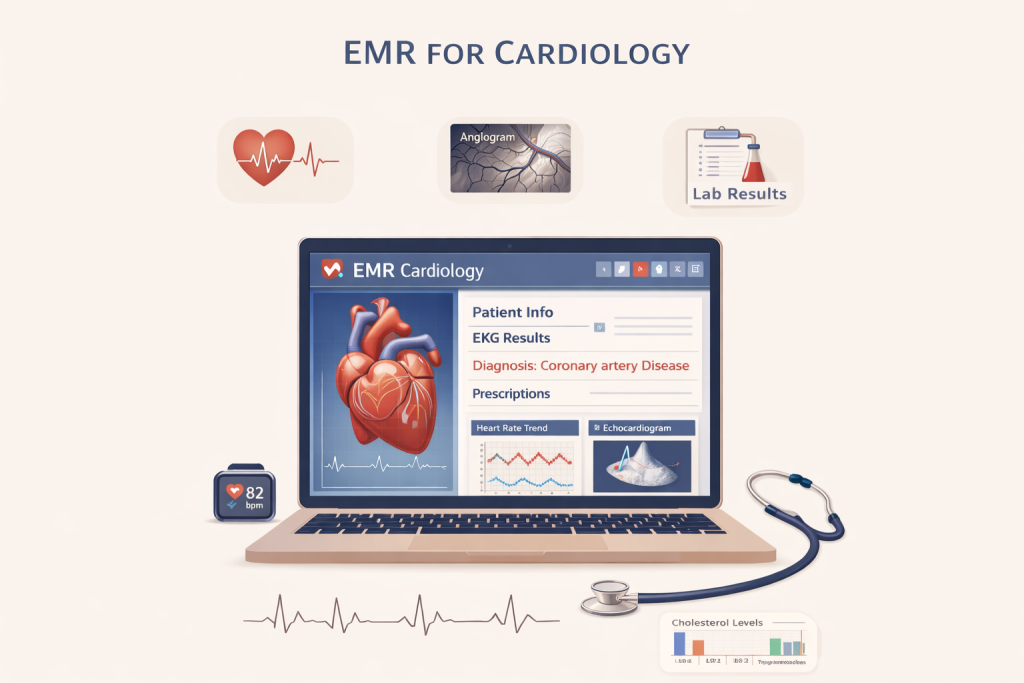
Key Features to Look for in the Best Cardiology EMR Software
1. Cardiology-Specific Clinical Templates
ECG interpretation
Heart sound documentation
Risk factor assessment
Procedure and intervention notes
2. Diagnostic Device Integration
A modern cardiology EMR should seamlessly integrate with:
ECG/EKG machines
Echo and imaging systems
Lab information systems
3. AI-Based Data Extraction and Automation
Manual data entry is time-consuming and error-prone. AI-driven automation, like that offered by DeepAarogya, significantly improves efficiency.
4. Predictive Analytics and Clinical Decision Support
AI-powered alerts for:
Abnormal vitals
Medication interactions
High-risk patient profiles
5. Secure Patient Data Management
Encrypted storage
Role-based access
Secure cloud or hybrid deployment
6. Patient Engagement Tools
Digital access to reports
Appointment reminders
Follow-up tracking
7. Interoperability
The EMR should exchange data smoothly with labs, pharmacies, insurance systems, and national health platforms.
Benefits of Using Advanced Cardiology EMR Software
1. Improved Clinical Outcomes
Better access to complete patient histories leads to more accurate diagnoses and treatment decisions.
2. Reduced Administrative Burden
Automation reduces paperwork, freeing cardiologists to focus on patient care rather than documentation.
3. Enhanced Patient Trust and Satisfaction
Digital records improve transparency and continuity of care, strengthening patient confidence.
4. Data-Driven Practice Growth
Analytics help clinics understand patient trends, outcomes, and operational performance.
Buying Guide: How to Choose the Right Cardiology EMR
Step 1: Assess Your Practice Needs
Consider patient volume, diagnostics used, staff size, and digital maturity.
Step 2: Evaluate AI Capabilities
EMRs without AI will struggle to scale in the future. Platforms like DeepAarogya AI are built with long-term intelligence in mind.
Step 3: Check Integration and Scalability
Ensure the EMR can grow with your practice and integrate with future technologies.
Step 4: Focus on Ease of Use
Adoption fails when software is complex. Intuitive design is critical.
Step 5: Consider Total Cost of Ownership
Look beyond licensing fees—training, support, and scalability matter.
Frequently Asked Questions (FAQs) – Cardiology EMR Software
1. What is the best EMR software for cardiology?
The best EMR software for cardiology in 2026 is one that combines cardiology-specific workflows, diagnostic integration, strong data security, and AI-driven automation. Traditional EMRs with cardiology modules remain useful, but AI-enabled platforms like DeepAarogya AI are gaining attention for their ability to digitize handwritten records, extract structured clinical data, and support predictive care—especially in Indian healthcare settings.
2. Why do cardiology practices need specialized EMR software?
Cardiology involves complex and long-term patient data such as ECGs, echocardiograms, stress tests, and chronic disease tracking. Specialized cardiology EMRs are designed to handle this data efficiently, reduce clinical errors, improve decision-making, and support better patient outcomes compared to generic EMR systems.
4. Is DeepAarogya AI a full cardiology EMR system?
DeepAarogya AI is best described as an AI-powered EMR-enabling platform. It integrates with existing EMR and hospital systems to enhance them with intelligent data extraction, automation, and analytics. Rather than replacing current systems, it strengthens cardiology workflows and accelerates digital adoption.
5. Can DeepAarogya AI be used by small cardiology clinics in India?
Yes. DeepAarogya AI is well-suited for small and mid-sized cardiology clinics, especially those that still use paper prescriptions or semi-digital systems. Its AI-driven digitization helps clinics modernize quickly without expensive or disruptive EMR replacements.