
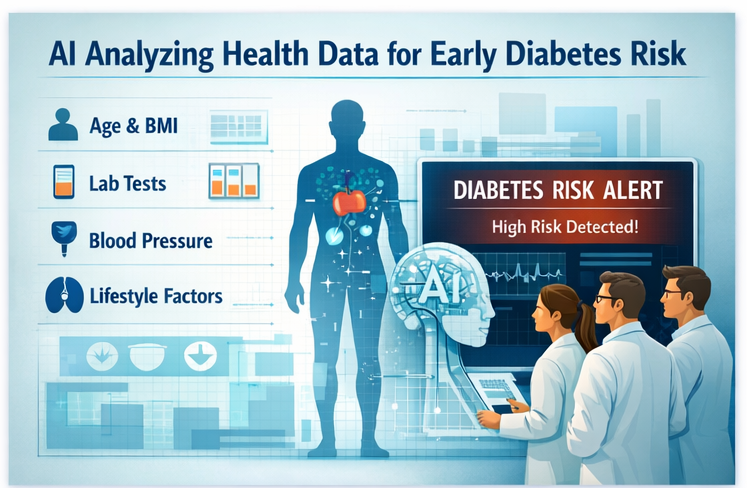
Diabetes is no longer just a “silent killer” that strikes without warning. In 2026, the integration of Artificial Intelligence (AI) and Machine Learning (ML) into standard medical care has turned the tide. We are shifting from a reactive “wait and see” approach to a predictive healthcare model where your risk of Type 2 Diabetes can be flagged an entire decade before a drop of blood shows high sugar.
Why Traditional Screening Is Failing Us
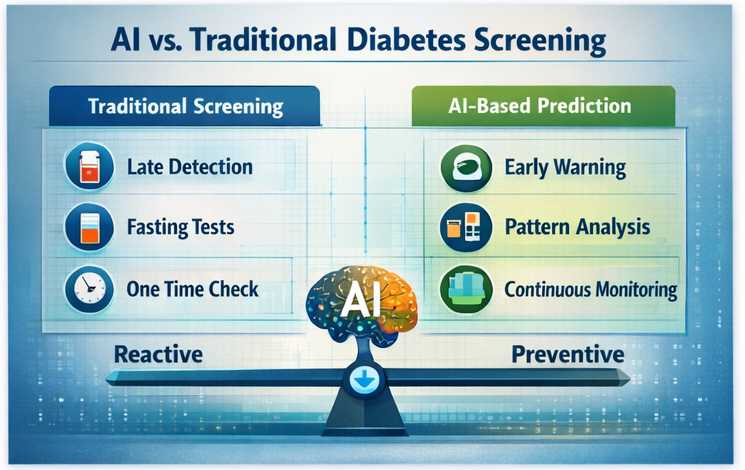
For decades, the medical community has relied on the HbA1c test and Fasting Plasma Glucose (FPG). While effective at diagnosing diabetes, these tests are “lagging indicators.” By the time your HbA1c crosses the 6.5% threshold, metabolic damage—such as insulin resistance and beta-cell dysfunction—has likely been occurring for years.
- The Problem
Tests only capture a “snapshot” of current sugar levels. - The Result
50% of patients remain undiagnosed until complications appear.
The Breakthrough: How AI Predicts What Doctors Can’t See
AI doesn’t just look at one number; it looks at the trajectory of your health. By using deep learning algorithms, AI can identify “hidden” signatures of diabetes risk within data that humans find impossible to correlate.
1. AI-ECG: Your Heart as a Window to Metabolism
Groundbreaking research from Imperial College London (2024-2025) has shown that AI can detect diabetes risk by analyzing Electrocardiograms (ECGs). Subtle electrical patterns in heart rhythms—invisible to the human eye—often shift years before blood sugar rises.
The AIRE-DM Tool: This AI model can predict diabetes onset up to 10 years in advance with 70% accuracy just by reading a routine heart scan.
2. Analyzing “Normal” Lab Results
AI models like CatBoost and XGBoost are now used to scan your past 5 years of routine blood work. Even if every individual test (CBC, Liver Enzymes, Lipid Profile) came back in the “normal range,” the AI identifies downward or upward drifts.
3. Predictive Biomarkers: Oxidative Stress & Inflammation
Modern AI frameworks now incorporate Total Antioxidant Status (TAS) and C-reactive protein (CRP). Studies published in Scientific Reports (2025) highlight that AI can use these markers to identify metabolic imbalance years before the pancreas begins to fail.
Real-World Applications
Predictive Health Apps
Wearables are now integrating with AI platforms that provide a “Metabolic Risk Score.” These apps analyze your Heart Rate Variability (HRV) and sleep patterns to alert you if your body’s stress response mimics early-stage prediabetes.
Smart CGMs (Continuous Glucose Monitors)
AI-powered CGMs no longer just tell you your current sugar. They use Generative AI to simulate how a specific meal will affect you before you eat it, based on your historical data.
FAQs: Understanding AI in Diabetes Prevention
1. Can AI really tell me if I’ll get diabetes in 10 years?
Yes. By analyzing longitudinal data (data over time), AI models like the AIRE-DM can identify structural and electrical changes in the body that precede a diabetes diagnosis by a decade.
2. Is AI more accurate than a blood test?
For diagnosis, blood tests remain the gold standard. However, for prediction and prevention, AI is significantly more powerful because it identifies the pathway to the disease, not just the disease itself.
3. Will AI replace my doctor?
No. AI acts as a Clinical Decision Support (CDS) tool. It provides your doctor with a “risk map,” allowing them to spend more time on personalized treatment rather than manual data analysis.
4. What data does the AI need to predict my risk?
AI models look at:
-
Age, BMI, and Waist Circumference
-
Historical blood pressure trends
-
Routine blood panels (Lipids, Liver, CBC)
-
Lifestyle data (Sleep, activity levels)