
A doctor begins a consultation by reviewing the patient’s history. Then comes the current complaint, previous reports, medications, clinical notes, treatment plan, and perhaps information from another department.
The problem is not always a lack of data.
The problem is finding the right information at the right moment.
When healthcare teams have to move between multiple screens, tabs, systems, files, or disconnected workflows during a consultation, valuable time can be spent navigating technology instead of focusing on the patient.
This is where a connected EMR workflow can make a meaningful difference.
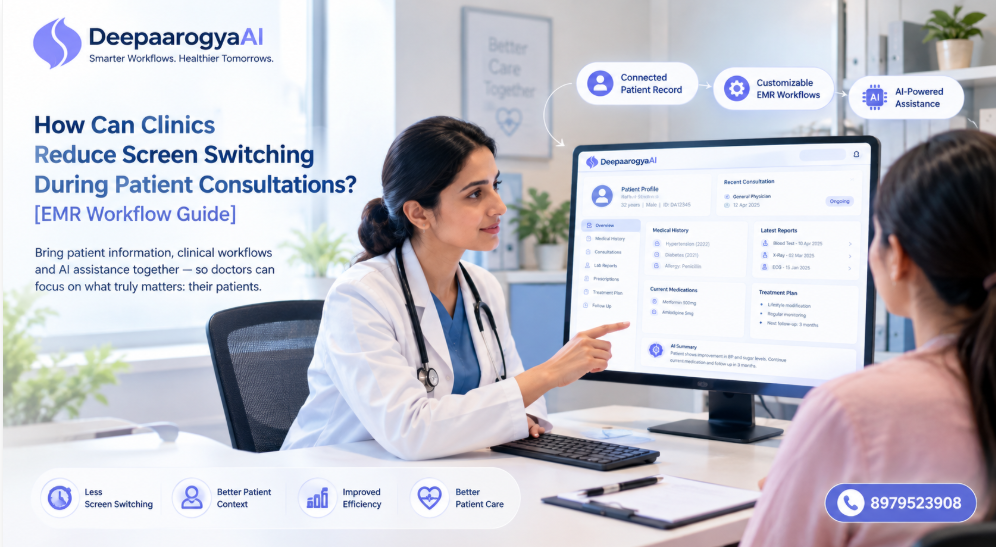
DeepaarogyaAI helps bring patient information and clinical workflows together so healthcare professionals can spend less time searching across systems and more time focusing on the consultation.
Why Does Screen Switching Become a Problem in Healthcare?
In a busy clinic or hospital, a single patient encounter can involve multiple types of information:
- Patient demographics
- Medical history
- Previous consultations
- Clinical notes
- Diagnostic information
- Prescriptions
- Treatment plans
- Department-specific records
- Billing or administrative information
- Follow-up information
When these details are spread across different places, healthcare professionals may repeatedly switch between screens to understand the patient’s complete context.
For one patient, this may seem like a small inconvenience.
Across dozens of consultations every day, however, small workflow interruptions can become a significant operational burden.
Screen switching can lead to:
Interrupted concentration: Doctors may have to move their attention between the patient and multiple digital interfaces.
Slower documentation: Important information may need to be searched for before it can be recorded.
Fragmented context: Relevant patient information may not appear together when the clinician needs it.
Workflow friction: Staff may spend additional time navigating between different parts of the system.
Reduced consultation efficiency: More time can be spent managing information rather than using it.
The goal of healthcare technology should not simply be to digitize every piece of information.
It should make that information easier to use.
What Does a Connected Consultation Workflow Look Like?
A connected consultation workflow brings relevant information into the clinical workflow instead of forcing the user to repeatedly search for it.
Consider a patient returning to a multispecialty clinic.
The doctor wants to understand:
- What brought the patient to the clinic previously?
- What was documented during the earlier consultation?
- What investigations or reports are available?
- What treatment was recommended?
- What information is relevant to today’s consultation?
In a fragmented workflow, the doctor may need to search through different screens or systems.
In a connected EMR workflow, relevant information can be available within the patient’s digital record.
This creates a more natural sequence:
Patient → Medical Record → Relevant Information → Consultation → Clinical Documentation → Next Action
Instead of:
Patient → Search → Open System → Find Record → Open Another Section → Search Again → Return to Consultation
That difference may appear small.
For healthcare teams handling high patient volumes, it can become important.
How Can DeepaarogyaAI Help Reduce Screen Switching?
DeepaarogyaAI is designed around connected healthcare workflows rather than isolated pieces of information.
The objective is to make the patient’s digital record more useful during day-to-day clinical operations.
1. Bring Patient Context Into One Connected Record
A patient’s healthcare journey can generate information across multiple encounters and workflows.
A connected EMR helps organize that information around the patient.
Instead of treating each interaction as a separate data point, the record can provide a broader view of the patient’s clinical context.
This can help doctors access relevant information without repeatedly searching across disconnected locations.
The patient record becomes a working clinical resource—not simply a place to store documentation.
2. Reduce Unnecessary Navigation During Consultations
A consultation should primarily be a conversation between the healthcare professional and the patient.
Technology should support that conversation.
If clinicians constantly need to navigate through multiple screens to locate basic patient information, the software becomes an additional task.
A well-structured EMR workflow can reduce unnecessary navigation by keeping relevant information closer to the point where it is needed.
This can be particularly useful in busy outpatient environments where doctors may handle many consultations in a day.
3. Connect Information With the Relevant Workflow
Not every piece of information is equally important for every consultation.
An orthopedic doctor, physiotherapist, physician, nutritionist, and other healthcare professionals may need different information depending on the patient’s care journey.
This is why healthcare software needs to support department-specific workflows rather than forcing every department into exactly the same process.
DeepaarogyaAI’s customizable EMR approach can support workflows based on the needs of different healthcare functions.
The objective is simple:
Show the right information within the workflow where it is useful.
Why Context Matters More Than More Data
Healthcare organizations often focus on collecting more digital information.
But more data does not automatically mean better workflow.
Imagine a doctor has access to hundreds of records but needs three specific pieces of information during a consultation.
If finding those three details requires navigating through multiple screens, the system may still create friction.
The real value comes from contextual accessibility.
For example:
Raw information:
The patient has several previous consultation records.
Useful context:
The doctor can quickly understand what was previously documented and what is relevant to the current encounter.
This is an important distinction.
Healthcare technology should not simply answer:
“Where is the data?”
It should help answer:
“What information matters for this workflow right now?”
Can AI Make Clinical Workflows More Efficient?
AI can play a role when it is integrated into the workflow instead of being treated as a separate destination.
For example, AI-assisted capabilities can help healthcare teams work with consultation information more efficiently.
Instead of creating another tool that requires clinicians to leave their existing workflow, AI can be incorporated into the broader EMR experience.
This approach can help support tasks such as:
- Structuring consultation information
- Creating useful summaries
- Reducing manual documentation effort
- Making patient information easier to review
- Supporting more actionable clinical workflows
The important principle is AI should reduce workflow complexity, not add another screen to manage.
Screen Switching Is Also a Staff Productivity Issue
The impact of fragmented software is not limited to doctors.
Front-desk teams, nurses, administrative staff, and other healthcare professionals may also interact with multiple pieces of information during a patient’s journey.
Consider a clinic where:
- One screen contains patient registration information.
- Another contains clinical information.
- Another contains reports.
- Another is used for administrative tasks.
- Another contains information from a different workflow.
Every additional system creates another point where users may need to switch context.
This can increase the cognitive load on staff.
A connected healthcare platform can help bring workflows closer together and reduce unnecessary movement between systems.
Better workflow design is therefore not only a clinical improvement—it can also be an operational improvement.
What Should Clinics Look for in an EMR?
If a clinic wants to reduce workflow friction, simply choosing software with a large feature list may not be enough.
Instead, healthcare organizations should evaluate how the system behaves during an actual consultation.
Here are some questions to ask.
1. Can clinicians access the patient’s relevant history easily?
Patient information should be organized in a way that supports clinical use.
2. Can different departments work within connected workflows?
A multispecialty organization should be able to support different department requirements while maintaining patient context.
3. Can workflows be customized?
Every clinic does not operate in exactly the same way.
4. Does the system reduce documentation effort?
Technology should make documentation more manageable rather than create additional administrative work.
5. Can AI capabilities work within the workflow?
AI should ideally support the user’s existing process instead of forcing them into another application.
6. Can the system grow with the organization?
As a clinic adds doctors, departments, locations, or services, the EMR should be capable of supporting evolving workflows.
From More Screens to One Connected Workflow
The future of healthcare software is not necessarily about giving clinicians more dashboards.
It is about creating simpler, more connected workflows.
A doctor should not need to think about where information is stored while talking to a patient.
The technology should help organize that information around the patient’s journey.
This is where a connected EMR can make a difference.
Instead of treating:
- patient records,
- clinical documentation,
- departmental workflows,
- AI assistance,
- and operational processes
as completely separate experiences, healthcare organizations can move toward a more connected digital environment.
How DeepaarogyaAI Fits Into This Approach
DeepaarogyaAI is built around the idea of making healthcare workflows more connected and intelligent.
Rather than adding another isolated tool to a clinic’s technology stack, its EMR approach can help bring patient information and department-specific workflows into a connected environment.
For healthcare organizations, this can mean:
Less unnecessary navigation
Access relevant patient information within connected workflows.
More organized clinical context
Keep patient information connected across encounters and workflows.
Department-specific flexibility
Support different healthcare workflows instead of forcing every department into one rigid process.
AI-assisted efficiency
Use AI capabilities to support documentation and information handling.
A more connected patient journey
Help healthcare teams work with patient information across the care process.
The goal is not to eliminate every screen.
The goal is to eliminate unnecessary screen switching.
What Does a Better Consultation Experience Look Like?
Imagine a doctor opening a patient’s record before the consultation.
Instead of searching through different locations, the doctor can work from a connected patient record.
During the consultation, relevant information is available within the workflow.
The doctor documents the encounter.
The system supports the next steps.
The patient moves forward in their care journey.
The doctor moves to the next consultation.
This creates a smoother flow:
Review → Consult → Document → Act
rather than:
Search → Switch → Search → Open → Return → Document → Switch Again
That difference is exactly where healthcare software can create practical value.
The Bigger Opportunity: Designing Healthcare Around Workflows
Digital transformation in healthcare is often described as moving from paper to software.
But the next stage is different.
It is about moving from software-driven processes to workflow-driven technology.
A clinic does not need technology simply because it is digital.
It needs technology that helps its people work better.
That means:
- Patient information should be accessible.
- Clinical workflows should be connected.
- Department-specific requirements should be supported.
- Documentation should be efficient.
- AI should assist rather than complicate.
- The patient’s journey should remain connected.
When these principles come together, healthcare technology becomes less of an obstacle and more of an operational partner.
Final Thoughts
Screen switching may look like a small technology problem.
But in a busy healthcare environment, repeated small interruptions can accumulate into significant workflow friction.
Doctors need patient context, not more tabs.
Staff need connected workflows, not disconnected systems.
Healthcare organizations need technology that fits the way their teams actually work.
A connected EMR approach can help move healthcare organizations toward that goal.
With DeepaarogyaAI, clinics and healthcare organizations can explore a more connected way to manage patient information, clinical workflows, department-specific processes, and AI-assisted healthcare operations.
The future of healthcare technology is not about adding more screens.
It is about making every screen more useful.
FAQs
1. What is screen switching in healthcare?
Screen switching refers to repeatedly moving between different screens, systems, applications, or sections to find and manage information needed during a healthcare workflow.
2. Why can excessive screen switching affect clinical workflows?
Frequent navigation can interrupt concentration, increase cognitive load, slow information retrieval, and add friction to documentation and consultation workflows.
3. Can an EMR reduce screen switching?
A well-designed EMR can reduce unnecessary navigation by connecting patient information and workflows within a unified digital environment.
4. How does a connected patient record help doctors?
A connected patient record can make relevant information easier to access and help clinicians understand the patient’s broader context during an encounter.
5. Can different departments use customized EMR workflows?
Yes. Healthcare organizations can benefit from EMR workflows that support department-specific requirements while maintaining continuity of patient information.
6. What role can AI play in reducing workflow friction?
AI can support tasks such as information organization, summarization, and documentation, helping healthcare professionals spend less time on repetitive information-handling tasks.
7. Is reducing screen switching the same as using fewer software systems?
Not necessarily. The goal is not simply to reduce the number of systems. It is to make necessary information and workflows more connected so users do not have to repeatedly move between disconnected processes.
8. How can DeepaarogyaAI help healthcare organizations?
DeepaarogyaAI provides a connected EMR approach designed to support patient records, customizable healthcare workflows, department-specific processes, and AI-assisted efficiency.