
Modern clinics and hospitals generate enormous amounts of healthcare data.
Patient histories.
Previous consultations.
Prescriptions.
Investigation reports.
Radiology records.
Vitals.
Treatment plans.
Follow-up information.
But having more data does not automatically make clinical workflows easier.
The real challenge is finding the relevant information at the right moment.
A doctor may need to understand what happened during a previous visit, review an investigation report, check an existing prescription, look at relevant patient history, and decide what needs to happen next.
If that information is scattered across different systems, the problem is no longer a lack of data.
It is a lack of usable context.
This is where AI-powered healthcare platforms can play an important supporting role.
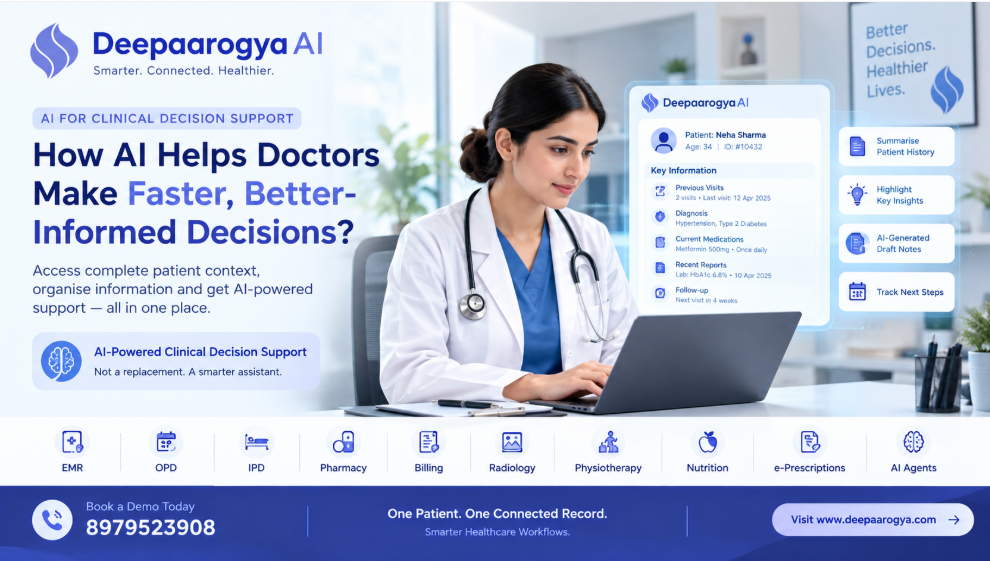
DeepaarogyaAI brings together EMR, OPD, IPD, pharmacy, billing, radiology, physiotherapy, nutrition, e-prescriptions and AI-powered workflows around a connected patient record. This creates a foundation where healthcare teams can work with information in a more organised way.
The future of healthcare is not simply about collecting more data. It is about making the right information easier to use.
Book a Demo | Try for Free | Contact Us
Why Do Doctors Need Better Access to Patient Context?
A consultation is rarely based on one piece of information.
Consider a returning patient.
The doctor may need to understand:
- What was discussed during the previous visit?
- What diagnosis was recorded?
- Which medicines were prescribed?
- What investigations were ordered?
- Are relevant reports available?
- Has the patient’s condition changed?
- What follow-up was recommended?
- Which other departments have been involved?
When this information exists in different locations, healthcare professionals may spend valuable time searching, switching systems, or asking staff to retrieve information.
This can make a simple consultation more complicated than it needs to be.
A connected digital record can bring relevant information together so that the healthcare team has a clearer picture of the patient’s journey.
What Is AI-Assisted Clinical Decision Support?
AI-assisted clinical decision support refers to technology that helps healthcare professionals organise, summarise, surface, or interpret relevant information within a clinical workflow.
It does not mean replacing the doctor.
Instead, AI can assist with tasks such as:
1. Summarising Patient Information
Long patient records can contain information from multiple visits.
AI can help create structured summaries that make important information easier to review.
2. Organising Clinical Information
Patient information can be structured around consultations, investigations, prescriptions, follow-ups, and other relevant activities.
3. Highlighting Relevant Context
When information is connected, healthcare professionals can work from a broader patient context instead of isolated records.
4. Supporting Documentation
AI-generated drafts can reduce repetitive documentation work while allowing clinicians to review and approve the final information.
5. Connecting the Next Step
The patient journey does not end with a consultation.
Relevant workflows may continue through pharmacy, radiology, physiotherapy, nutrition, billing, or follow-up.
The goal is to make these transitions more connected.
The Problem With Disconnected Clinical Information
Imagine a patient visits an orthopedic clinic.
The patient’s journey might look like this:
Consultation → X-ray → Doctor Review → Prescription → Physiotherapy → Follow-Up
Now imagine that every stage uses a different system.
The doctor records the consultation in one place.
The radiology report exists somewhere else.
The physiotherapy team maintains another record.
The prescription is generated separately.
Follow-up information is handled through another communication channel.
The information exists—but it is fragmented.
This is where a connected healthcare platform can make a difference.
DeepaarogyaAI’s platform connects workflows such as radiology, physiotherapy, nutrition, pharmacy and billing with the broader patient record.
Instead of thinking about every department as an independent system, the healthcare organization can think about the patient journey as one connected workflow.
How AI Can Make Patient Information More Useful
1. Turn Long Records Into Useful Summaries
Doctors do not always need to read every piece of historical information before every interaction.
A structured patient summary can make it easier to identify relevant information.
For example:
Patient history
↓
Previous consultation
↓
Diagnosis
↓
Investigation
↓
Treatment
↓
Current visit
↓
Follow-up
AI can assist in organising information into a format that is easier for healthcare professionals to review.
The clinician remains responsible for interpreting the information and making the clinical decision.
2. Reduce Information Searching
One of the hidden problems in healthcare administration is information retrieval.
A doctor may know that a report exists—but finding it can take time.
A connected system can reduce unnecessary searching by keeping relevant information associated with the patient’s record.
DeepaarogyaAI’s approach is based on connecting multiple healthcare workflows around the same patient record.
That means the focus shifts from:
“Where is this information?”
to:
“What does this information tell us?”
3. Connect Investigations With the Patient Journey
Diagnostic information is valuable only when it can be used effectively within the care workflow.
Consider:
Doctor consultation
↓
Investigation ordered
↓
Radiology
↓
Report
↓
Doctor review
↓
Treatment decision
When these stages are connected, information can remain associated with the relevant patient context.
DeepaarogyaAI includes radiology workflows where imaging orders, queues and reports can be connected to the patient chart.
This helps move healthcare organisations toward a workflow where information follows the patient rather than becoming trapped inside departmental silos.
4. Make AI Assistance Part of the Workflow
AI becomes more useful when it is integrated into the system healthcare professionals already use.
Instead of:
Patient Record → Copy Information → Separate AI Tool → Generate Output → Copy Back
a connected approach can support:
Patient Record → AI Assistance → Review → Approved Workflow
DeepaarogyaAI’s AI-powered workflows include capabilities such as SOAP documentation, patient summaries, discharge summaries, nutrition assistance and other healthcare tasks.
The important principle is human oversight.
AI can assist.
The healthcare professional reviews and approves relevant clinical outputs.
5. Support Continuity Between Departments
Healthcare is rarely a single-department experience.
A patient may interact with:
- Doctor
- Nursing team
- Radiology
- Pharmacy
- Physiotherapy
- Nutrition
- Billing
- Follow-up team
If every department sees only its own part of the patient’s information, continuity can become difficult.
A connected patient record provides a stronger foundation for coordinated workflows.
For example:
Doctor → Radiology → Physiotherapy → Pharmacy → Follow-Up
can become a connected sequence rather than several independent processes.
AI Should Assist Doctors—Not Replace Them
This distinction is critical.
AI in healthcare should not be positioned as a replacement for professional judgement.
Instead, its value can come from reducing repetitive information-management tasks.
Think about the difference:
Traditional approach
Collect → Search → Read → Organise → Document → Coordinate
AI-assisted approach
Collect → Connect → AI assists → Clinician reviews → Act
The second approach does not remove the doctor.
It gives the doctor a more organised workflow.
That distinction is particularly important when AI-generated clinical information is involved.
What Does This Mean for Clinics and Hospitals?
For healthcare organisations, AI-assisted information workflows can support several areas.
For Doctors
- Easier access to relevant patient information
- Structured patient summaries
- AI-assisted documentation
- Better visibility across connected workflows
For Patients
- More connected healthcare journeys
- Less repetitive information sharing
- Better continuity between visits and departments
- Digital prescriptions and communication workflows
For Hospital Teams
- Connected clinical workflows
- Shared patient context
- Less unnecessary information duplication
- Better coordination between departments
For Administrators
- Greater visibility into healthcare workflows
- More organised digital records
- Connected clinical and operational processes
- A stronger foundation for AI adoption
Why an AI Hospital OS Matters
Adding AI to a disconnected healthcare environment can create another layer of complexity.
The bigger opportunity is to build AI into the healthcare operating environment itself.
DeepaarogyaAI positions its platform as an AI Hospital OS, bringing together:
- AI-powered EMR
- OPD
- IPD
- Pharmacy
- Billing
- Radiology
- Physiotherapy
- Nutrition
- e-Prescriptions
- AI agents
- Healthcare integrations
around a connected patient-record environment.
This creates an important foundation:
One patient.
One connected record.
Multiple intelligent workflows.
5 Questions Healthcare Leaders Should Ask Before Adopting AI
Before choosing an AI healthcare platform, ask:
1. Is the AI connected to the patient record?
AI becomes more useful when it can work within the relevant healthcare context.
2. Does it support human review?
Clinical outputs should remain subject to appropriate professional review and approval.
3. Can it work across departments?
Healthcare does not operate inside one department.
4. Does it reduce workflow fragmentation?
Adding another standalone application may create another information silo.
5. Can it grow with the organisation?
A useful platform should support evolving workflows across clinical and operational areas.
DeepaarogyaAI: From Patient Data to Actionable Context
The next stage of healthcare digitisation is not simply putting more information into computers.
It is making healthcare information connected, organised and useful.
DeepaarogyaAI brings multiple clinical and operational workflows together around a connected patient record, while AI-powered workflows assist healthcare teams with documentation, summaries, communication and other repetitive tasks.
The goal is simple:
Give healthcare teams better access to the right information, at the right point in the patient journey.
With a connected AI Hospital OS, clinics and hospitals can move beyond isolated digital tools toward a more intelligent healthcare workflow.
Ready to explore a more connected approach to healthcare management?
Book a Demo | Try for Free | Contact DeepaarogyaAI
Frequently Asked Questions
1. Can AI make clinical decisions for doctors?
AI should not replace professional clinical judgement. It can assist by organising information, generating summaries, supporting documentation and surfacing relevant context. Healthcare professionals remain responsible for reviewing and making appropriate clinical decisions.
2. How can AI help doctors manage patient records?
AI can assist with summarising information, organising records and reducing repetitive documentation. When combined with a connected patient record, it can help healthcare professionals access relevant information more efficiently.
3. What is an AI Hospital OS?
An AI Hospital OS is a healthcare technology environment designed to connect clinical, administrative and AI-powered workflows rather than treating every function as a separate application.
4. Can DeepaarogyaAI connect different healthcare departments?
DeepaarogyaAI’s platform connects workflows including EMR, OPD, IPD, pharmacy, billing, radiology, physiotherapy and nutrition around a connected patient record.
5. Can AI-generated clinical information be reviewed by doctors?
Yes. DeepaarogyaAI describes AI outputs as drafts within review workflows, with clinicians responsible for reviewing and approving relevant clinical content.
6. Is AI useful only for large hospitals?
No. AI-assisted workflows can be relevant to clinics as well as larger healthcare organisations, particularly when repetitive documentation, fragmented information and multiple departmental workflows create operational challenges.
Final Takeaway
Healthcare AI is most valuable when it improves the way healthcare professionals work with information—not when it simply adds another layer of technology.
The future is moving from:
Digital Records → Connected Records → Intelligent Workflows
And DeepaarogyaAI is designed around that transition.
One patient. One connected record. Smarter healthcare workflows.