
A patient visits a clinic and explains their symptoms to the doctor.
Later, they are sent for a diagnostic test.
Then they visit physiotherapy.
They collect medicines from the pharmacy.
At the next appointment, they are asked about their previous treatment again.
For patients, this can feel frustrating.
For healthcare teams, it can mean repeated questions, repeated data entry, and valuable clinical context being scattered across different workflows.
The problem is not always that the clinic lacks patient information.
The problem is that the right information may not be available to the right person at the right time.
This is where a connected patient record can make a meaningful difference.
Instead of treating every visit, department, and interaction as a separate event, modern healthcare technology can connect the patient journey around a shared digital record.
DeepaarogyaAI is designed around this approach, bringing EMR, OPD, IPD, pharmacy, billing, radiology, physiotherapy, nutrition, e-prescriptions, and AI-assisted workflows together around one patient record.
Why Do Patients Have to Repeat Their Medical Information?
Imagine a patient visiting an orthopedic clinic for persistent knee pain.
During the consultation, the doctor records:
- Symptoms
- Medical history
- Diagnosis
- Previous treatment
- Investigations
- Prescription
- Follow-up instructions
The doctor then recommends physiotherapy.
The patient moves to another department.
If the physiotherapy workflow is disconnected from the clinical record, the patient may be asked to explain their condition again.
Later, the patient undergoes radiology.
The same information may need to be communicated again.
Then the patient visits the pharmacy.
At the next consultation, the doctor needs to understand what happened during the previous stages.
This creates a cycle:
Explain → Record → Repeat → Re-enter → Search → Explain again
For a single patient, this may seem like a small inconvenience.
Across hundreds or thousands of visits, however, repeated information handling can become a significant operational challenge.
What Happens When Patient Information Is Fragmented?
Healthcare involves many different people and departments.
A single patient journey can include:
Reception → Doctor → Laboratory → Radiology → Pharmacy → Physiotherapy → Nutrition → Billing → Follow-up
Each team has a different responsibility.
But they are all working with information about the same patient.
When those workflows operate independently, several problems can appear.
1. Patients Repeat the Same Information
Patients may have to explain:
- Previous diagnoses
- Current medications
- Existing conditions
- Previous investigations
- Treatment history
- Symptoms
- Follow-up instructions
This can make the healthcare experience feel repetitive.
A connected record can help relevant information remain available to authorized teams instead of requiring the patient to repeatedly provide the same context.
2. Staff Spend Time Searching for Information
The problem is not limited to patients.
Healthcare staff may also spend time searching for:
- Previous prescriptions
- Old reports
- Consultation notes
- Investigation results
- Previous visits
- Follow-up information
If information exists across paper files, separate applications, messages, spreadsheets, or disconnected systems, finding the right information can take additional effort.
Digitization alone does not solve fragmentation.
The information also needs to be connected.
3. Important Context Can Be Lost Between Departments
Consider a patient who visits a doctor and is referred to physiotherapy.
The doctor understands the patient’s diagnosis and treatment plan.
The physiotherapist needs relevant information to continue the care journey.
If the information transfer depends entirely on manual communication, there is a greater opportunity for delays or missing context.
A connected workflow creates a different model:
Doctor → Patient Record → Physiotherapy
The goal is not to give every department unlimited information.
The goal is to make appropriate patient context available within the relevant workflow.
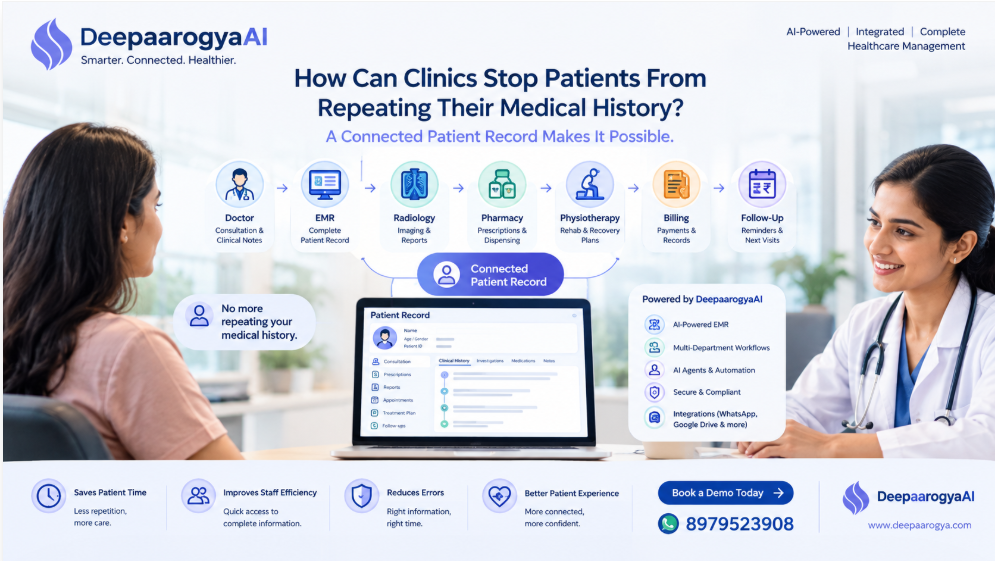
What Is a Connected Patient Record?
A connected patient record is more than a digital version of a paper file.
A basic digital record may simply store information electronically.
A connected record aims to make that information useful across multiple stages of the patient journey.
For example:
Consultation
The doctor records the patient’s symptoms, diagnosis, treatment and clinical notes.
↓
Radiology
Relevant imaging orders and reports remain associated with the patient’s record.
↓
Pharmacy
Prescription and dispensing workflows remain connected to the patient’s information.
↓
Physiotherapy
The rehabilitation team can work within the connected patient journey.
↓
Billing
Relevant services and transactions remain part of the broader operational workflow.
↓
Follow-Up
The patient’s next interaction can continue from the existing record.
This creates a much more continuous experience.
One patient. One connected record. Multiple healthcare workflows.
That is the model DeepaarogyaAI is built around. Its website describes a workflow spanning engagement, intake, consultation, coordination, billing and follow-up.
How Can AI Make Connected Patient Records More Useful?
A connected record provides the information.
AI can help healthcare teams work with that information more efficiently.
This is where the combination of EMR + connected workflows + AI becomes particularly valuable.
1. AI Can Help Create Patient Summaries
Healthcare records can become lengthy.
A patient may have:
- Multiple consultations
- Several investigations
- Different prescriptions
- Follow-up visits
- Department interactions
- Clinical notes
Reviewing everything manually can take time.
AI-assisted patient summaries can help organize relevant information into a more concise format for professional review.
DeepaarogyaAI includes an AI Patient Summary workflow designed to draft summaries from available patient information, with clinician review before finalization.
The goal is simple:
Less searching. More usable context.
2. AI Can Assist With Clinical Documentation
Documentation is another area where information gets repeatedly processed.
Doctors may need to convert consultation information into structured clinical notes.
AI-assisted workflows can help prepare documentation drafts that healthcare professionals can review and approve.
DeepaarogyaAI’s SOAP Agent supports structured SOAP documentation, including multilingual support, while keeping the output within a clinician-review workflow.
This is an important principle:
AI assists the workflow. The healthcare professional remains in control.
3. AI Can Support Discharge Documentation
In an inpatient setting, discharge documentation may involve information collected throughout the patient’s stay.
Relevant information can include:
- Case sheets
- Orders
- Nursing notes
- Vitals
- Procedures
- Medications
- Investigations
An AI-assisted workflow can help organize this information into a structured draft.
DeepaarogyaAI’s platform includes a Patient Summary/Discharge Summary capability designed around this type of workflow, with professional review before finalization.
How Does This Improve the Patient Experience?
A connected record isn’t just a technology improvement.
It can change how patients experience a clinic.
Imagine two different journeys.
Traditional fragmented journey
Patient explains history
↓
Reception records information
↓
Doctor asks again
↓
Patient visits another department
↓
Information is communicated manually
↓
Patient explains history again
↓
Next visit begins with searching old records
Connected journey
Patient information is captured
↓
Doctor accesses the record
↓
Relevant information flows into connected workflows
↓
Radiology, pharmacy or physiotherapy work from the appropriate patient context
↓
Follow-up continues from the same record
The second model can reduce unnecessary repetition and make the healthcare journey feel more organized.
Which Healthcare Departments Can Benefit?
The need for connected information becomes particularly important when patients interact with multiple departments.
🩺 EMR and OPD
Doctors can access the patient’s existing clinical history and document the current consultation within the same record.
🩻 Radiology
Imaging orders and reports can remain associated with the patient’s chart rather than becoming isolated information.
💊 Pharmacy
Prescription and pharmacy workflows can remain connected to the patient journey.
💗 Physiotherapy
For practices involving rehabilitation, patient information can continue into physiotherapy workflows instead of beginning as a completely separate record.
DeepaarogyaAI specifically provides physiotherapy workflows involving protocol tracking, outcomes, team assignment, session management and billing.
🥗 Nutrition
Nutrition care can also form part of the connected journey.
DeepaarogyaAI provides an AI-assisted nutritional workflow designed to generate plans for professional review.
🧾 Billing
Clinical and operational information can remain connected rather than requiring teams to reconstruct the patient’s journey manually.
Why Is “One Record” Better Than Multiple Patient Records?
Many healthcare organizations use several digital tools.
One application may manage appointments.
Another may manage billing.
Another may store clinical information.
Another may handle communication.
Another may manage a specialty workflow.
The issue is not necessarily that each application is bad.
The problem occurs when the systems do not communicate effectively.
A connected healthcare platform can reduce this fragmentation by bringing multiple workflows around the same patient record.
DeepaarogyaAI positions its platform as an AI Hospital OS for Indian clinics and hospitals, connecting areas such as EMR, OPD, IPD, pharmacy, billing, physiotherapy and nutrition.
This creates a simple operating principle:
Instead of asking:
“Where is this patient’s information?”
Healthcare teams can work toward:
“The patient’s information is connected to their journey.”
How Can Clinics Start Reducing Repeated Patient Information?
Technology is only one part of the solution.
Clinics should also examine their existing workflow.
Ask these questions:
1. How many times is the same patient information entered?
Track repeated demographic and clinical data entry.
2. Which departments ask patients for information already available elsewhere?
This can identify disconnected workflows.
3. Where do reports and prescriptions get stored?
If important information exists in multiple locations, consider how it can be better connected.
4. How much time do staff spend searching for previous information?
This can reveal hidden administrative workload.
5. Can the next department access relevant information without asking the patient to start again?
This is one of the most important questions.
6. Can AI assist with repetitive documentation?
Identify tasks where AI can prepare drafts while keeping professional review in place.
What Makes DeepaarogyaAI Relevant to This Problem?
DeepaarogyaAI is designed around the idea that healthcare should operate through connected workflows rather than isolated software tools.
Its platform brings together:
- AI-powered EMR
- OPD
- IPD
- Pharmacy
- Billing
- Radiology
- Physiotherapy
- Nutrition
- e-Prescriptions
- AI Agents
- WhatsApp workflows
- Google Drive integration
- Telemedicine integrations
These capabilities are designed around the same patient record and broader healthcare journey.
The platform also offers specialty-focused workflows, including orthopedics, pediatrics, ENT, physiotherapy, nutrition and other specialties listed on its website.
This matters because healthcare is rarely a single-department activity.
A patient may need several services during one care journey.
The technology should help preserve that context.
The Future of Healthcare Is Not Just Digital. It Is Connected.
Healthcare digitization has already changed how clinics store information.
But the next challenge is bigger.
It is not enough to ask:
“Do we have an EMR?”
The better questions are:
- Can different departments work from connected information?
- Can patients avoid unnecessary repetition?
- Can doctors quickly understand relevant history?
- Can AI assist with repetitive documentation?
- Can prescriptions, reports, billing and follow-ups remain connected?
- Can the patient journey continue beyond a single consultation?
A digital record stores information.
A connected patient record makes that information part of a journey.
And when AI is added to that connected foundation, healthcare teams can move toward workflows that are more organized, context-aware and efficient.
Conclusion: One Patient Should Not Become Five Different Records
A patient is not a separate person every time they move from the doctor to radiology, pharmacy, physiotherapy or billing.
Yet fragmented systems can make it feel that way.
Patients repeat information.
Staff search for records.
Departments recreate data.
Important context can become disconnected.
A connected patient record offers a better direction.
With the right digital infrastructure, a patient’s journey can move from:
Engage → Intake → Consult → Coordinate → Bill → Follow-Up
without turning every stage into a separate information silo.
DeepaarogyaAI brings these workflows together through its AI Hospital OS, with EMR, OPD, IPD, pharmacy, billing, radiology, physiotherapy, nutrition and AI-assisted workflows connected around the patient record.
The goal is not simply to make healthcare more digital.
It is to make healthcare more connected.
Ready to Build a More Connected Patient Journey?
Explore how DeepaarogyaAI can help your clinic connect its healthcare workflows around one patient record.
👉 Explore DeepaarogyaAI: https://www.deepaarogya.com/
👉 Schedule a Demo: Visit the DeepaarogyaAI website and connect with the team for a workflow optimization consultation.
📱 WhatsApp: +91 89795 23908
One platform. Every department. One connected patient journey.
Frequently Asked Questions
1. Why do patients have to repeat their medical history?
Patients may need to repeat information when different departments or healthcare systems operate with separate records. A connected patient record can help relevant information remain available across appropriate workflows.
2. What is a connected patient record?
A connected patient record brings relevant clinical and operational information together around the same patient so different healthcare workflows can work with appropriate context.
3. Can AI help doctors understand patient history?
Yes. AI can assist with organizing existing information into summaries and structured documentation. These outputs should be reviewed by the appropriate healthcare professional.
4. Can a connected record reduce duplicate data entry?
It can help reduce unnecessary re-entry when multiple workflows use the same underlying patient information rather than maintaining separate records.
5. Can DeepaarogyaAI connect pharmacy and physiotherapy with EMR?
Yes. DeepaarogyaAI’s platform connects EMR with workflows including pharmacy, physiotherapy, nutrition, billing and other departments around the patient record.
6. Does DeepaarogyaAI’s AI replace doctors?
No. DeepaarogyaAI describes its AI outputs as drafts that remain subject to professional review and approval rather than autonomous diagnosis or decision-making.
7. Can DeepaarogyaAI support specialty clinics?
Yes. The platform is designed for different healthcare practices and lists specialty workflows including orthopedics, pediatrics, ENT, physiotherapy, nutrition, cardiology, pulmonology and oncology.
8. How can a clinic evaluate whether DeepaarogyaAI is suitable?
A clinic can discuss its existing workflow with the DeepaarogyaAI team and explore how the platform can be configured around its specific requirements.