
A clinic can have an EMR, appointment system, billing software, pharmacy workflow, diagnostic records, and multiple digital communication channels—and still struggle with one basic question:
“What needs attention right now?”
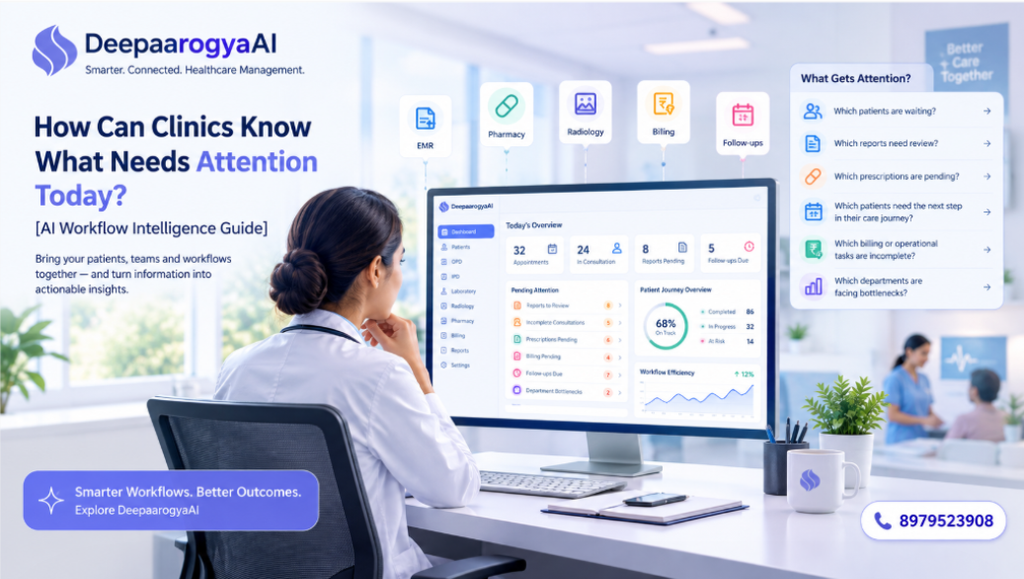
Which patients are waiting?
Which consultations are incomplete?
Which reports need review?
Which prescriptions are pending?
Which patients need the next step in their care journey?
Which billing or operational tasks are still incomplete?
Which departments are becoming bottlenecks?
In a busy healthcare environment, the challenge is not always a lack of information.
Sometimes, it is too much information spread across different workflows.
Healthcare teams need more than digital records. They need a way to turn those records and workflows into actionable visibility.
This is where AI-powered workflow intelligence can become valuable.
Instead of making doctors and administrators search through different systems to identify what requires attention, a connected healthcare platform can help bring relevant information together around the patient and the workflow.
And this is one of the areas where DeepaarogyaAI can help clinics and hospitals move toward smarter, more organized healthcare management.
The Problem: Healthcare Teams Have Information Everywhere
Consider a typical clinic.
The reception team manages appointments.
The doctor manages consultations and clinical notes.
The diagnostic team manages reports.
The pharmacy handles medicines.
The billing team manages payments.
The physiotherapy team manages sessions.
The nutrition team may manage diet plans.
The administration team monitors the overall operation.
Each team may have important information.
But the bigger question is:
Can everyone easily see what requires attention next?
When information is fragmented, staff may spend time checking different screens, messages, spreadsheets, files, or applications.
That creates a hidden operational problem:
Information exists, but action is delayed.
For example:
- A report may be available but not yet reviewed.
- A patient’s next step may not be clearly visible to the appropriate team.
- A department may be waiting for information from another department.
- A billing task may remain incomplete.
- A follow-up requirement may not be visible at the right time.
- A doctor may need to search through previous information before making a decision.
None of these problems necessarily come from a lack of technology.
They can come from technology that is not sufficiently connected.
What Is Workflow Intelligence in Healthcare?
Workflow intelligence means using connected healthcare information to help teams understand:
What happened?
What is happening now?
What needs attention?
What should happen next?
Traditional software often focuses on recording events.
A stronger healthcare workflow can also help teams act on those events.
For example:
Patient registered → Consultation completed → Investigation ordered → Report available → Doctor review → Treatment decision → Prescription → Follow-up
Each stage creates information.
If those stages are connected, the system can provide better visibility into the patient’s journey.
Instead of asking staff to manually reconstruct what happened, the workflow itself becomes easier to understand.
Why “What Needs Attention?” Is More Important Than “What Happened?”
Healthcare organizations already generate enormous amounts of data.
The challenge is turning that data into useful action.
Imagine an administrator opening the system at the beginning of the day.
A traditional dashboard might show:
- Number of appointments
- Number of patients
- Revenue
- Pending bills
- Department statistics
These numbers can be useful.
But an intelligent workflow can go one step further.
It can help answer:
Which workflows require attention?
For example:
Clinical
- Pending documentation
- Reports requiring review
- Incomplete clinical workflows
Patient Journey
- Upcoming care steps
- Patients requiring appropriate follow-up
- Pending communication
Operations
- Delayed workflows
- Department bottlenecks
- Incomplete tasks
Financial
- Pending billing activities
- Uncompleted operational steps
- Potential areas requiring review
The difference is important.
A dashboard tells you what the numbers are.
Workflow intelligence helps you understand where action may be required.
How a Connected Patient Record Creates Better Visibility
The foundation of useful workflow intelligence is connected information.
If patient information exists in isolated systems, it becomes difficult to understand the complete journey.
DeepaarogyaAI is designed around a connected patient record, bringing healthcare workflows such as EMR, OPD, IPD, pharmacy, billing, radiology, physiotherapy, nutrition, e-prescriptions, and AI agents into a broader connected ecosystem.
This matters because different departments may interact with the same patient at different stages.
Consider an orthopedic patient:
Consultation
↓
Radiology
↓
Diagnosis
↓
Prescription
↓
Physiotherapy
↓
Follow-Up
If these stages are disconnected, every department may only see its own part of the journey.
With a connected approach, the patient’s broader context can remain available across relevant workflows.
That creates an opportunity for better operational visibility.
From Patient Data to Actionable Workflows
The real value of healthcare data is not simply storing it.
It is making the information useful when people need it.
Consider three levels of healthcare technology.
Level 1: Digital Records
The clinic replaces paper with digital records.
This improves storage and accessibility.
Level 2: Connected Records
Different workflows become connected around the patient.
This improves continuity.
Level 3: Intelligent Workflows
AI and automation help teams understand information and identify relevant next actions.
This improves operational intelligence.
The progression looks like this:
Paper → Digital → Connected → Intelligent
DeepaarogyaAI is built around this broader transition toward connected and AI-assisted healthcare operations.
Where Can AI Assist Healthcare Workflows?
AI does not have to replace healthcare professionals to be useful.
In many workflows, its value comes from reducing repetitive work and organizing information for review.
DeepaarogyaAI includes AI agents designed for different healthcare workflows.
For example, AI-assisted clinical documentation can help create structured drafts from consultation information.
A discharge workflow can use relevant information from the patient’s hospital record to assist with creating a discharge-summary draft.
Nutrition workflows can assist with generating diet-plan drafts based on available patient information.
The important principle is:
AI assists. Healthcare professionals review.
AI-generated information should remain within appropriate clinical review and approval workflows.
This keeps technology focused on supporting professionals rather than replacing clinical responsibility.
What Could an Intelligent Daily Workflow Look Like?
Imagine a clinic starting its day with a connected view of its operations.
Instead of checking multiple systems independently, the team can work from a more organized workflow.
Morning
The system shows the day’s scheduled patients and relevant appointment information.
During consultations
Doctors work with the patient’s existing information rather than repeatedly reconstructing the history.
AI-assisted documentation can help structure clinical information.
After consultation
Relevant next steps can continue through connected workflows such as:
- e-Prescription
- Billing
- Pharmacy
- Radiology
- Physiotherapy
- Nutrition
- Follow-up
Throughout the day
Teams can focus on the workflows that require attention instead of manually searching through unrelated information.
This creates a simple operational philosophy:
Don’t just record what happened. Make it easier to understand what happens next.
How This Can Help Doctors
Doctors often have limited time.
Their primary responsibility is patient care, but documentation and information management are unavoidable parts of clinical practice.
A connected AI-assisted workflow can help by reducing repetitive administrative activities.
Potential benefits include:
- More organized patient information
- Structured clinical documentation
- Easier access to previous information
- AI-assisted documentation
- Better visibility across relevant departments
- Less repetitive data entry
The goal isn’t to make doctors spend more time inside software.
It is to make software work more effectively around the doctor’s workflow.
How This Can Help Hospital Administrators
Administrators have a different challenge.
They need to understand the organization as a whole.
They may need visibility into:
- Patient flow
- Department operations
- Billing
- Pharmacy
- Diagnostics
- Staff workflows
- Follow-up processes
- Operational bottlenecks
When these processes are disconnected, administrators may have to depend heavily on manual reporting.
A connected healthcare platform creates a stronger foundation for understanding how different workflows interact.
That can support a more data-driven approach to healthcare management.
How This Can Improve the Patient Experience
Patients rarely think about a clinic in terms of departments.
They experience it as one journey.
They don’t necessarily see:
“Now I am interacting with the EMR.”
“Now I am interacting with the billing system.”
“Now I am interacting with the pharmacy.”
They simply expect the clinic to know what is happening.
A connected workflow can help create that experience.
For example:
Patient → Consultation → Prescription → Pharmacy → Follow-Up
When the underlying information is connected, the experience can become more coordinated.
Patients may spend less time repeating information and navigating disconnected processes.
Why AI Alone Is Not Enough
This is an important distinction.
Adding AI to a disconnected healthcare environment does not automatically create an intelligent healthcare system.
If patient information is scattered across multiple systems, an AI tool may still lack the context required to provide useful workflow assistance.
That is why the combination matters:
Connected Data + Healthcare Workflows + AI
A useful healthcare AI strategy needs more than an AI model.
It needs:
- Structured patient information
- Connected workflows
- Appropriate context
- Specialty-specific processes
- Human review
- Operational integration
This is where the concept of an AI Hospital OS becomes relevant.
Instead of adding isolated AI features to individual departments, DeepaarogyaAI brings clinical, operational, and AI-assisted workflows together around the patient record.
The Bigger Opportunity: From Reactive to Proactive Healthcare Operations
Many healthcare teams operate reactively.
Something happens.
Someone notices it.
Someone searches for the information.
Someone decides what to do.
Someone completes the task.
A more connected workflow can help shift this model.
Instead of:
Event → Search → Understand → Act
The goal becomes:
Event → Context → Visibility → Action
This does not mean AI makes decisions independently.
It means the system can help make relevant information easier to see and act upon.
That distinction is critical in healthcare.
What Should Clinics Look for in an AI Healthcare Platform?
Before adopting another technology tool, clinics should ask a few important questions.
1. Is the patient record connected?
Can relevant information move with the patient across workflows?
2. Does AI work inside the workflow?
Or does staff have to repeatedly copy information into separate AI tools?
3. Can workflows be customized?
Every specialty and healthcare organization operates differently.
4. Is there human oversight?
AI-generated clinical content should be reviewed by appropriate healthcare professionals.
5. Can clinical and operational workflows work together?
Healthcare doesn’t stop at the consultation.
6. Can the platform grow with the organization?
A solution should support the organization’s evolving requirements rather than creating another isolated technology layer.
How DeepaarogyaAI Fits Into This Model
DeepaarogyaAI brings together multiple healthcare capabilities around a connected patient record.
Its broader ecosystem includes:
AI-powered EMR
OPD
IPD
Pharmacy
Billing
Radiology
Physiotherapy
Nutrition
e-Prescriptions
AI Agents
Healthcare Integrations
This creates a foundation where information doesn’t simply remain stored.
It can become part of connected workflows.
For clinics and hospitals looking to move beyond basic digitization, the opportunity is significant:
Don’t just collect more healthcare data.
Connect it.
Don’t just connect it.
Make it actionable.
The Future of Healthcare Operations Is Intelligent Visibility
Healthcare organizations don’t necessarily need another screen full of numbers.
They need clarity.
They need to know:
What is happening?
What matters?
What needs attention?
What happens next?
And they need this information within the workflow—not after spending hours manually collecting it.
The next generation of healthcare technology will therefore be about more than digital records.
It will be about connected, contextual, and intelligent workflows.
That is the direction DeepaarogyaAI is working toward with its AI Hospital OS.
One connected patient record.
Multiple healthcare workflows.
AI-assisted operations.
Human oversight.
And a clearer path from information to action.
Ready to Make Your Healthcare Workflows More Intelligent?
Your clinic may already have valuable patient data.
Your teams may already have established processes.
The next opportunity is to connect those workflows and make the information more useful.
Explore DeepaarogyaAI and discover how AI-powered, connected healthcare workflows can support smarter healthcare management.
👉 Explore DeepaarogyaAI: https://www.deepaarogya.com/
👉 Book a Demo: Visit the DeepaarogyaAI website to explore the platform and discuss your healthcare workflow requirements.
Frequently Asked Questions (FAQs)
1. What is workflow intelligence in healthcare?
Workflow intelligence refers to using connected healthcare data, workflows, automation, and AI-assisted tools to help healthcare teams understand what is happening, what requires attention, and what the next appropriate workflow step may be.
2. How is workflow intelligence different from a healthcare dashboard?
A dashboard primarily presents information and metrics. Workflow intelligence aims to provide greater context around those metrics and help teams identify relevant workflows or tasks that may require attention.
3. Why is a connected patient record important?
A connected patient record helps relevant information remain available across different stages and departments of the patient’s healthcare journey. This can reduce fragmented information and repetitive data entry.
4. Can AI replace doctors in healthcare workflows?
AI should not replace clinical responsibility. AI can assist with tasks such as documentation and information organization, while healthcare professionals review, edit, and approve appropriate outputs.
5. How can AI help reduce administrative workload?
AI can assist with repetitive activities such as clinical documentation, structured drafts, summaries, and other workflow-support tasks, allowing healthcare professionals to spend more time on activities requiring their expertise.
6. What healthcare workflows does DeepaarogyaAI support?
DeepaarogyaAI brings together workflows including EMR, OPD, IPD, pharmacy, billing, radiology, physiotherapy, nutrition, e-prescriptions, and AI-assisted workflows around a connected patient record.
7. Can workflow intelligence improve patient experience?
Connected workflows can help reduce unnecessary repetition, improve coordination between departments, and support a smoother patient journey from consultation through treatment and follow-up.
8. Is workflow intelligence useful only for large hospitals?
No. The underlying principles can be useful for clinics and hospitals of different sizes. The specific workflows and level of implementation can depend on the organization’s requirements.
9. What is an AI Hospital OS?
An AI Hospital OS is a broader healthcare technology approach that brings clinical, operational, and AI-assisted workflows together within one connected ecosystem instead of treating every healthcare function as a separate software silo.
10. What is the first step toward intelligent healthcare operations?
The first step is understanding how information currently moves through the organization. From there, clinics can identify disconnected workflows, repetitive processes, bottlenecks, and opportunities to connect patient information and AI-assisted workflows more effectively.
Final Thought
The smartest healthcare system isn’t necessarily the one with the most data.
It is the one that helps the right people understand the right information at the right time—and know what needs attention next.
That is where connected healthcare and AI-powered workflow intelligence can make a meaningful difference.