
Healthcare teams spend a significant amount of time managing information. Patient details need to be captured, clinical notes need to be documented, records need to be updated, and information needs to remain available throughout the patient journey.
But there is a problem that often goes unnoticed: the same information may have to be entered or reviewed multiple times across different healthcare workflows.
A patient’s basic details may already exist in the system, yet staff may need to enter them again. A doctor’s consultation notes may need to be converted into structured records. Information collected during one interaction may need to be referenced again later.
This repetitive work doesn’t improve patient care. It consumes valuable staff time and creates opportunities for inconsistent or incomplete information.
This is where AI-powered healthcare management can make a meaningful difference.
With an AI-driven platform such as DeepaarogyaAI, healthcare organizations can move toward more connected workflows where information captured during one part of the patient journey can support other relevant processes.
The goal isn’t simply to enter data faster.
The goal is to reduce unnecessary data entry so healthcare teams can spend more time on patients and less time managing information.
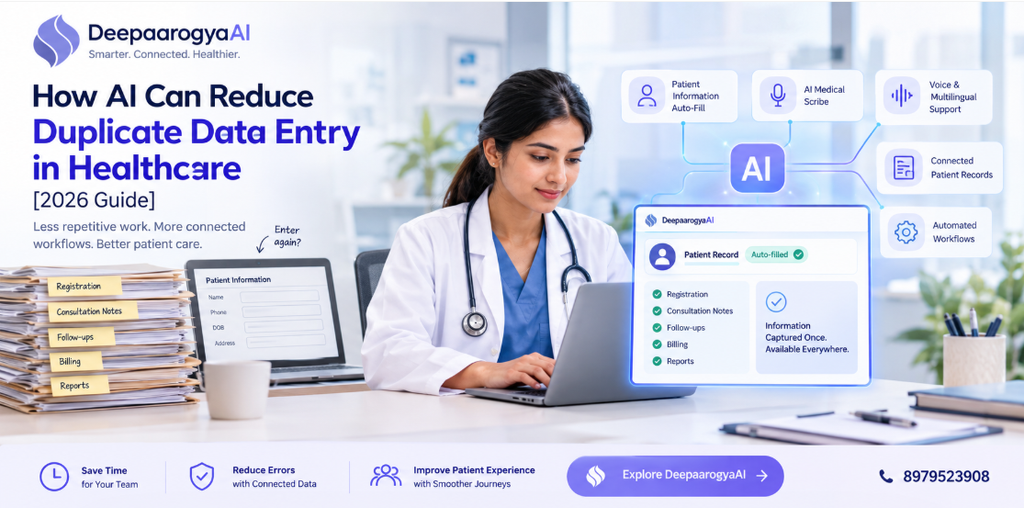
What Is Duplicate Data Entry in Healthcare?
Duplicate data entry happens when the same patient information has to be manually entered, copied, or recorded in multiple places.
For example, a patient’s information might be collected during registration and then manually entered again into another workflow.
Similarly, information from a consultation may need to be transferred into records, follow-up workflows, reports, or other administrative processes.
Some repetition is necessary. However, unnecessary repetition can create additional workload for healthcare staff.
Common examples include:
- Re-entering patient demographic information
- Copying consultation information between workflows
- Manually updating patient records
- Repeating information across administrative processes
- Entering data collected through different patient interactions
- Searching for information that already exists elsewhere
- Converting unstructured clinical information into organized records
When these tasks happen repeatedly throughout the day, even small amounts of duplication can become a significant operational burden.
Why Does Duplicate Data Entry Matter?
At first glance, entering information twice may seem like a minor inconvenience.
But healthcare organizations manage large volumes of information every day.
A small repetitive task multiplied across hundreds or thousands of patient interactions can become a major productivity issue.
1. It Consumes Staff Time
Administrative teams already manage multiple responsibilities.
If employees spend a considerable portion of their working day entering information that already exists, less time is available for other important activities.
AI can help automate or streamline parts of these repetitive workflows.
2. It Can Create Inconsistencies
Whenever information is manually copied from one place to another, there is a possibility of differences between records.
For example, one version of a patient’s information might be updated while another remains unchanged.
A connected workflow can reduce the need to maintain multiple disconnected versions of the same information.
3. It Adds Friction to the Patient Journey
Patients don’t see every administrative process happening behind the scenes.
But they can experience the effects.
Repeating information, waiting while staff search for records, or completing similar forms multiple times can make healthcare interactions feel unnecessarily complicated.
A smoother information workflow can contribute to a more organized patient experience.
4. It Increases Administrative Workload
Healthcare professionals should not have to spend excessive time performing repetitive information-management tasks.
Reducing unnecessary data entry can help teams focus their attention on higher-value activities.
How Can AI Reduce Duplicate Data Entry?
AI can help healthcare organizations approach information management differently.
Instead of treating every workflow as an isolated process, AI can help connect information and automate repetitive steps where appropriate.
Here are some important ways AI can contribute.
1. Capture Information Once and Reuse It
One of the simplest principles for reducing duplicate data entry is:
Capture information once, then make it available wherever it is legitimately needed.
For example, when patient information has already been captured, staff shouldn’t unnecessarily recreate the same information in another workflow.
A connected healthcare platform can help make relevant information accessible across appropriate stages of the patient journey.
This can reduce repetitive administrative work while creating a more organized record of patient interactions.
2. Convert Unstructured Information Into Organized Data
Healthcare information isn’t always entered in a perfectly structured format.
Doctors and healthcare teams may work with notes, conversations, observations, and other forms of unstructured information.
AI can assist in turning relevant information into more organized and usable data.
This can reduce the amount of manual formatting and transcription required from staff.
Instead of spending time organizing every piece of information manually, healthcare teams can use AI-assisted workflows to make information easier to manage.
3. AI Medical Scribes Can Reduce Documentation Work
Clinical documentation is one area where repetitive data entry can become particularly time-consuming.
An AI medical scribe can assist with documentation by capturing relevant information from a clinical interaction and helping generate structured documentation.
This can reduce the amount of manual typing required during or after consultations.
For doctors, the benefit isn’t simply faster documentation.
It can create a workflow where clinical information is captured more efficiently and can contribute to the patient’s ongoing record.
4. Reduce Repetitive Patient Information Handling
Patient information can appear across registration, consultations, follow-ups, billing-related workflows, and other administrative processes.
A connected healthcare system can help reduce unnecessary repetition by keeping relevant information accessible within the appropriate workflow.
This can help staff avoid repeatedly searching for or manually recreating information.
The result is a more streamlined information-management process.
5. Support Multilingual and Voice-Based Data Capture
Healthcare interactions aren’t always text-based.
Patients and healthcare professionals may communicate using voice, and patients may prefer communicating in different languages.
AI-powered voice and multilingual capabilities can help capture information in a more natural way.
Instead of requiring every interaction to become a manual typing exercise, AI can assist in converting spoken information into usable digital records.
This is particularly valuable when healthcare teams want to reduce documentation friction without disrupting natural conversations.
Where Can DeepaarogyaAI Fit In?
The biggest opportunity isn’t simply automating one data-entry task.
It is connecting different healthcare workflows so that information doesn’t have to be unnecessarily recreated at every step.
DeepaarogyaAI is designed around a more connected approach to healthcare management.
Instead of viewing patient interactions as isolated events, the platform can help bring together relevant information across the patient journey.
This can support areas such as:
- Patient information management
- AI-assisted clinical documentation
- Patient communication
- Healthcare workflows
- Connected patient records
- AI-powered healthcare agents
- Voice-based interactions
- Multilingual healthcare communication
- Data-driven decision-making
The underlying idea is simple:
Less repetitive information handling. More connected healthcare workflows.
From Data Entry to Intelligent Workflows
Traditional healthcare software often focuses on storing information.
AI-powered healthcare management can go one step further.
It can help organizations work with that information more intelligently.
Imagine a patient journey where:
Patient interaction → Information captured → AI-assisted processing → Structured record → Relevant workflow → Follow-up
Instead of requiring staff to manually move information between every stage, connected AI workflows can help reduce unnecessary administrative steps.
This changes the role of technology.
It isn’t just a digital storage system.
It becomes an intelligent layer supporting healthcare operations.
How Reducing Duplicate Data Entry Can Help Doctors
Doctors already have to balance clinical decision-making with documentation and administrative responsibilities.
Reducing repetitive information-management tasks can help create a more efficient workflow.
Potential benefits include:
More time for patients:
Less time spent on repetitive documentation can create more room for meaningful patient interactions.
Reduced documentation burden:
AI-assisted documentation can help streamline the process of turning clinical interactions into records.
Better information accessibility:
Connected records can make relevant patient information easier to access.
More organized workflows:
Information can move more naturally through different stages of the patient journey.
Improved operational efficiency:
Staff can spend less time performing repetitive administrative tasks.
How It Can Help Healthcare Administrators
The impact isn’t limited to doctors.
Administrative teams often handle large amounts of patient and operational information.
A connected AI platform can help reduce repetitive tasks and support more efficient workflows.
For example, instead of repeatedly searching for information or manually transferring details between processes, teams can work with information that is already available within the relevant system.
This can help healthcare organizations move toward:
Fewer repetitive tasks → Better workflow efficiency → More organized operations
Why Connected Healthcare Matters
Reducing duplicate data entry is closely connected to a larger healthcare challenge: information fragmentation.
When information is scattered across disconnected workflows, healthcare teams may spend time locating, verifying, and transferring it.
A connected healthcare environment takes a different approach.
Relevant information can become part of a continuous patient journey rather than remaining isolated inside individual interactions.
This is why AI should not be viewed only as a chatbot or automation tool.
Its larger value can come from connecting information, people, and workflows.
AI Should Reduce Work, Not Add Another Layer
There is an important distinction between adopting AI and actually improving healthcare operations.
Adding another software tool doesn’t automatically reduce workload.
If healthcare professionals have to enter information into the existing system and then repeat the same process in an AI tool, the organization hasn’t solved the underlying problem.
The technology should fit into the workflow.
A successful AI strategy should therefore focus on:
- Reducing unnecessary manual steps
- Connecting relevant information
- Automating repetitive processes
- Making information easier to access
- Supporting healthcare professionals
- Improving the overall patient journey
AI should make healthcare workflows simpler—not create another task for the team.
What Should Healthcare Organizations Look for in an AI Platform?
Before implementing an AI-powered healthcare solution, organizations should evaluate more than individual features.
Consider these questions:
1. Does it connect workflows?
AI becomes more useful when it works as part of the broader healthcare workflow.
2. Can it reduce repetitive documentation?
Look for capabilities that can assist with capturing and organizing information.
3. Can it work with different forms of communication?
Voice and multilingual capabilities can make technology more accessible to different users.
4. Does it support the complete patient journey?
The best value may come from connecting multiple stages rather than automating one isolated task.
5. Does it support healthcare professionals?
AI should assist doctors and staff rather than make their workflows unnecessarily complicated.
6. Is information handled securely?
Healthcare organizations should always consider appropriate security, privacy, access control, and compliance requirements when evaluating technology.
The Future: Healthcare With Less Repetitive Work
Healthcare will always require documentation and information management.
The goal isn’t to eliminate data entry completely.
The goal is to eliminate unnecessary data entry.
As AI becomes more integrated into healthcare workflows, organizations can move toward systems where information is captured more intelligently, documentation becomes more efficient, and relevant data can support the next stage of the patient journey.
This creates a simple but powerful shift:
From repeatedly entering information to intelligently connecting information.
For doctors and healthcare teams, that can mean less administrative friction.
For patients, it can mean smoother interactions.
For healthcare organizations, it can mean more efficient operations.
How DeepaarogyaAI Can Help
DeepaarogyaAI brings AI into healthcare management with a focus on connected, intelligent workflows.
From AI-powered agents and voice interactions to AI-assisted documentation, patient journeys, connected records, and data-driven healthcare management, the platform is designed to help healthcare organizations work with information more efficiently.
Instead of asking healthcare teams to simply “enter data faster,” the better question is:
Why should the same information need to be entered repeatedly in the first place?
That’s where intelligent healthcare workflows can make a difference.
DeepaarogyaAI helps healthcare organizations move toward smarter, more connected, and more efficient healthcare management.
Frequently Asked Questions
1. What is duplicate data entry in healthcare?
Duplicate data entry occurs when the same patient or healthcare information is manually entered, copied, or updated in multiple workflows or systems.
2. Can AI completely eliminate data entry?
Not necessarily. Some information still needs to be captured, verified, or reviewed by healthcare professionals. AI can help reduce unnecessary repetitive entry and assist with documentation.
3. How can AI medical scribes reduce documentation workload?
AI medical scribes can assist in capturing relevant information from clinical interactions and generating structured documentation, reducing the amount of manual documentation required.
4. Can AI help connect patient information across workflows?
AI-powered healthcare platforms can help organize and connect relevant information across appropriate workflows, reducing unnecessary repetition and making information easier to access.
5. How does reducing duplicate data entry benefit doctors?
It can reduce repetitive administrative work, streamline documentation, and give doctors more time to focus on patient interactions and clinical responsibilities.
6. Can voice AI help with healthcare data capture?
Yes. Voice-based AI can assist with capturing spoken information and converting it into usable digital information, depending on the capabilities of the healthcare platform.
7. Why is connected healthcare important?
Connected healthcare can reduce information fragmentation by helping relevant information move more efficiently between different stages of the patient journey.
8. How does DeepaarogyaAI support healthcare workflows?
DeepaarogyaAI brings together AI-powered capabilities such as AI agents, voice interactions, AI-assisted documentation, connected patient information, patient journeys, and healthcare analytics to support more intelligent healthcare management.
Final Takeaway
Duplicate data entry may look like a small administrative problem, but across a busy healthcare organization, repetitive information handling can become a significant source of wasted time and workflow friction.
AI offers an opportunity to change that.
The future of healthcare isn’t simply about collecting more data.
It’s about making the information already collected more connected, accessible, and useful.
With intelligent workflows, AI-assisted documentation, voice capabilities, and connected healthcare management, organizations can move closer to a model where technology handles more of the repetitive work while healthcare professionals focus on what matters most: delivering better patient care.
Ready to make healthcare workflows smarter and more connected?
Explore DeepaarogyaAI and discover how AI can help transform the way your healthcare organization manages patients, information, and everyday workflows.